What Is a Blast Chiller and Why Kitchens Use One
A stockpot of reduced veal jus, a tray of lasagna, or a hotel pan of rice can hold a kitchen hostage while it cools. What is a blast chiller? It is a high-performance refrigeration cabinet designed to pull heat out of cooked food quickly and evenly, turning one of the most time-sensitive parts of prep into a controlled, repeatable process.
For restaurants, caterers, bakeries, and serious culinary spaces, that control affects far more than storage. It supports food safety, protects texture, reduces waste, and lets a team cook when the rhythm is right rather than when refrigerator space finally opens up.
What Is a Blast Chiller?
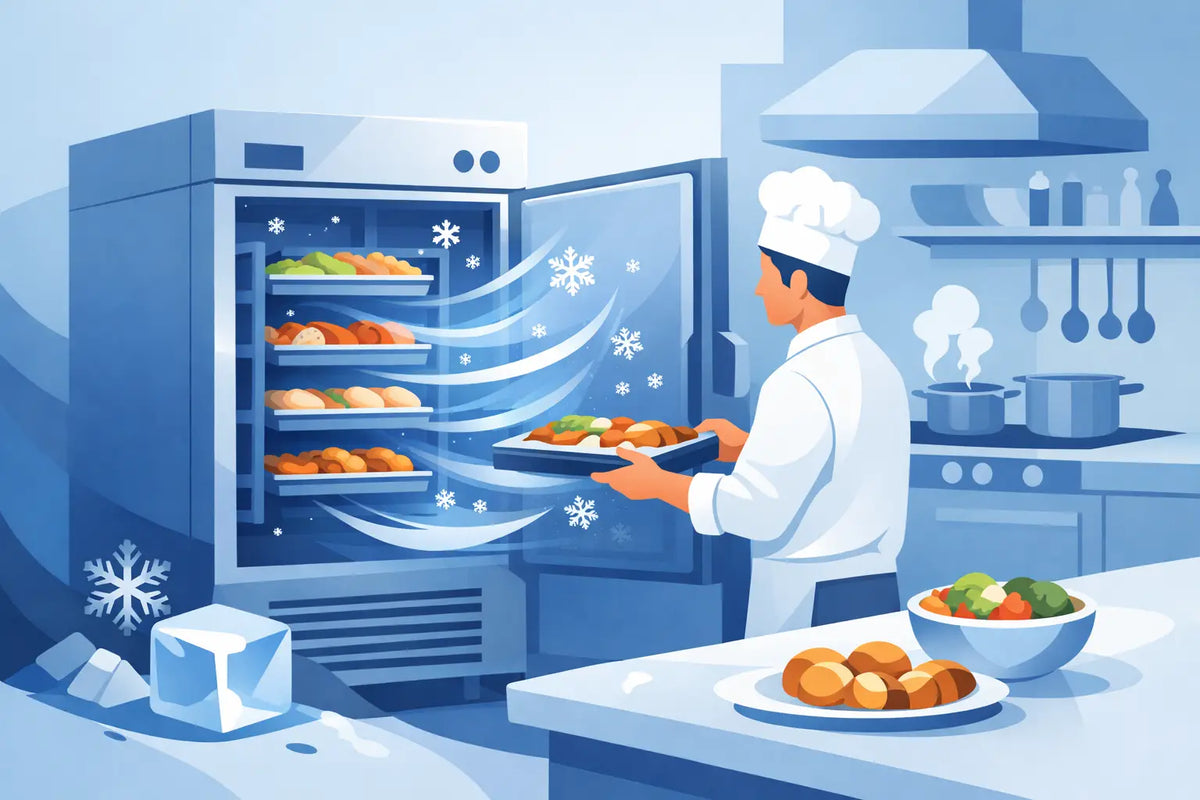
A blast chiller uses powerful forced-air circulation and low cabinet temperatures to rapidly bring the core temperature of hot food down to refrigeration-safe levels. Unlike a standard reach-in refrigerator, which is built primarily to hold already-cold products at a stable temperature, a blast chiller is engineered to remove a large heat load fast.
The distinction matters. Place several hot sheet pans in a conventional refrigerator and the appliance may struggle to recover. Interior temperatures can rise, surrounding ingredients can be affected, and the food in the pans may cool too slowly through the temperature range where bacteria multiply most readily. A blast chiller moves cold air aggressively around the product, drawing heat away with much greater speed.
In many commercial applications, operators use blast chilling to support the familiar cooling benchmark of bringing food from 135°F to 70°F within two hours, then from 70°F to 41°F or below within a total of six hours. Local health codes and operational procedures still govern the process, but a properly sized blast chiller makes those targets far more manageable than improvising with ice baths, shallow pans, and overloaded refrigeration.
Some units also offer blast-freeze cycles. These take food below freezing rapidly, helping preserve quality for products intended for longer holding. Chilling and freezing are related functions, but they serve different production plans.
Why Rapid Chilling Changes the Food
Food safety is the clearest reason to invest in rapid chilling, but it is not the only one. Speed changes the physical result on the plate.
When food cools slowly, moisture can migrate, starches can continue to set, and delicate surfaces can become dull or soggy. Rapid chilling helps a braised protein retain a cleaner structure, keeps cooked vegetables brighter, and gives sauces a more stable finish. A custard or mousse benefits from fast, even cooling. Fresh pasta components, cooked grains, and prepared fillings become easier to portion and hold with consistency.
For bakeries and pastry programs, controlled chilling can be especially valuable. Creams set with greater predictability, laminated dough can return to a workable temperature quickly, and plated dessert components can be produced ahead without sacrificing their intended texture. In a busy kitchen, quality often comes down to preserving the exact point at which a product is ready.
A blast chiller does not make poor technique disappear. Overcooked seafood will not become tender because it is chilled quickly, and food must still be covered, labeled, dated, and handled correctly. But when the cooking is precise, rapid chilling helps preserve that work for the next service.
Blast Chiller vs. Refrigerator vs. Freezer
These three pieces of refrigeration equipment can sit close together in a kitchen, yet their roles are distinct.
A standard refrigerator is a holding environment. It keeps cold inventory cold and provides easy access during service and prep. It is not designed to absorb the heat of large batches of freshly cooked food without affecting its operating temperature.
A freezer is intended for long-term frozen storage. It may eventually freeze hot product, but doing so can take too long and can strain the equipment. Slow freezing also tends to form larger ice crystals, which can damage cellular structure and lead to excess moisture loss after thawing.
A blast chiller is the bridge between production and storage. It rapidly chills or freezes product, then allows the operator to move that product into the appropriate refrigerator or freezer for holding. Some models can hold food after a cycle, but their greatest value is the controlled transition from hot to cold.
That workflow is particularly useful for commissaries, high-volume catering, meal-prep operations, hotels, and restaurants with concentrated prep days. Cook a batch once, chill it correctly, portion it with confidence, and reheat only what service requires.
Where a Blast Chiller Earns Its Counter Space
The strongest case for a blast chiller is not simply high volume. It is repeatable production with meaningful heat loads and a need to protect labor, quality, or both.
A chef-driven restaurant may use one to cool stocks, sauces, confit, braises, and prep for several days of service. A pizzeria can chill prepared toppings, sauces, and cooked components without crowding its walk-in. A caterer can cool banquet production safely before transport. A dessert concept can stabilize creams, cakes, and frozen treats on a dependable schedule.
It also has a place in premium residential kitchens where entertaining is frequent and cooking is ambitious. A serious home cook producing a holiday feast, whole-animal barbecue, cured meats, or a carefully staged tasting menu gains a professional tool for handling make-ahead work with more control. The trade-off is straightforward: these are specialized machines that require space, electrical planning, and a real production habit to justify the investment.
How to Choose the Right Blast Chiller
Capacity should be the first practical question. Consider the number and size of pans you need to chill in a single cycle, not simply the amount of food your kitchen produces in a day. An undersized unit can create a new bottleneck. An oversized cabinet can consume valuable floor space and capital without improving your actual workflow.
Look closely at pan compatibility and internal rail spacing. Many commercial blast chillers are configured for full-size hotel pans or bakery sheet pans, but layouts vary. The cabinet must fit the vessels your team already uses, especially if you handle deep pans, gastronorm pans, pizza ingredients, or pastry trays.
Cycle performance matters as well. Manufacturers commonly state chilling and freezing capacities based on a defined amount of product and a specified starting temperature. Those ratings are useful, but real performance depends on food density, pan depth, loading pattern, and whether hot items have room for air to circulate. Dense stock in deep containers cools differently from a thin layer of roasted vegetables.
Also assess the installation details before purchasing. Measure clearances, door swing, ventilation needs, drainage requirements, electrical supply, and the path from delivery to final placement. A blast chiller should sit near the point where hot production ends, without interrupting the movement of cooks, carts, or service staff. Its placement is part of the kitchen's rhythm.
Features Worth Paying Attention To
Probe-driven controls are valuable because they measure the food's core temperature rather than relying only on a timed cycle. This is particularly useful for variable batch sizes and dense products. Programmable cycles can help standardize recurring prep, while data logging and alarms may support HACCP documentation in operations that require close process records.
Consider the door, interior, and exterior as working surfaces, not just specifications. Stainless steel construction, easy-clean corners, durable gaskets, strong hinges, and removable racks make a difference when the unit is opened and loaded throughout a long prep shift. The best equipment feels composed under pressure, not delicate.
Using a Blast Chiller Well
A blast chiller performs best when food is portioned thoughtfully. Divide large batches into shallow pans where practical, avoid stacking pans tightly, and leave room for airflow. Covering methods should follow your operation's food-safety practices, but do not seal in heat so completely that cooling becomes uneven.
Load the cabinet promptly after cooking, select the correct cycle, and use a sanitized probe according to the unit's instructions. Once the product reaches its target temperature, move it to designated refrigerated or frozen storage if that is your process. Labeling remains essential: rapid chilling gives food a safer, more controlled start, but it does not replace disciplined rotation.
Cleaning and maintenance deserve the same attention as the cooling cycle. Wipe spills quickly, clean the interior and door gaskets regularly, keep condenser areas free of grease and dust, and have the equipment serviced according to the manufacturer's recommendations. Airflow is the machine's craft. Anything that restricts it compromises performance.
A blast chiller is not glamorous in the way a live-fire grill or a polished pizza oven can be, yet it quietly protects the work that happens around both. When a kitchen can cool with precision, it gains time to season more carefully, prep more deliberately, and send every plate out with the texture and confidence it was meant to have.