How to Choose Commercial Kitchen Equipment
The first rush tells the truth about a kitchen. A range that cannot recover between tickets, a prep table that bottlenecks the line, or an ice machine that runs short at 8 p.m. will shape every plate and every guest interaction that follows. Choosing commercial kitchen equipment is not simply a matter of filling a floor plan. It is the work of building a dependable rhythm for prep, production, holding, cleaning, and service.
For a new restaurant, a growing catering operation, or a serious outdoor cooking space, the best equipment plan begins with how food actually moves through the room. Capacity matters. So do materials, heat recovery, door swings, electrical requirements, ventilation, cleaning access, and the hands that will use each piece during a demanding shift.
Start With the Menu, Not the Equipment List
A menu reveals the equipment a kitchen needs more honestly than a catalog category ever can. Consider what must be cooked to order, what can be prepared ahead, what needs cold holding, and where the menu leaves little room for inconsistency. A pizzeria with high-volume carryout has different heat and dough-management needs than a steakhouse, hotel breakfast program, smoothie bar, or neighborhood bakery.
Map each core item from receiving through service. A composed salad may move from walk-in cooler to prep table to service line. Fried chicken needs refrigerated storage, breading space, fryer capacity, draining and holding, then dish area support. That path exposes the equipment that protects speed and food quality, along with the pieces that may be unnecessary.
It also helps separate essential production equipment from aspirational purchases. A combi oven can bring remarkable control to roasting, steaming, baking, and regeneration, but it may not be the first investment for a concept built around pizza and cold sandwiches. A charbroiler creates a distinctive live-fire character, yet it brings ventilation, fuel, cleaning, and recovery considerations that should be part of the decision from the beginning.
Match Capacity to Peak Demand
Buy for the busiest credible hour, not the average day. Estimate covers, turns, menu mix, batch sizes, and the time each item occupies a station. Then leave practical room for a larger-than-expected rush, an employee still learning the line, or a menu special that performs better than forecast.
Oversizing has a cost. Larger equipment can consume more energy, demand more floor space, and slow down a lean operation. Undersizing is usually more visible to guests: longer ticket times, uneven output, exhausted staff, and compromised food. The right capacity is the one that lets the kitchen maintain its standards when the room is full.
Build Commercial Kitchen Equipment Around Workflow
A kitchen should feel intentional in motion. Raw ingredients arrive and are stored. Prep happens near the tools and cold storage that support it. Cooking equipment sits in a coherent heatline. Finished food travels the shortest reasonable route to pass, pickup, or plating. Warewashing stays separate from clean prep and service traffic.
That order reduces unnecessary steps, but it also improves safety and labor efficiency. A prep cook should not have to cross a hot line repeatedly for refrigerated ingredients. A dishwasher should not be forced to navigate around servers carrying finished plates. Even a few feet of poorly planned travel becomes expensive over hundreds of repetitions.
For compact footprints, multipurpose equipment can earn its space. Combi ovens, refrigerated sandwich and salad prep tables, undercounter refrigeration, and high-performance countertop equipment can consolidate functions without making the work feel cramped. The trade-off is that shared equipment may become a pinch point when several cooks need it at once. In a high-volume kitchen, dedicated capacity often protects the pace of service.
Plan the Heatline With Purpose
The cooking line is where menu identity becomes tangible. Gas ranges offer familiar flame response and versatile burner layouts. Induction delivers rapid, precise heat with less ambient heat in the kitchen, but requires compatible cookware and sufficient electrical capacity. Fryers need recovery performance that matches order volume, while grills and charbroilers need enough cooking surface to avoid crowding proteins and sacrificing the crust guests expect.
Pizza ovens deserve their own careful analysis. Deck, conveyor, and high-temperature styles each produce a different service rhythm and finished result. Consider bake time, product diameter, daily volume, fuel source, exhaust requirements, and the kind of char, lift, or crispness your concept promises. The best oven is not necessarily the hottest or largest one. It is the one that consistently produces your pizza at the tempo of your business.
Treat Refrigeration as a Food-Safety System
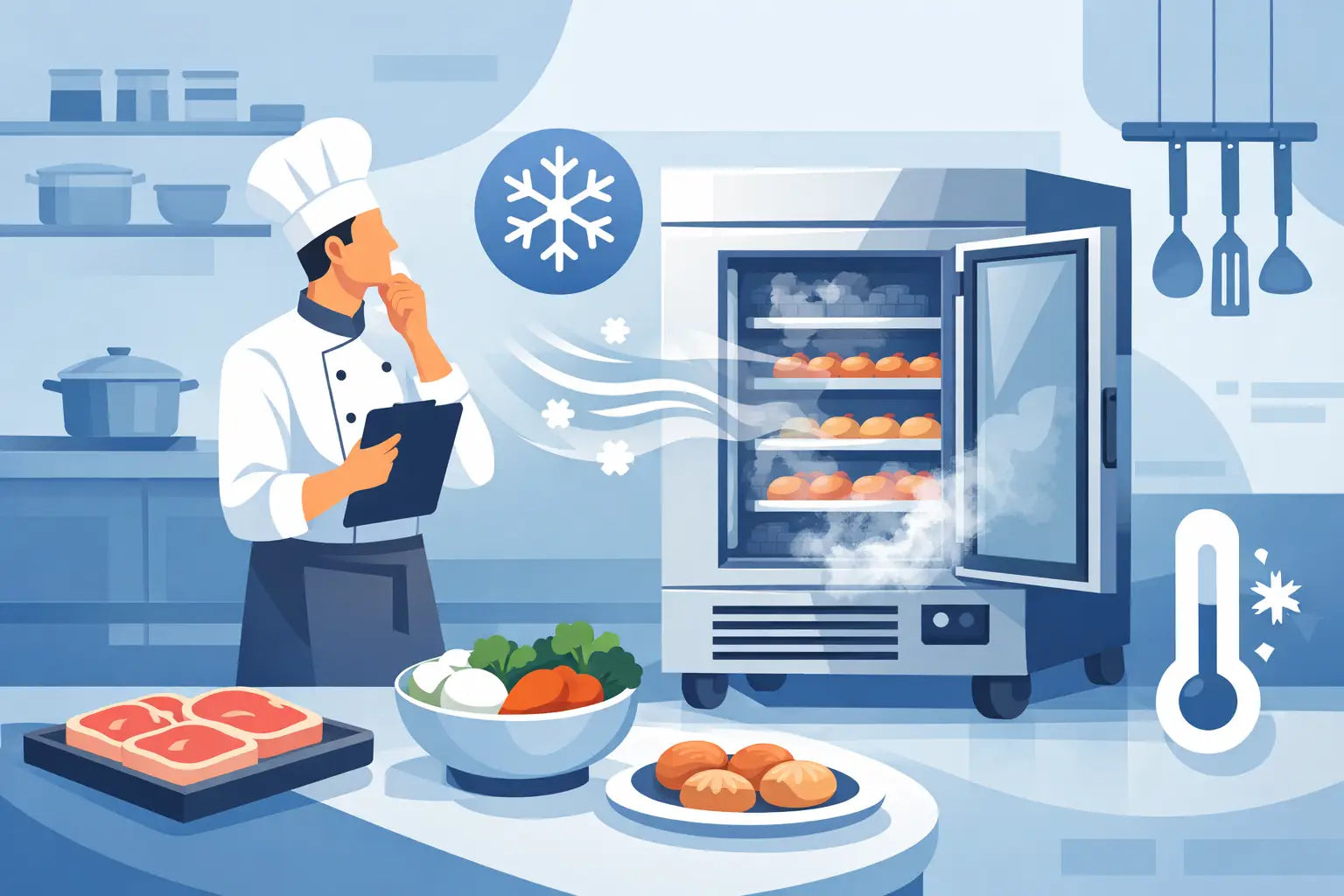
Refrigeration is often viewed as background infrastructure until it fails. In reality, it governs product quality, waste, prep speed, and food safety every hour of the day. Walk-in coolers and freezers provide bulk storage, while reach-in units, chef bases, undercounter cabinets, and prep tables place ingredients where the work happens.
Choose refrigerator and freezer capacity based on delivery frequency, par levels, pan configurations, and growth plans. A kitchen that receives product twice weekly needs a different storage strategy than one with daily deliveries. Think beyond cubic feet. Shelf spacing, door configuration, usable pan access, interior layout, and the ability to organize raw and ready-to-eat foods are equally consequential.
Temperature control should fit the task. Blast chillers can protect quality and accelerate cooling for soups, proteins, sauces, and prepared components. Specialized curing and aging cabinets offer controlled environments for operators whose products depend on time, humidity, and airflow. These are not universal needs, but where the menu calls for them, they can create a meaningful advantage in consistency and product depth.
Confirm Utilities Before You Commit
A beautiful equipment package can become an expensive problem if the building cannot support it. Before placing an order, verify gas type and BTU supply, electrical voltage and phase, available amperage, water connections, drains, hood requirements, fire suppression, floor loading, and access routes for delivery and installation.
Electrical details deserve particular attention. A piece of equipment may be listed in 120V, 208V, 240V, or 480V configurations, sometimes in single-phase or three-phase versions. Selecting the wrong configuration can delay installation and create costly field changes. Water-consuming equipment, including ice machines, dishwashers, combi ovens, and some beverage systems, may also require filtration, drainage, or specific water conditions to perform as intended.
Measure more than the equipment footprint. Account for clearance, ventilation, service access, door openings, turning radius, and the route from truck to final location. A walk-in cooler panel, a heavy range, or a large mixer must be able to enter the building safely. Early verification is less glamorous than choosing finishes, but it is one of the clearest ways to protect a project schedule.
Look Beyond Purchase Price
Commercial equipment earns its value over years of use. The lowest upfront price may be sensible for a low-volume or temporary application, but it can become costly if recovery is slow, construction is light, cleaning is difficult, or downtime disrupts service. Stainless steel grade, insulation, controls, compressor design, burner construction, warranty coverage, and parts availability all deserve a place in the evaluation.
Energy and water use matter, especially for refrigeration, ice production, warewashing, and equipment that runs continuously. Yet efficiency should be judged in context. An ultra-efficient unit that does not have the output needed at peak demand is not a bargain. The goal is dependable performance with operating costs that fit the business model.
When comparing models, use a consistent lens: dimensions, capacity, utilities, production rate, materials, cleaning needs, warranty, and installation requirements. This makes it easier to distinguish a feature that genuinely supports the operation from one that merely sounds impressive.
Give the Final Plan a Service Test
Before finalizing commercial kitchen equipment, walk through a busy service on paper. Picture a delivery arriving during prep, a full ticket rail, a dishwasher cycling racks, and a cooler door opening throughout the shift. Ask where staff will stand, where hot pans will land, where backup product will wait, and what happens if the highest-volume item doubles for an hour.
A well-built kitchen does more than contain appliances. It gives cooks clear sightlines, dependable temperatures, usable surfaces, and the quiet confidence to focus on flavor and hospitality. Culinary Precisions can help translate those operational questions into equipment choices that fit the menu, the room, and the pace you intend to set.