Best Soft Serve Machines for Cafes to Buy
A cafe’s soft serve program can be a high-margin differentiator or a daily operational headache. The difference usually comes down to selecting a machine sized for real traffic, not the busiest Saturday you hope to have or the quietest Tuesday you remember. The best soft serve machines for cafes deliver consistent texture, recover quickly between orders, fit the available utility setup, and can be cleaned correctly by the team on shift.
For a small coffee bar, a compact countertop unit may turn iced coffee add-ons, affogatos, and cones into dependable incremental sales. For a busy cafe with lunch traffic, a higher-output commercial floor machine may be the only practical choice. Start with the service model, then match the equipment to it.
What Makes the Best Soft Serve Machines for Cafes?
The right machine is not simply the one with the highest advertised output. It is the unit that produces the volume, menu flexibility, and food-safe consistency your operation requires without demanding more labor or electrical capacity than your cafe can support.
Capacity is the first decision. Manufacturers typically express output in servings or quarts per hour, but those numbers assume defined serving sizes and favorable operating conditions. A cafe that expects a steady flow of orders over several hours needs recovery capacity: the machine’s ability to freeze and replenish product while dispensing. A unit that handles a brief rush but softens during a sustained line will disappoint customers and slow service.
The second decision is hopper and cylinder configuration. The hopper holds liquid mix before freezing, while the freezing cylinder produces the finished soft serve. Larger hoppers reduce refill frequency, which matters when staff are balancing espresso drinks, food orders, and counter service. Larger cylinders generally support higher output, although they also affect footprint, energy use, and cleaning requirements.
Finally, choose a commercial machine built around serviceability. Soft serve equipment works hard. Wear components, seals, scraper blades, drive systems, and refrigeration parts all require attention over time. A lower initial price can become expensive if replacement parts, technical support, or routine maintenance are difficult to access.
Choose a Machine Type That Fits Your Menu
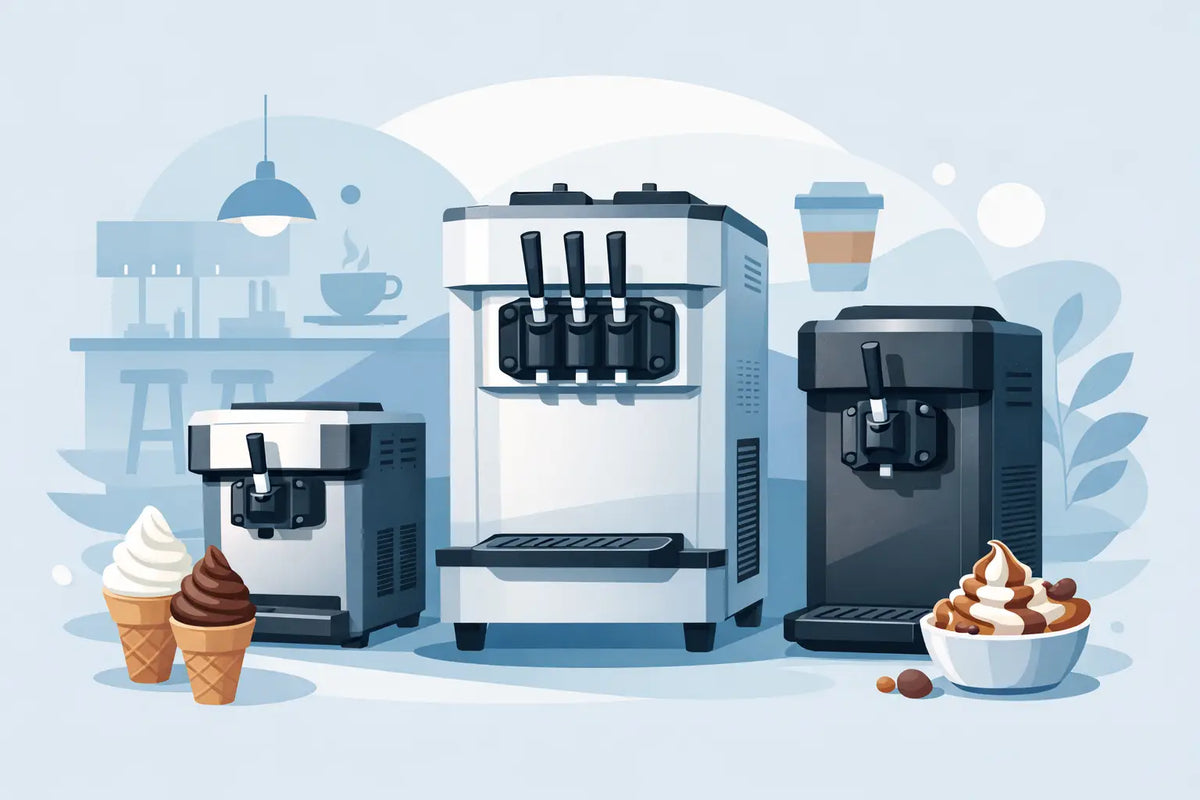
Single-flavor countertop machines
A single-flavor countertop machine is often the strongest entry point for a cafe adding soft serve without building an entire dessert counter. It is suited to straightforward menus: vanilla cones, cups, affogatos, cold brew floats, or a rotating specialty flavor. Countertop placement keeps the machine close to the point of sale, but only if the counter can support its weight, ventilation clearances, and electrical requirements.
This format works best when demand is moderate and the menu is focused. Its limitation is obvious: one flavor leaves little room for customers who expect choice. It also places production equipment in an area that may already be crowded with grinders, blenders, ice bins, and display cases.
Two-flavor machines with a twist option
Two-flavor machines produce two distinct flavors plus a combined twist. For cafes, that third serving option can expand the menu without adding another piece of equipment. A classic pairing such as vanilla and chocolate is familiar, while vanilla and a seasonal flavor can create a more signature dessert offer.
These machines require more space, more mix management, and more disciplined cleaning than a single-flavor unit. They make sense when the added variety will genuinely increase sales. If nearly every customer will order vanilla, paying for dual-flavor capability may not improve the return on the equipment.
Floor models for sustained volume
Floor-standing soft serve machines are designed for higher throughput and larger product reserves. They are a practical fit for high-volume cafes, bakery-cafes, campus dining locations, and hospitality operations where soft serve is a meaningful revenue center rather than an occasional add-on.
The trade-off is a larger capital commitment and a more demanding installation. Measure doors, aisles, service access, ventilation space, and the final equipment location before ordering. Confirm the electrical circuit and voltage requirements early. A powerful machine cannot perform to specification if it is installed on an inadequate power supply or packed tightly against a wall.
Gravity-fed versus pump-fed systems
Gravity-fed machines move mix from the hopper into the freezing cylinder using gravity. They are generally simpler in design and can be a smart choice for operations that value straightforward daily procedures. Product texture is often slightly different from a pump-fed system, depending on mix, settings, and machine design.
Pump-fed systems introduce air into the mix in a more controlled way, creating greater overrun. Overrun is the increase in volume produced when air is incorporated into the frozen dessert. Properly managed overrun can create a lighter texture and improve yield, but it also adds mechanical complexity. For a cafe focused on dense, premium soft serve or gelato-style applications, gravity feed may align better with the desired product. For operations prioritizing volume and a lighter classic soft serve profile, pump feed may earn its place.
Size for Your Busiest Realistic Hour
Do not buy based only on daily sales projections. Calculate the busiest 60 to 90 minutes, because that is when customer expectations and machine limits collide.
Begin with an expected number of servings during peak service. Then consider serving size, menu applications, and whether staff will dispense multiple products from the machine. A small four-ounce cone requires far less production than a large cup topped with cookies, sauces, and a swirl. Also account for sampling, remakes, and the occasional employee serving that is larger than standard.
For a cafe testing demand, a lower-capacity commercial unit can be a disciplined choice. Keep the menu tight, monitor sales patterns, and avoid promising soft serve all day if the equipment is only suited to intermittent demand. For an established operation where frozen desserts are central to traffic, choose enough capacity to protect quality during the rush rather than asking staff to apologize for a machine that cannot recover.
Installation Details That Can Decide the Purchase
A soft serve machine is not plug-and-play in every cafe. Before selecting a model, verify its electrical specifications against the building’s available service. Some commercial machines require dedicated circuits, specific voltage, or higher-amperage connections. Planning this before delivery prevents costly surprises and delayed openings.
Airflow is equally important. Air-cooled machines need room around their vents to reject heat efficiently. In a hot kitchen or a tight service counter, restricted airflow can reduce performance and add strain to the refrigeration system. Water-cooled options may be appropriate in certain demanding environments, but they require water connections and can increase utility costs.
The machine also needs a sanitary, practical location. Staff should have room to refill hoppers, clean components, access controls, and service the unit without moving other equipment. Position it where the team can work quickly while keeping splash zones, handwashing access, and cleaning procedures under control.
Cleaning Is Part of Production, Not an Afterthought
Every cafe owner wants a machine that runs reliably. The daily habits behind that reliability matter as much as the specification sheet. Soft serve mix is a dairy or dairy-alternative food product that requires careful temperature control, proper handling, and a documented cleaning routine.
Review how often the machine must be disassembled, brushed, sanitized, and reassembled according to the manufacturer’s instructions and local health requirements. Some units offer refrigerated hoppers or heat-treatment features that can extend the interval between full breakdowns under approved procedures. Those features can reduce labor pressure, but they do not remove the need for disciplined sanitation or trained staff.
Assign responsibility clearly. The opening or closing team should know how to check mix levels, inspect product quality, wipe exterior surfaces, and recognize warning indicators. Keep recommended cleaning supplies and replacement wear parts on hand. A machine that is easy to clean correctly is usually more valuable than one with impressive output that the team struggles to maintain.
Evaluate the Mix Before You Evaluate the Machine
The mix you intend to serve affects the machine choice, final texture, and operating cost. Traditional dairy mixes, high-butterfat formulas, vegan bases, and reduced-sugar products do not all freeze or dispense the same way. Ask whether a machine is compatible with the viscosity and formulation of your chosen mix before making a purchase.
Premium ingredients can create an exceptional product, but consistency is the real standard. Test the serving texture at opening, during peak demand, and near closing. The goal is a smooth, stable product that holds its shape without becoming icy, loose, or overly airy. Proper machine settings, mix temperature, and a reliable supply chain all contribute to that result.
Buy for Support, Parts, and Long-Term Performance
Soft serve machines are revenue-producing equipment, so downtime carries a direct cost. When comparing options, look beyond stated capacity and finish. Confirm warranty coverage, the availability of replacement parts, access to technical support, and the practicality of local service when needed.
Culinary Precisions supports operators who need commercial equipment selected around performance, reliability, and the realities of daily service. The best purchase is one that fits the cafe’s current volume while leaving enough room for a program to grow.
A well-chosen soft serve machine gives a cafe more than another dessert option. It gives the team a repeatable way to turn a simple cone, float, or affogato into a fast, memorable reason for customers to come back.