How to Maintain Soft Serve Machines Properly
A soft serve machine can be one of the most profitable pieces of equipment in a kitchen, but only when it delivers a smooth, safe product every shift. Learning how to maintain soft serve machines protects that performance. It reduces costly downtime, preserves product texture, supports food safety, and helps your team serve every cone, cup, shake, or sundae with confidence.
Soft serve equipment works under constant pressure from dairy mix, sugar, temperature changes, moving components, and repeated dispensing. Small maintenance lapses can quickly turn into icy product, weak overrun, mix leaks, inconsistent freezing, or a machine that locks down during peak service. A disciplined cleaning and preventive maintenance routine is the operational standard that keeps those problems from becoming emergencies.
Start With the Manufacturer's Schedule
Every commercial soft serve machine has its own requirements for cleaning intervals, disassembly, lubrication, sanitizing, mix storage, and service. Some models are designed for daily disassembly and cleaning, while others are built for longer cleaning cycles when operated under specific conditions. The manufacturer manual is the controlling document, along with local health department requirements.
Do not assume a longer clean cycle means less responsibility. Operators still need to inspect mix levels, check product temperature, wipe food-contact surfaces, and monitor machine performance every day. A machine can be technically within its cleaning cycle and still need immediate attention if it is producing an off texture, leaking, running unusually loud, or holding mix outside the required temperature range.
Build the prescribed schedule into opening, closing, and weekly task lists. Assign responsibility by role, then train staff on the reason behind each step. The goal is not merely to check a box. It is to protect the machine's freezing system, product quality, and food-safe operation.
Daily Soft Serve Machine Maintenance
Daily care begins with observation. Before service, confirm that the machine is switched to the correct operating mode, the hopper contains adequate mix, and the refrigeration system has had time to stabilize. Check the display or gauges for warnings, review mix temperature where applicable, and dispense a small test portion. The product should be uniform, smooth, and firm enough to hold its shape without appearing dry, grainy, or runny.
Wipe the exterior, dispensing area, drip tray, and door handle throughout service. Sticky residue attracts debris and makes small leaks harder to spot. Empty and clean drip trays before they overflow, especially in high-volume operations where frequent dispensing can create condensation and product buildup.
At close, follow the machine's approved cleaning or standby procedure. If your operation uses a hopper-fed unit that remains loaded between services, verify that mix is held at the required refrigerated temperature. Never top off old mix with new mix without following the machine manufacturer and food safety procedures. Rotate product properly, date containers, and discard mix when required.
Pay close attention to the consistency of the draw. Product that becomes too soft may point to warm mix, a dirty condenser, an overloaded machine, improper settings, or a developing refrigeration issue. Product that is overly firm, crumbly, or icy can indicate a freeze setting problem, low mix level, formulation changes, or worn components. Address the cause instead of repeatedly adjusting controls to mask it.
Clean and Sanitize Food-Contact Parts Correctly
Thorough cleaning is the foundation of soft serve machine maintenance. Dairy and nondairy mixes leave proteins, fats, sugars, and stabilizers on internal surfaces. If that residue is not removed, it can support bacterial growth, restrict product flow, damage seals, and compromise flavor.
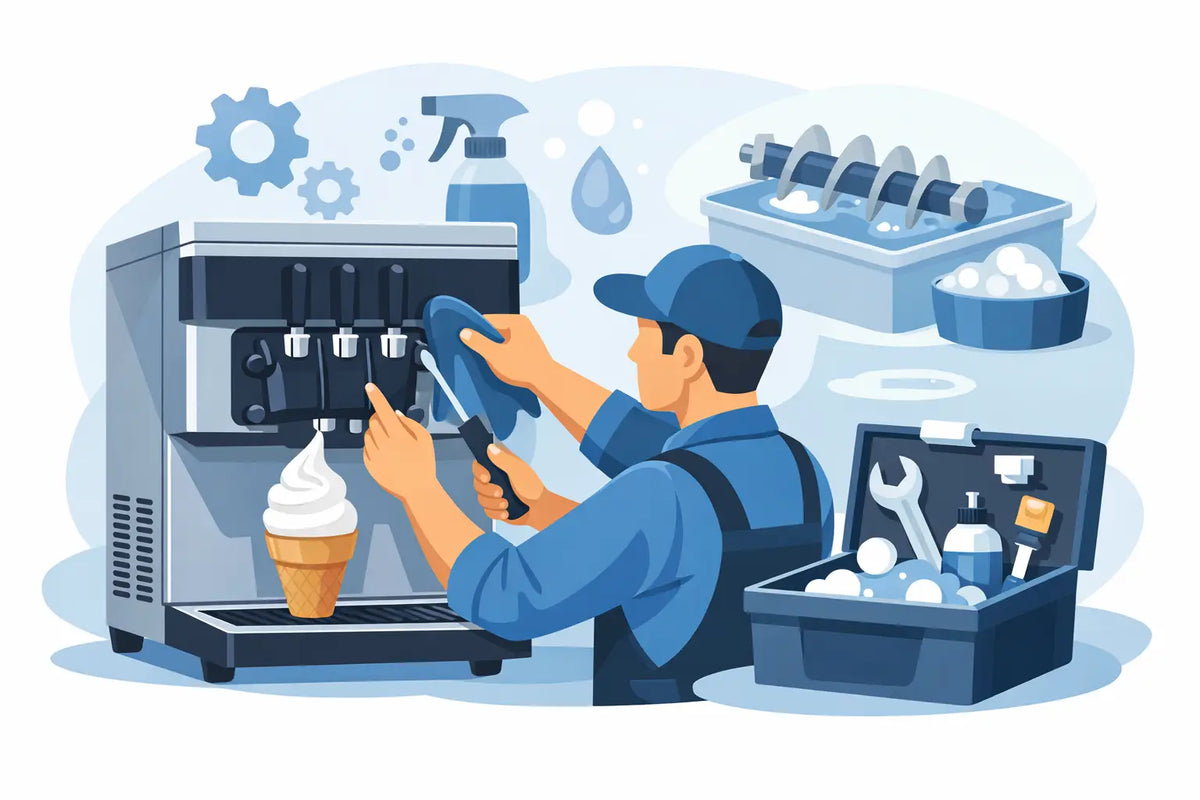
When the required cleaning interval arrives, drain or properly dispose of the remaining mix according to your operating procedure. Flush the system with the recommended cleaning solution and water, then disassemble food-contact components as instructed. This commonly includes the dispensing door, draw valves, handles, beaters, scraper blades, seals, gaskets, and O-rings. Exact parts vary by model.
Wash components using the approved detergent concentration and water temperature. Scrub ports, valve openings, and narrow channels with the correct brushes. These areas often look clean from the outside while holding residue inside. Rinse thoroughly before sanitizing, because detergent left behind can reduce sanitizer effectiveness.
Sanitize parts and internal product pathways using the approved sanitizer at the correct concentration. More sanitizer is not better. An overly strong solution can damage components and create chemical residue, while a weak solution may not control microbes effectively. Use test strips when required and allow components to air dry rather than wiping them with a towel that could reintroduce contamination.
Inspect Parts During Every Disassembly
Cleaning time is also inspection time. Look for cracked O-rings, flattened seals, worn scraper blades, chipped plastic parts, damaged valve assemblies, and missing lubrication. A low-cost seal can prevent a high-cost repair when replaced before it fails.
Use only food-grade lubricant approved for your specific model, and apply it sparingly to the locations identified in the manual. Excess lubricant can migrate into product areas or collect debris. Keep a small inventory of commonly replaced wear parts so a damaged gasket does not take the machine out of service during a busy weekend.
Protect Airflow and Refrigeration Performance
The freezing system cannot perform efficiently without proper airflow. Condenser coils collect dust, grease, flour, lint, and airborne debris, particularly in busy commercial kitchens. As coils become blocked, the machine works harder to remove heat. The result can be soft product, long recovery times, higher energy use, compressor stress, and eventual equipment failure.
Inspect and clean condenser filters or coils at the interval recommended for your environment. A quick-service restaurant near fryers may need more frequent attention than a low-volume café with a cleaner equipment area. Turn the machine off and follow safe cleaning instructions before servicing any condenser area. Do not use aggressive tools that can bend coil fins or damage electrical components.
Maintain the required clearance around air intake and exhaust areas. Do not stack boxes, towels, or supplies against the machine, and avoid placing it beside equipment that throws excessive heat or grease into the air. A soft serve machine needs room to breathe, especially when demand is high.
Train Operators to Catch Problems Early
The strongest maintenance plan can fail if only one person understands the machine. Train opening and closing staff to recognize normal operation and the early signs of trouble. They should know how to read alerts, identify a mix shortage, verify that vents are unobstructed, clean the dispensing area, and report product changes before continuing service.
Create a simple log for cleaning, sanitizing, temperatures, part replacement, error codes, and service calls. This record helps managers identify repeat issues. If a machine repeatedly produces soft product at the same time of day, for example, the log may reveal a peak-demand pattern, inadequate airflow, or a staff procedure that needs correction.
Do not let employees bypass alarms or reset a recurring code without documenting it. A reset may restore operation temporarily, but repeated warnings are diagnostic information. Calling a qualified technician early is usually less disruptive than waiting for a full shutdown.
Schedule Professional Preventive Service
Daily cleaning does not replace professional maintenance. Depending on the machine, volume of use, and operating environment, schedule qualified service to inspect refrigeration performance, electrical connections, drive components, belts or gears where applicable, calibration, and internal wear. A technician can identify declining performance before it affects product quality or damages major components.
Preventive service is particularly valuable before your highest-volume season. A frozen dessert shop preparing for summer, a resort entering holiday traffic, or a restaurant adding a seasonal menu should not wait for the first hot weekend to discover that recovery times are too slow. Plan service during a lower-demand period whenever possible.
Avoid the Habits That Shorten Machine Life
Several shortcuts create avoidable failures. Running the machine with low mix can affect freezing performance and may introduce air into the system. Using unapproved cleaners or lubricants can damage seals and food-contact surfaces. Skipping disassembly because the exterior looks clean allows residue to remain in the product path.
It also pays to match production to equipment capacity. A single-barrel countertop machine may be an excellent fit for a limited menu or lower-volume operation, but it may struggle when asked to support continuous peak-hour demand. If the machine is frequently unable to recover between draws, the solution may be operational changes or a higher-capacity unit, not more aggressive settings.
A well-maintained soft serve machine is not just cleaner. It is faster to recover, more consistent at the draw, easier for staff to operate, and better positioned to protect the guest experience. Treat its maintenance routine with the same precision you expect from its finished product, and it will keep delivering professional results when the line is at its longest.