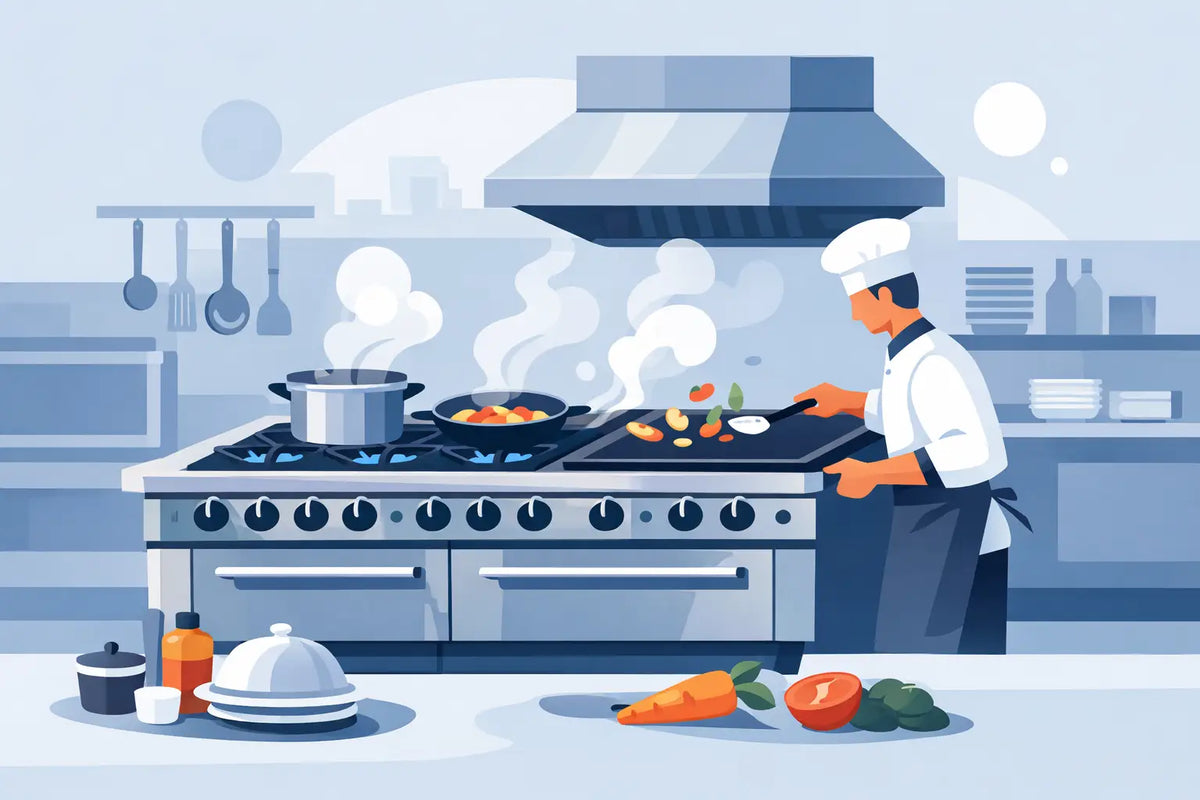
Commercial Gas Range Review for Busy Kitchens
The wrong range shows itself during the rush. Burners struggle to recover after cold pans hit the grates, oven temperatures drift across a full load, and cramped work space slows every cook on the line. A useful commercial gas range review should look beyond a headline BTU number and focus on the output, control, and durability your kitchen needs every day.
For restaurants, caterers, food trucks, bakeries, and serious home cooks building a professional-style kitchen, a gas range is often the central production tool. It handles sauces, sautés, stocks, braises, roasting, and finishing work in one footprint. The best choice is not necessarily the largest or highest-powered model. It is the range that matches your menu, volume, utility setup, ventilation plan, and crew.
What a Commercial Gas Range Must Deliver
Commercial gas ranges are built for sustained production, not occasional meal prep. Their value comes from fast heat response, high burner output, heavy-duty construction, and an oven designed to keep working through repeated cycles. Open burners deliver direct flame access for sauté pans, stockpots, and quick reductions. Sealed burners can simplify cleanup, but may not offer the same open-grate flexibility on every model.
Power matters, yet usable power matters more. A high-BTU burner can bring large quantities to temperature quickly, but it also needs a control valve that can hold a low flame for delicate sauces. Look for a range that gives cooks both ends of the spectrum: forceful heat for searing and boiling, plus reliable low-end control for holding and simmering.
Grate design deserves close attention. Continuous cast-iron grates let cooks slide pans between burners instead of lifting them, which improves speed and reduces strain during a busy service. They should sit level, support the pan sizes you actually use, and remain stable under heavy pots. A range that looks substantial but cannot comfortably carry a large stockpot on its rear burners will create avoidable bottlenecks.
Burner count is not the whole story
Four, six, and ten-burner configurations each serve a purpose. A compact four-burner range may suit a café, concession operation, or tight prep kitchen where the oven carries much of the workload. A six-burner model is a common choice for independent restaurants because it provides versatile capacity without consuming an excessive amount of line space. Larger battery ranges make sense when several cooks need simultaneous pan work, but only if the hood, gas supply, and workflow can support them.
Consider how your cooks work, not just how many pans they can place on the top. A six-burner range with clear access on both sides can outperform a crowded larger unit that leaves no landing space for hot pans, sheet trays, or plated components.
Commercial Gas Range Review: The Oven Determines Versatility
The range top may get the attention, but the base oven often determines whether a unit earns its footprint. Standard ovens support roasting, baking, holding, and finishing in a compact setup. If your menu relies on sheet pans, braised meats, casseroles, or baked sides, confirm the interior dimensions and rack positions before buying. Exterior width does not tell you whether your preferred pan size will fit.
A convection oven base uses a fan to circulate hot air, promoting more even cooking and often reducing cook times. It is a strong fit for operations that regularly roast proteins, bake in batches, or need dependable browning across multiple pans. The trade-off is that fan-driven airflow can be too aggressive for certain delicate products, and convection components add another system to maintain.
A standard oven base can be the better choice for kitchens that use the oven primarily for holding, low-and-slow cooking, or occasional baking. It is also usually simpler. The right answer depends on production. Choose convection because your menu benefits from it, not because it sounds like a universal upgrade.
Temperature control is another point where specifications need real-world interpretation. A range oven should have a clear thermostat range, a door that closes firmly, and insulation that helps it recover after opening. Ask how frequently the door will open during service. If cooks are constantly retrieving pans, recovery performance and proper preheating discipline become more important than a broad temperature range on paper.
Construction That Holds Up Under Pressure
Commercial equipment pays for itself through years of consistent work. Stainless steel exterior panels help resist corrosion and simplify cleaning, but the frame, burner assemblies, valves, grates, and oven door hardware deserve equal scrutiny. These are the components that take the daily punishment.
Heavy cast-iron top grates retain heat and stand up to high temperatures, although they require routine cleaning and seasoning-minded care to limit surface rust. Removable burner heads, crumb trays, and drip trays make end-of-shift cleanup faster. That affects more than appearance. Grease and food debris can interfere with ignition, create flare-up concerns, and make sanitation harder to maintain.
Pay attention to serviceability. In a commercial kitchen, a component that can be accessed and replaced efficiently is far more valuable than a design that requires extensive disassembly for ordinary maintenance. Pilot systems, igniters, burner valves, and thermostats are working parts. A practical range makes inspection and cleaning manageable for the operator and repair work more straightforward for a qualified technician.
Measure the Kitchen Before You Compare Models
A range must fit the line physically and operationally. Measure the available width, depth, height under the hood, doorways, turns between delivery access and the kitchen, and clearance around the unit. Then account for the workspace it needs. Cooks need room to move hot pans safely, open the oven door fully, and access controls without reaching over active flames.
Gas requirements deserve the same level of attention. Confirm whether the range is configured for natural gas or liquid propane and verify that your supply, shutoff valve, and regulator meet the manufacturer’s requirements. Conversion is possible on some equipment, but it should never be treated as a casual adjustment. Proper installation protects performance, safety, and warranty coverage.
Ventilation is equally critical. Gas cooking adds heat, combustion byproducts, grease vapor, and moisture to the kitchen. Your hood system must be designed and maintained for the equipment and cooking methods involved. A high-output range installed under inadequate ventilation can make the kitchen uncomfortable, compromise air quality, and create compliance issues. Check local code requirements and work with qualified installation professionals before delivery day.
Match the Range to Your Menu and Service Pattern
A steakhouse that runs sauté and pan-seared proteins through dinner service needs a different range than a breakfast café turning out eggs, pancakes, and sauces from early morning. A catering operation may prioritize oven capacity and recovery for batch cooking, while a food truck may need a compact footprint, protected controls, and a utility plan suited to mobile operation.
Start with the items that create pressure during your busiest hour. Identify how many burners are active at once, the largest pots used, whether the oven is continuously loaded, and where cooks lose time. This approach prevents two costly mistakes: buying too little capacity and paying for capacity that sits unused.
For serious home cooks, the same discipline applies. Professional-grade gas ranges bring serious heat and a substantial footprint. They also demand proper clearances, ventilation, fuel compatibility, and a realistic assessment of how often their commercial capability will be used. A well-sized unit can elevate consistency and speed. An oversized one can consume valuable kitchen space without improving the meals you make.
The Buying Decision Comes Down to Total Performance
Price is only one part of the investment. Factor in expected production volume, cleaning time, gas consumption, ventilation needs, service access, and the cost of downtime. A less expensive range that struggles through peak service can cost more in labor, lost sales, and frustrated staff than a properly specified model.
Look for clear equipment specifications, dependable support, and construction suited to your daily demands. Culinary Precisions helps buyers evaluate professional kitchen equipment with performance, safety, and long-term reliability in view. The goal is not simply to put more BTUs on the line. It is to give your team precise, dependable heat when the kitchen is moving at full speed.
Choose the range that supports the way you cook at your busiest, then give it the installation, cleaning routine, and ventilation it needs to perform like a true production tool.