Pizza Dough Production Equipment Guide
A busy pizza program rarely breaks down because of the recipe. It breaks down when dough temperatures vary, portions drift, proofing space runs short, or the prep team spends its peak hours correcting avoidable inconsistencies. This pizza dough production equipment guide focuses on the tools that protect quality from the mixer to the oven, helping operators build a faster, cleaner, more reliable dough workflow.
The right setup depends on daily dough volume, menu style, available floor space, labor model, and how long dough must hold before service. A neighborhood pizzeria producing hundreds of dough balls each day needs different equipment than a high-output commissary or a serious home cook refining a long-fermented Neapolitan-style dough. The goal is the same: repeatable dough with the right development, temperature, fermentation, and portion weight.
Start With Your Dough Production Volume
Before comparing machines, calculate your real production requirement. Start with the number of dough balls needed per day, multiply by finished dough-ball weight, then account for peak-day demand and a reasonable buffer. A shop making 250 dough balls at 12 ounces each needs nearly 190 pounds of finished dough before allowing for waste or extra production.
This number shapes every decision. An undersized mixer extends prep time and may overheat the dough through repeated batches. A mixer that is too large for small batches may not develop dough properly. Dividers, rounders, proofers, and refrigeration should also be selected around production flow rather than a single impressive specification.
Consider how production is scheduled. Some operations mix once daily and cold-ferment dough for 24 to 72 hours. Others produce multiple batches throughout the day. Cold fermentation programs place more demand on refrigeration capacity and dough-box organization, while same-day programs may benefit more from controlled proofing capacity.
The Pizza Dough Production Equipment Guide: Core Tools
Commercial Dough Mixers
The mixer is the foundation of consistent dough production. For most pizza operations, spiral mixers are the preferred choice because they are engineered to develop dough efficiently while limiting friction heat. The rotating bowl and spiral hook create strong gluten development without the aggressive mixing action that can push dough temperature too high.
Planetary mixers can work well for smaller batches, multipurpose kitchens, and operations that need one machine for dough, sauces, whipped products, and fillings. Their versatility is valuable, but they are generally less specialized for high-volume pizza dough. Heavy dough also places significant strain on a planetary mixer, so operators should follow the manufacturer’s dough-capacity rating rather than relying on the total bowl volume.
Fork mixers offer a gentler action and are often chosen for artisan doughs with long fermentation schedules. They can be an excellent fit for bakeries and pizzerias prioritizing open crumb structure and low dough temperatures. The trade-off is typically longer mixing times and a more specialized production process.
When selecting a mixer, evaluate flour capacity, not just bowl size. Also consider voltage, electrical service, bowl direction, timer controls, safety guards, and whether the unit fits through receiving doors and into the prep area. A machine that cannot be safely loaded, cleaned, or serviced becomes a daily operational problem.
Dough Dividers and Rounders
Hand scaling can produce excellent pizza dough, but it introduces labor pressure and portion variation as volume grows. A dough divider portions bulk dough into consistent pieces, reducing waste and helping every pizza begin with the same foundation. For a menu with fixed pizza sizes, accurate portioning supports predictable food cost and more consistent bake results.
A divider-rounder combines portioning with initial rounding, creating smooth dough balls that are ready for proofing. This is particularly useful in high-volume shops where the team must prepare hundreds of portions quickly. Consistent rounding also improves handling at the make line because dough balls relax more evenly and are less likely to tear during stretching.
The best choice depends on output and dough style. Hydration level, dough temperature, oil content, and fermentation stage all affect how cleanly dough releases from equipment. High-hydration or highly fermented dough may require more careful handling than a firmer, same-day formula. Test equipment with your actual dough formula whenever possible.
Dough Sheeters and Presses
A dough sheeter rolls dough into a controlled thickness, making it useful for operations producing pan pizza, thin crust, flatbread, or other uniform formats. It improves speed and helps reduce the physical demand of repetitive rolling. Sheeters are not the ideal answer for every pizza style, however. For hand-stretched artisan pies, a sheeter can remove too much gas from the dough and change the finished texture.
Pizza presses provide fast, repeatable shaping and are common in high-volume service environments. They can reduce ticket times and make training easier, especially when the menu calls for a consistent diameter and thickness. The trade-off is character. A pressed crust may not have the same irregular edge and airy cornicione as hand-stretched dough, so the equipment must match the product promise.
Proofing Cabinets and Retarders
Fermentation is where dough develops flavor, extensibility, and structure. A proofing cabinet provides controlled warmth and humidity for dough that needs to rise on a predictable schedule. It is especially useful for same-day dough programs, par-baked products, and operations where ambient kitchen conditions change dramatically with the season.
For cold-fermented pizza dough, refrigeration is often more critical than heated proofing. Reach-in refrigerators, undercounter units, and dedicated retarder-proofers give operators better control over dough temperature and holding time. A retarder-proofer can slow fermentation overnight and transition to proofing when programmed correctly, reducing morning labor and improving readiness for service.
Avoid treating refrigeration as simple storage. Dough needs space for airflow, proper pan or dough-box organization, and recovery after the door opens repeatedly during prep. Overloaded refrigeration produces uneven temperatures, which leads to dough that is either underproofed, overproofed, or inconsistent from one stack of boxes to the next.
Dough Boxes, Pans, and Speed Racks
The simplest equipment often has the largest effect on organization. Dough boxes protect individual portions during cold fermentation, prevent skin formation when properly covered, and make inventory easier to rotate. Choose boxes that stack securely, fit your refrigeration layout, and can be cleaned quickly between batches.
Sheet pans and proofing pans may be a better fit for pan pizza, focaccia, and rectangular formats. Speed racks add vertical storage capacity and can keep fresh dough moving safely from the mixer to the cooler, proofing area, or make line. Measure rack height, aisle clearance, cooler access, and floor space before purchasing. Capacity only helps when staff can move it efficiently.
Build a Workflow, Not a Collection of Machines
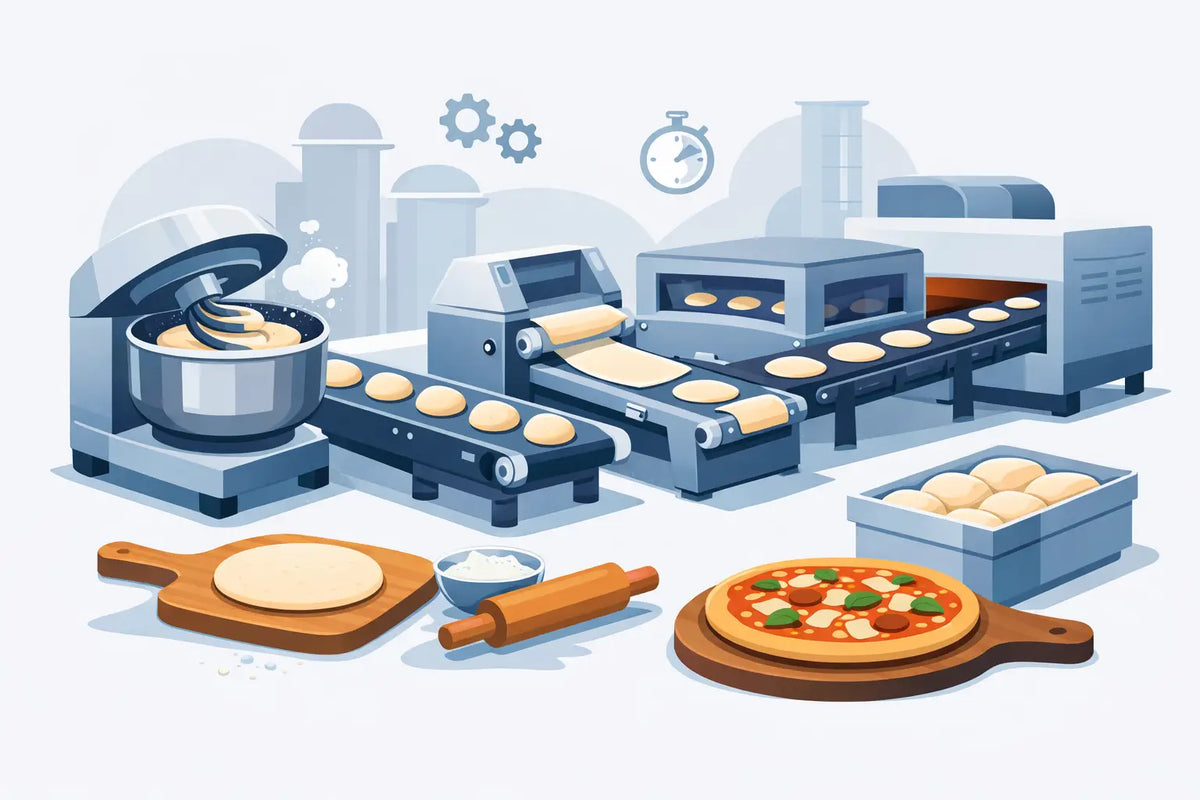
Strong pizza dough production follows a logical path: ingredient storage, scaling, mixing, resting, dividing, rounding, fermentation, tempering, stretching, and baking. Equipment should support that sequence with as little backtracking as possible.
Place dry ingredient storage near the scaling station and mixer. Position the divider and rounder close enough to receive dough without long carries or bottlenecks. Refrigeration, racks, and dough boxes should be accessible without crossing the hot line or dish area. This arrangement protects food safety, reduces labor, and gives managers a clearer view of production status.
Temperature is the control point that connects the entire system. Monitor water temperature, finished dough temperature, cooler temperature, and proofing conditions. Even premium equipment cannot correct a process that ignores these variables. A simple written dough standard with target temperatures, mix times, portion weights, and fermentation windows gives the team a dependable operating reference.
Prioritize Cleaning, Safety, and Service Access
Pizza dough equipment works hard, often in flour-heavy environments. Choose models with accessible bowls, removable guards where appropriate, easy-to-clean surfaces, and controls that staff can operate consistently. Flour buildup around moving parts, poor sanitation of dough-contact surfaces, and rushed cleaning routines can compromise both performance and food safety.
Safety features matter just as much. Look for bowl guards, emergency stops, stable bases, non-slip controls, and clear operating procedures. Employees should be trained on lockout procedures, safe loading practices, and the limits of each machine. A mixer or divider should never become a shortcut that exposes staff to preventable injury.
Serviceability deserves a place in the buying decision. Confirm utility requirements, replacement-part availability, warranty coverage, and clearance for routine maintenance. Commercial equipment earns its value over years of daily use, not only on installation day.
Choose Equipment That Supports Your Pizza Standard
The best equipment is not necessarily the largest or most automated option. A compact spiral mixer, properly sized refrigeration, durable dough boxes, and disciplined temperature control can outperform an oversized setup that does not match your workflow. Conversely, a growing operation may lose far more in labor and inconsistency by delaying a divider-rounder or additional cold-storage capacity.
Culinary Precisions helps serious operators build professional-grade kitchens around performance, durability, and production control. Start with the bottleneck your team feels most often, then select equipment that removes it without creating a new one. When every dough ball reaches the make line at the right weight, temperature, and fermentation stage, your oven crew can do what they do best: turn consistent prep into exceptional pizza.