Best Commercial Mixers for Dough for Busy Kitchens
The mixer that handles pancake batter beautifully can stall, overheat, or walk across the floor when faced with a full batch of pizza dough. Dough is one of the hardest jobs in a commercial kitchen because it demands torque, controlled mixing, and a machine built to repeat the work through a busy service. The best commercial mixers for dough are not simply the largest machines available. They are the mixers matched to your dough style, batch weight, production schedule, and available space.
For a pizzeria, bakery, restaurant prep kitchen, or serious home operation, the right choice protects consistency at the bench. It also helps your team produce better gluten development without pushing equipment beyond its rated capacity.
Start With the Dough You Produce
Before comparing bowl sizes or motor specifications, define what will go into the bowl. A high-hydration focaccia behaves very differently from a stiff bagel dough. A 60-quart planetary mixer may be highly useful for one operation, while a spiral mixer delivers better results for another.
Hydration is the first practical consideration. Wet doughs are easier for a mixer to move, although large batches still create significant load. Low-hydration doughs such as bagel, pretzel, cracker, and many tortilla formulas are denser and more demanding. These products need strong torque and should be mixed only in equipment rated for their weight and consistency.
Temperature matters too. Friction generated during mixing raises dough temperature. If your pizza dough is coming out warmer than your target range, fermentation timing becomes less predictable and finished crust quality can suffer. Mixer type, mixing time, room temperature, and ingredient temperature all affect that outcome.
Best Commercial Mixers for Dough by Mixer Type
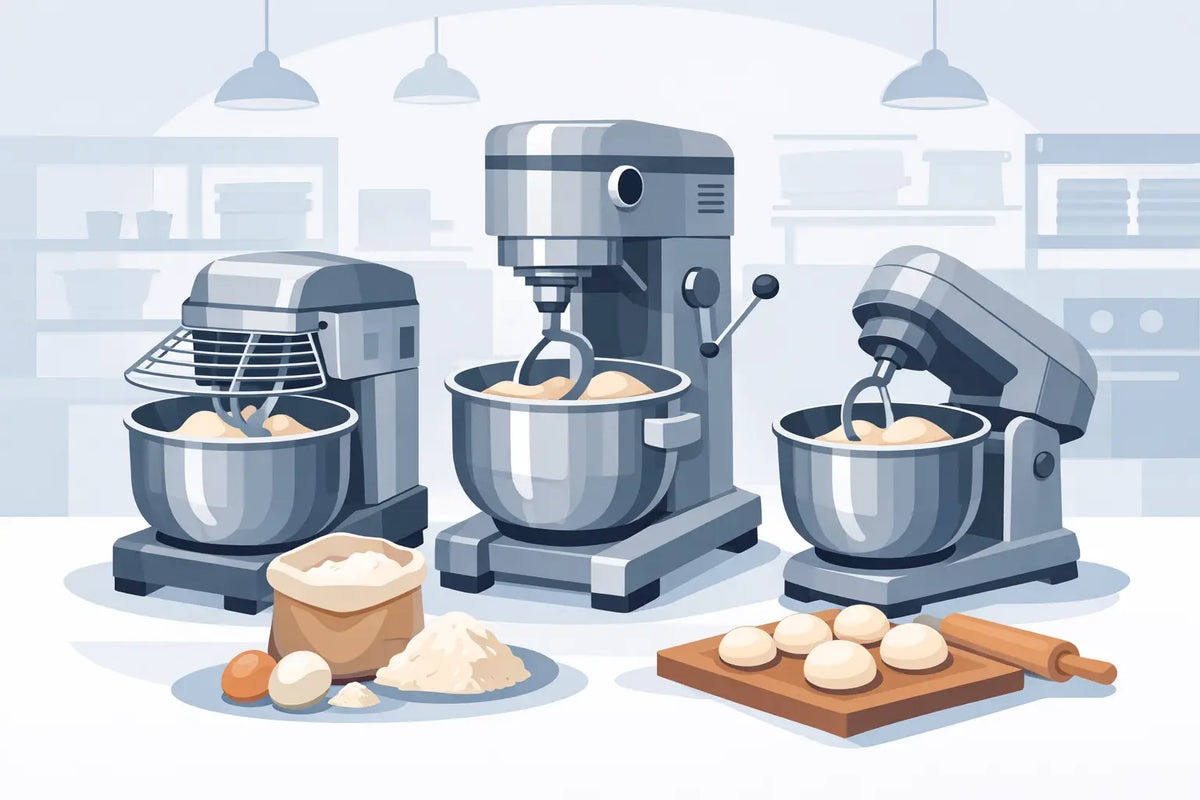
Spiral mixers for pizza, bread, and bakery dough
A spiral mixer is often the performance choice for dough-focused operations. Its bowl rotates while the spiral hook works the dough, creating efficient development with less friction than many general-purpose alternatives. This action is especially well suited to pizza dough, artisan bread, dinner rolls, and other yeast-raised formulas produced in steady volume.
Spiral mixers typically provide excellent dough development while keeping the process controlled. They are a strong fit when dough is a core product rather than an occasional prep task. For a pizzeria producing multiple dough batches before service, the dedicated design can improve repeatability and reduce the labor spent monitoring each mix.
The trade-off is versatility. A spiral mixer is purpose-built for dough, not for whipping cream, mixing cake batter, or blending mashed potatoes. Kitchens with one machine position and a broad prep list may need a more flexible solution.
Planetary mixers for versatile prep kitchens
Planetary mixers use interchangeable attachments, most commonly a dough hook, flat beater, and wire whip. The attachment moves around the bowl while rotating on its own axis, giving the mixer its planetary action. This makes it a practical all-around choice for restaurants, caterers, culinary programs, and bakeries with varied menus.
For moderate dough production, a commercial planetary mixer can be a productive workhorse. It can mix pizza dough in the morning, prepare cookie dough or fillings later, and handle sauces or whipped products as needed. The key is respecting its dough capacity, which is often lower than the bowl's total liquid capacity suggests.
A larger bowl does not automatically mean it can handle any amount of stiff dough. Always evaluate the manufacturer's stated flour or dough capacity and consider your lowest-hydration recipe. Running oversized, dense batches can strain the drivetrain and shorten the machine's service life.
Fork mixers for artisan-style dough
Fork mixers are a specialized option for bakeries pursuing gentle, traditional dough development. Their fork-shaped tool works at a relatively low speed, and many models use a rotating bowl. The result can be lower dough heating and a more delicate mixing action, particularly useful for high-quality bread production.
They are not the most common choice for every foodservice operation, but they deserve consideration where dough character is central to the menu. If your team produces naturally leavened loaves, high-hydration breads, or long-fermented doughs, a fork mixer may align with your process better than a high-speed general-purpose mixer.
Match Capacity to Real Batch Weight
Capacity should be measured by the dough you actually produce, not by an ambitious future number. Start with the weight of one normal batch, including flour, water, salt, yeast, oil, and inclusions. Then consider whether your operation needs one larger batch or several smaller batches to protect freshness and fermentation control.
Avoid buying at the absolute limit of a mixer's dough rating. A sensible operating margin gives the motor and transmission room to perform, especially with low-hydration formulas. It also gives your team flexibility when a recipe changes or a busy weekend requires a slightly larger batch.
Small operations may find a compact mixer is the right answer for controlled daily production. High-volume pizzerias and bakeries generally benefit from equipment that can keep pace without requiring the staff to run constant back-to-back cycles. The best choice depends on labor, proofing capacity, refrigeration space, and how much dough you can realistically manage at once.
Power, Speeds, and Mixing Control
Motor horsepower is useful, but it should not be viewed in isolation. A dependable dough mixer combines motor power with a capable transmission, gear system, bowl design, and appropriate mixing action. A machine with impressive horsepower on paper can still be the wrong fit if it is not engineered for the density and volume of your recipe.
For planetary mixers, multiple speeds are valuable because they let operators incorporate ingredients slowly before developing the dough at the recommended speed. Starting too fast can throw flour from the bowl, stress the dough hook, and create uneven hydration. Good process control begins with a slower pickup phase.
For spiral and fork mixers, consider the available speed settings and whether the machine's mixing cycle aligns with your production standards. Two-speed units can offer useful control for development, while simpler fixed-speed machines may be perfectly suitable for a consistent, well-tested formula. What matters is repeatable results, not features your staff will never use.
Plan for Footprint, Electrical Service, and Workflow
Commercial mixers demand more than counter or floor space. Measure the installation area, including clearance for the bowl, guard, controls, loading ingredients, and removing finished dough. Floor models need a stable, level surface. A mixer that is difficult to access will slow down prep and make cleaning less efficient.
Confirm your available electrical service before purchasing. Voltage, phase, plug configuration, and amperage must match the model's requirements. This is especially relevant when moving from a smaller countertop unit to a production-grade floor mixer. Planning the power connection early prevents expensive installation surprises.
Think through where flour is stored, where dough is portioned, and where dough boxes or proofing racks will go next. A mixer should support a clean, logical flow from scaling to mixing, fermentation, portioning, and baking. Equipment earns its place when it reduces unnecessary movement during a demanding prep shift.
Safety and Cleaning Are Part of Performance
A bowl guard, emergency stop, secure controls, and a stable base are not secondary details. They support safer work during repetitive production. Train every operator to stop the mixer before scraping the bowl, changing attachments, or adding ingredients that cannot be safely incorporated while it is running.
Cleaning also deserves a place in the buying decision. Dough residue can harden quickly, especially around hooks, guards, shafts, and bowl edges. Choose a model with accessible components and establish a cleaning routine immediately. A clean mixer supports food safety, protects moving parts, and keeps each batch free from cross-contact concerns.
When a Larger Mixer Is Not the Better Mixer
The temptation to size up is understandable, but oversized equipment can create its own problems. Small batches may not mix effectively in a very large bowl. The dough hook may not reach the ingredients properly, producing uneven development and forcing the operator to stop and scrape repeatedly.
If your operation makes both small test batches and large production runs, a primary production mixer paired with a smaller prep mixer may be more efficient than one oversized machine trying to do everything. This approach can also provide valuable backup capacity when production cannot pause.
Culinary Precisions helps kitchens evaluate equipment through the lens that matters most: dependable output under real working conditions. Choose the mixer that fits the dough, the volume, and the workflow you need today, with enough capacity to support the next stage of your operation. When the machine is correctly matched to the task, every batch becomes easier to control and every finished product has a better chance to meet your standard.