What Size Food Mixer Fits Your Kitchen Needs?
A mixer that is too small slows the line when dough backs up before service. One that is too large can waste counter space, power, and budget on capacity your kitchen will never use. The right answer to what size food mixer you need starts with the batch you must produce at your busiest hour, not the biggest bowl that fits in the room.
For bakeries, pizzerias, restaurants, caterers, and serious home kitchens, mixer capacity affects far more than volume. It shapes prep speed, recipe consistency, labor demands, and how confidently your team can produce under pressure. A properly sized commercial mixer earns its space by handling your real workload day after day.
What Size Food Mixer Is Right for Your Production?
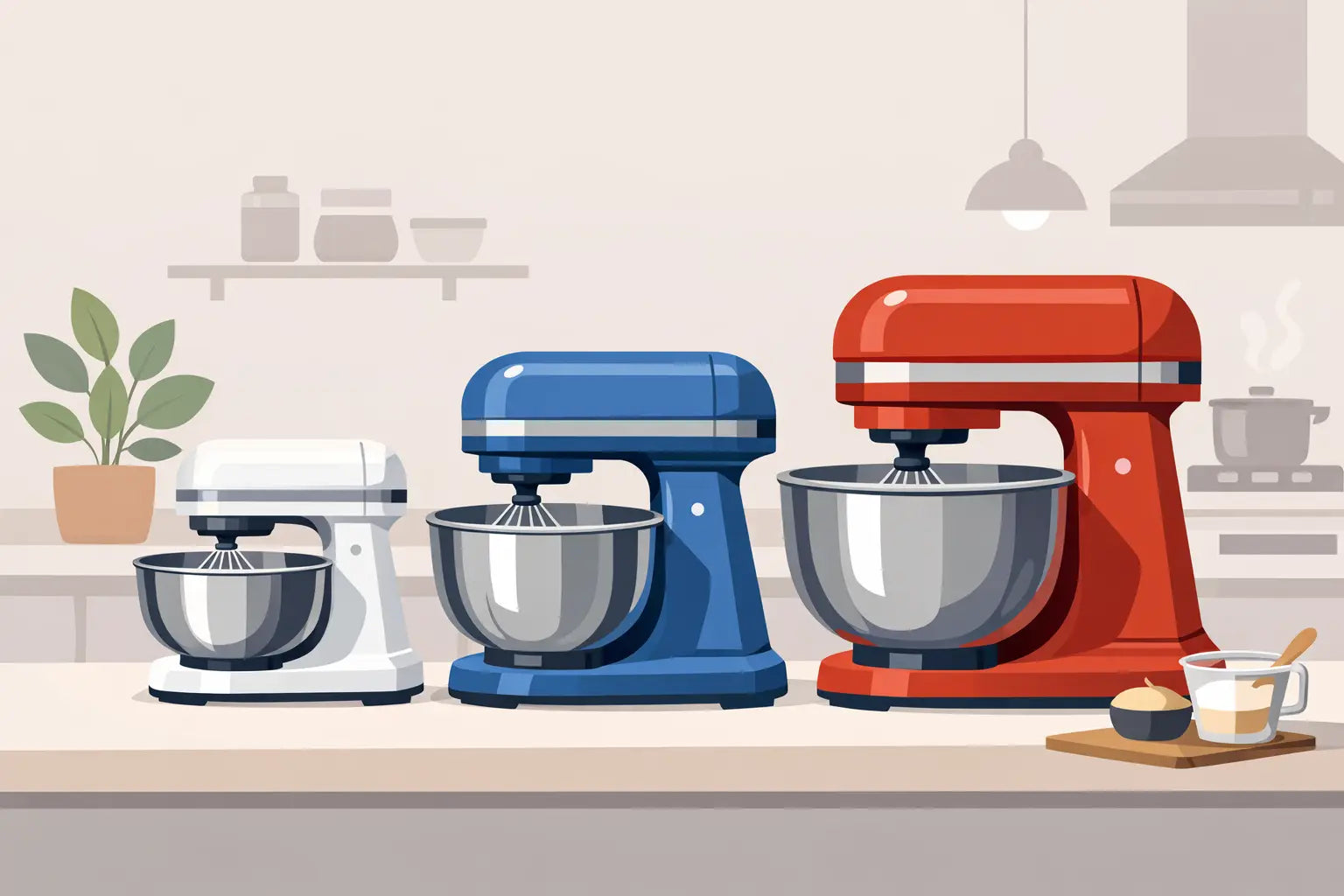
Food mixer sizes are generally measured by bowl capacity in quarts. Common planetary mixer capacities range from 5 to 8 quarts for serious home use, then 10, 20, 30, 40, 60, 80, and 140 quarts for commercial operations. Bowl size is a useful starting point, but it is not the same as usable batch capacity.
A 20-quart mixer does not mean every recipe can be made in a 20-quart batch. Thick pizza dough, bread dough, cold buttercream, and dense cookie dough put more load on the motor and drive system than whipped egg whites or cream. Manufacturers set maximum flour, dough, and liquid capacities for each model. Those limits should guide the purchase, especially when dough is central to your menu.
As a practical benchmark, a 20-quart mixer often suits smaller restaurants, cafes, test kitchens, and high-output home cooks making moderate batches. A 30-quart model gives a growing operation more room for sauces, fillings, frosting, mashed potatoes, and dough without moving into a full floor mixer. For bakeries, pizza operations, commissaries, and caterers that make repeated large batches, 40- to 60-quart equipment is often the more productive choice.
The best capacity is usually the smallest mixer that can comfortably complete your normal peak batch in one cycle. Buying around peak production prevents rushed second batches while avoiding the inefficiency of running a large bowl nearly empty.
Start With the Product You Mix Most Often
Your core product should determine the mixer before bowl capacity does. A kitchen that primarily whips cream and mixes cake batter has different requirements from one producing high-hydration pizza dough or dense bagel dough.
Dough Requires More Than Bowl Volume
Dough is the toughest sizing test. A mixer may handle a generous amount of light batter yet have a much lower maximum flour capacity for stiff dough. If you produce bread, bagels, pizza, pretzels, or cookies, review the machine's stated dough rating and recommended mixing time. Do not assume a larger bowl automatically means it can handle any dough formula at full capacity.
For frequent bread and pizza production, a spiral mixer may be a better match than a planetary mixer. Spiral mixers are designed to develop dough efficiently while keeping stress and heat under control. Planetary mixers remain the more versatile option because they can also whip, blend, beat, and mix with multiple attachments. Many commercial kitchens benefit from a planetary mixer for general prep and a dedicated spiral mixer when dough volume becomes a major part of the operation.
Hydration matters, too. A 65% hydration pizza dough is easier on equipment than a low-hydration bagel dough. High-fat cookie dough can also be demanding, particularly when mixed cold. Use your heaviest, stiffest, most frequent recipe as the benchmark rather than the easiest item on the prep list.
Light Mixtures Need Enough Minimum Capacity
Oversizing has a trade-off. An 80-quart mixer may be ideal for a commissary producing large batches of dough, but it may not whip a small quantity of egg whites or cream effectively. The whisk needs enough product in the bowl to make proper contact and incorporate air.
If your menu calls for both large production and small, delicate batches, consider whether a second smaller mixer improves workflow. A 20-quart mixer paired with a 60-quart floor model can be more efficient than forcing every task through one oversized machine. This setup also provides valuable backup capacity during a busy prep shift.
Match Mixer Capacity to Batch Frequency
Think in batches per shift, not just pounds per recipe. If you need 40 pounds of pizza dough every afternoon, a smaller mixer may complete the work in several batches. That can be completely acceptable if prep time and labor are available. But if the same mixer is also needed for whipped toppings, sauces, fillings, and dessert batter, those repeated dough cycles may create a production bottleneck.
A larger machine often reduces labor by consolidating batches, but it only delivers that benefit when recipes are scaled correctly and the team can safely handle the output. Large bowls of dough are heavy. Consider who will load ingredients, remove the bowl, divide the product, and clean the equipment.
Use these capacity ranges as a starting point:
- 5 to 10 quarts: Serious home cooks, small-batch pastry work, and low-volume specialty prep.
- 20 quarts: Cafes, small restaurants, food trucks, and kitchens producing several moderate batches daily.
- 30 to 40 quarts: Busy restaurants, small bakeries, pizzerias, and caterers with consistent prep volume.
- 60 quarts and above: Bakeries, commissaries, institutions, high-volume pizzerias, and operations producing large batches every day.
Consider Power, Speed, and Attachments
A food mixer is a production platform, not just a bowl with a motor. Planetary mixers commonly use a dough hook, flat beater, and wire whip. With compatible attachments, some models can support meat grinding, vegetable slicing, pasta production, and other prep tasks. That versatility can justify a larger investment when counter space is limited and one machine must support several stations.
Power should match workload. Heavy dough mixed frequently needs a commercial-grade motor, durable transmission, and appropriate speed control. A mixer that performs well with occasional cake batter may struggle with repeated dense dough batches, even if the bowl looks large enough on paper.
Multiple speeds give operators control over incorporation, gluten development, emulsification, and aeration. A slow first speed is particularly useful for adding flour and liquids without throwing ingredients from the bowl. Higher speeds help whip cream, egg whites, and light batters quickly. For daily commercial use, prioritize a machine with clear controls, a dependable bowl lift, and safety features that support disciplined operation.
Measure the Kitchen Before You Choose
Floor space and counter space are only part of the equation. A mixer needs clearance for the bowl, guard, attachments, ingredient loading, cleaning, and operator movement. A floor model may fit the footprint on a layout drawing but still become awkward if a team member cannot comfortably move around it with a dough tub or sheet pan rack.
Check the overall height, especially for countertop mixers placed beneath wall cabinets. Confirm the electrical requirements before ordering. Larger commercial mixers may require higher-voltage service, while smaller units may operate on standard electrical connections. The right electrical setup protects performance and avoids costly installation delays.
Weight also matters. Commercial mixers are built for stability, which means they can be substantial pieces of equipment. Verify that the counter, stand, or floor location can support the unit, and plan for delivery access through doors, hallways, and prep areas.
Choose for the Next Stage, Not an Imaginary Future
It is wise to allow room for growth, but buying far beyond your actual demand can create new problems. Larger equipment costs more, occupies more space, may need different electrical service, and can be less effective for small batches. A better approach is to buy one step ahead of your current production when growth is supported by a real menu, customer base, or expansion plan.
For example, a pizzeria consistently mixing two 20-quart batches each day may be ready for a 30- or 40-quart mixer if demand is climbing and prep is taking staff away from other work. A new operation still testing its volume may be better served by a versatile 20-quart model until its production pattern is proven.
Culinary Precisions helps serious kitchens select performance-driven equipment based on real production demands, not guesswork. Begin with your heaviest recipe, your busiest prep window, and the amount your team needs ready before service. The right mixer size will make every batch more consistent and give your kitchen the capacity to move with confidence.