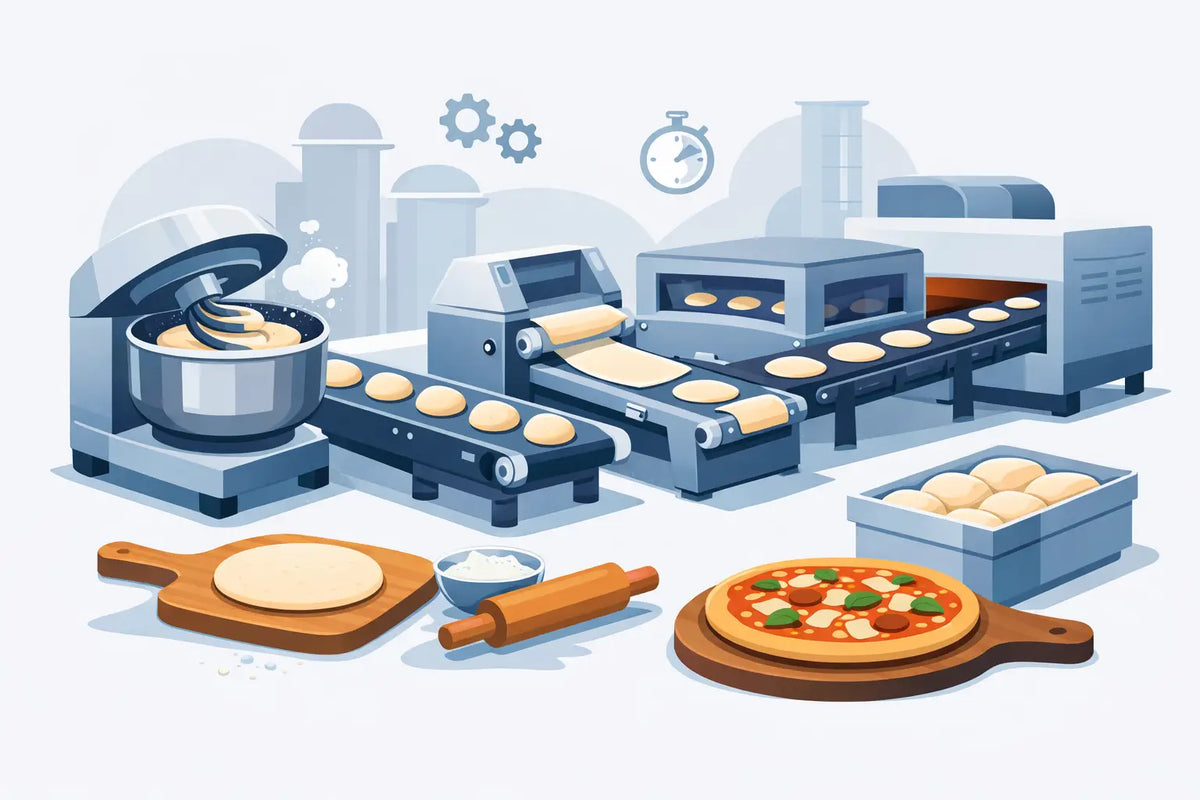
Commercial Mixers Built for the Rhythm of Service
The first tray of dough often tells the truth about a kitchen. If it is properly developed, portioned on time, and ready when the oven is hot, service begins with control. If mixing runs long, the dough warms too quickly, or a small machine strains under a full batch, that lost rhythm reaches every station. Commercial mixers are not simply prep equipment. They are the mechanical center of production for bakeries, pizzerias, pastry programs, restaurants, and high-volume culinary workspaces.
The right model creates repeatability without flattening the craft. It gives a pizza operation the strength to produce a consistent dough schedule, helps a pastry team build stable meringues and buttercreams, and lets a restaurant turn out sauces, fillings, mashed potatoes, and batters with less labor at the bench. Selecting one well starts with the work itself, not with bowl size alone.
Commercial Mixers Start With the Product You Make
A mixer should be chosen around your heaviest regular task, not your lightest or most occasional one. A 20-quart machine that excels at whipped cream and cake batter may not be the right answer for a pizza concept producing dense, low-hydration dough all day. Likewise, a large floor model can be an unnecessary use of space and capital for a café whose mixer runs only during morning pastry prep.
Think first about the products that set the pace of your operation. Dough is especially demanding because its resistance increases as gluten develops. A thick bagel dough, pretzel dough, or stiff bread formula places far more load on a mixer than a similar-looking batch of muffin batter. Capacity ratings often vary by product type, hydration level, flour strength, and mixing method. A stated flour capacity is useful, but it is not a promise that every dough formula can be mixed at that maximum weight.
Your daily batch pattern matters just as much. A kitchen making one large dough batch before opening needs a different machine than a restaurant running smaller batches of whipped cream, biscuit dough, and mashed potatoes throughout service. The goal is not to buy the biggest mixer possible. It is to choose a machine that handles your expected batch with room to work, without consuming more floor area, electrical capacity, or operator attention than the kitchen can spare.
Planetary Mixers for Versatile Prep
Planetary mixers are the familiar all-purpose workhorses found in restaurants, bakeries, catering kitchens, and institutional foodservice. Their attachment hub and changing agitators allow one machine to perform several jobs. A flat beater handles batters, frostings, and mashed preparations; a wire whip brings air into cream, egg whites, and mousse; a dough hook works through many bread and pizza doughs.
That flexibility is their advantage. For an operation with a varied menu, a planetary mixer can earn its footprint across the day. It is also a natural fit when attachment-driven tasks matter, such as grinding meat, slicing vegetables, or preparing pasta, provided the mixer is designed to accept those accessories.
The trade-off is that planetary mixers are not always the most efficient choice for very large volumes of heavy artisan dough. Their versatility does not eliminate the need to respect rated dough capacity, speed guidance, and mix times. For dense doughs produced at scale, a spiral mixer may provide better development with less stress on the product and the machine.
Spiral Mixers for Dough-Centered Operations
Spiral mixers are purpose-built for dough. The hook rotates while the bowl turns, creating a mixing action that develops gluten efficiently and evenly. This movement is particularly valuable for pizzerias, bread programs, bagel shops, and bakeries where dough quality is a signature part of the menu.
A spiral mixer can often handle substantial dough loads while maintaining a cooler, more controlled mix than a general-purpose model. That matters because dough temperature influences fermentation, extensibility, flavor development, and the window in which your team can shape and bake it. A cool, properly developed dough gives the baker more control at the bench and the cook more consistency in the oven.
It depends on your menu, however. A spiral mixer is exceptional at its intended work, but it does not replace the broad utility of a planetary mixer for whipped cream, cake batter, or small prep tasks. Many growing pizza and bakery operations eventually use both: a spiral mixer for the dough room and a planetary unit for pastry, sauces, and prep.
Size Capacity by Production, Not by Guesswork
Quart size is a starting point, not the entire specification. A compact countertop mixer may suit a chef-driven restaurant that mixes a few smaller batches each day. A 30-, 40-, or 60-quart floor mixer may be more appropriate for catering production, hotel kitchens, commissaries, and bakeries with sustained volume.
Before selecting capacity, calculate the weight of a typical batch, the number of batches needed per day, and the time available to make them. Then consider your peak production day, not a quiet Tuesday. If your current recipe fills a bowl to its practical limit, moving up a size may reduce batch count and protect the equipment from being routinely pushed to the edge of its range.
There is also a lower limit to consider. A very large bowl can be less effective for small quantities. If a machine cannot adequately incorporate a small batch of frosting or whip a modest amount of cream, your team may still need a smaller companion mixer. Two thoughtfully sized machines can be more useful than one oversized unit, especially in kitchens where prep tasks overlap.
Floor models require attention to the physical room around them. Measure the equipment footprint, bowl swing, guard clearance, and the route from receiving to final placement. A mixer that cannot clear a doorway, fit beneath a low hood line, or sit comfortably near its ingredient storage creates friction before the first batch is made. Heavy equipment also needs a stable, level surface and a workflow that allows staff to load, unload, and clean it without crossing the busiest traffic path.
Power, Speed, and the Details That Protect Quality
Motor strength matters, but more horsepower is not automatically better. The useful question is whether the motor and transmission are designed for your intended product at your intended batch size. Heavy doughs need torque and durable gearing. Delicate creams and emulsions need speed control that lets the operator build volume without overworking the product.
Multiple speeds give a kitchen more precision. Starting a dough slowly helps contain flour and begins hydration evenly; increasing speed at the correct point develops structure. With whipped cream or egg whites, gradual speed changes let the operator watch texture closely rather than racing past the ideal stage. Digital timers can add further consistency, particularly when several cooks share prep responsibilities.
Electrical requirements should be settled before the mixer arrives. Confirm voltage, phase, amperage, plug type, and whether your facility has the right circuit available. A 120-volt countertop machine may integrate easily into an existing kitchen, while a larger floor model can require a dedicated higher-voltage connection. This is a practical detail, but it shapes installation cost and timeline.
The Parts Your Team Touches Every Day
The finest specifications do little good if a mixer is awkward to operate during a busy prep shift. Bowl-lift controls, safety guards, attachment changes, and bowl removal all deserve close attention. A smooth bowl-lift mechanism reduces strain when handling heavy batches. A clear safety guard helps staff monitor ingredients while keeping hands away from moving parts. Controls should be legible, durable, and positioned where an operator can use them without reaching across the machine.
Material quality also shows up in daily maintenance. Stainless steel bowls and attachments support sanitation and hold up to repeated washing. A finished metal body is easier to wipe clean after flour dust, butter, syrup, or sauce splatter settles across the prep area. Look for accessible surfaces around the bowl cradle and guard, because hard-to-clean crevices become a problem long before the mixer reaches the end of its service life.
Attachments deserve the same discipline as the mixer itself. A dough hook, flat beater, and wire whip cover the essential range for most planetary applications. Specialized attachments can expand production, but only when they will genuinely be used. Buying around an imagined future menu can add cost without improving the operation. Buy for the work you make now, with a clear view of the menu you expect to build next.
Build the Mixer Into the Kitchen’s Rhythm
The best placement is usually close to dry storage, scaling space, and the next step in production. For dough, that may mean a clear path from flour bins to the mixer, then from the mixer to a bench, divider, retarder, or dough trays. For pastry, it may mean adjacency to refrigeration and a clean finishing station. Every unnecessary carry adds time and increases the chance that a bowl sits too long while the team is pulled elsewhere.
Plan for cleaning, too. Flour-heavy operations need a routine for wiping the exterior, guard, attachments, and surrounding floor after every use. Teams should inspect attachments for wear, use the correct speed for each product, and avoid treating the mixer as a food processor or an oversized stirring tool. Respecting the machine’s limits is part of preserving the texture, temperature, and character of the food it produces.
When comparing commercial mixers, choose the one that gives your team a steadier hand at the point where ingredients become preparation. The right machine does not ask for attention. It earns it back, batch after batch, leaving more room for the heat, timing, and hospitality that guests remember.