Deck Oven vs Conveyor Oven: Which Fits?
A busy Friday service exposes the real difference between oven types. When tickets stack up, a pizza oven must do more than reach temperature. It has to match your menu, your team’s skill level, your available space, and the pace your operation promises customers. In the deck oven vs conveyor oven decision, the best choice is not simply about heat. It is about building a repeatable production system that protects food quality under pressure.
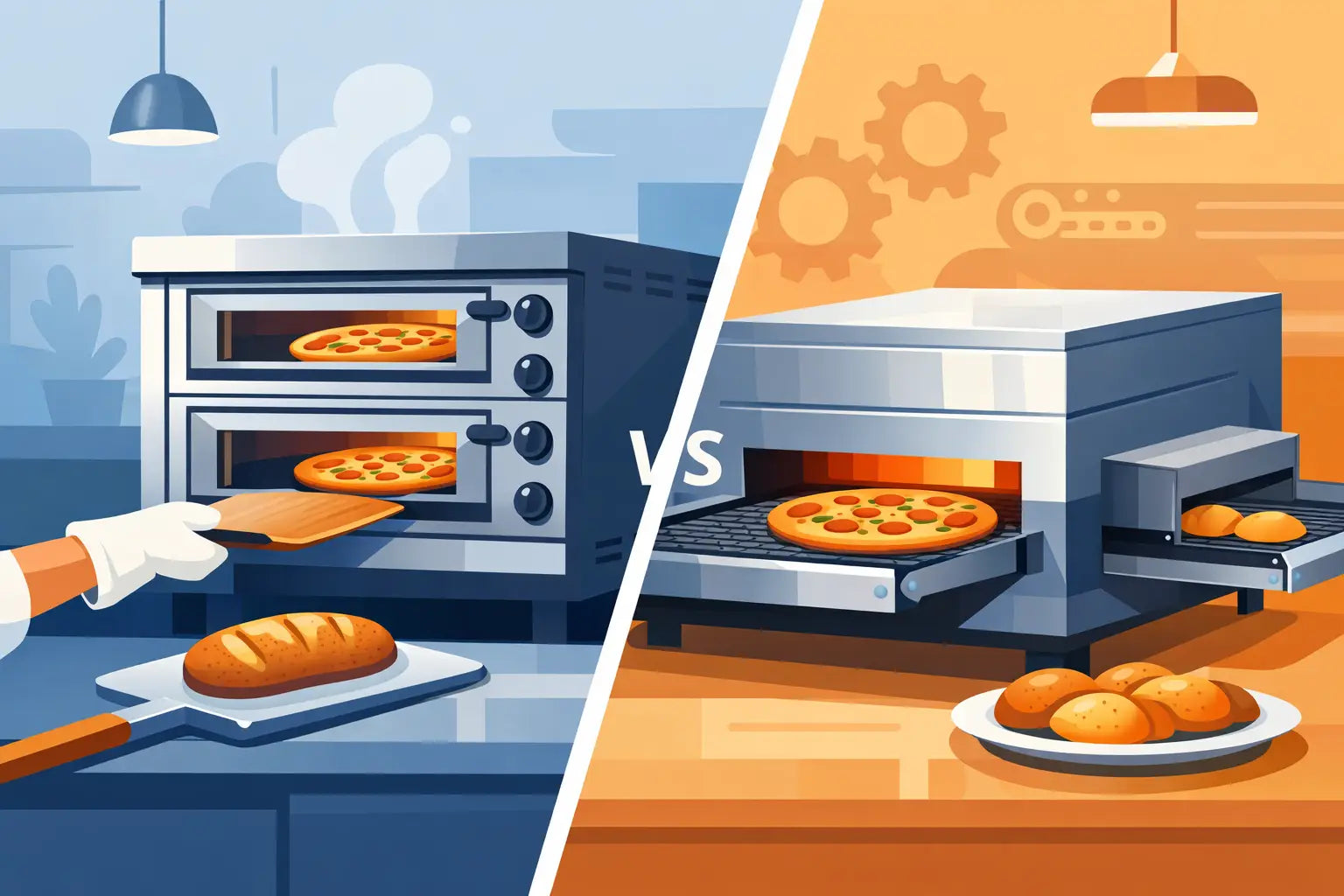
A deck oven gives chefs direct control over the bake and the finished crust. A conveyor oven prioritizes predictable output, speed, and easier operation across the line. Both can be high-performing commercial assets. The right fit depends on how you define performance in your kitchen.
Deck Oven vs Conveyor Oven: The Core Difference
A deck oven bakes pizzas on a stationary cooking surface, typically stone, brick, ceramic, or a composite deck. The operator loads the pizza, monitors its progress, turns it as needed, and removes it when the crust, cheese, and toppings are properly finished. Heat is delivered through the deck, the oven chamber, and, depending on the model, radiant elements or gas burners.
A conveyor oven moves pizzas through a temperature-controlled chamber on a belt. The operator sets the belt speed and oven temperature, then loads the pizza at one end. It exits at the other end after a programmed bake time. This approach reduces variation between employees and creates a clear, continuous path from make line to finished product.
Neither format is automatically better. A chef-driven artisan pizza program may require the responsiveness and crust character of a deck oven. A high-volume quick-service operation may benefit more from the consistency and labor efficiency of a conveyor system.
Choose a Deck Oven for Hands-On Pizza Quality
Deck ovens are built for operators who want more influence over the bake. Their cooking decks absorb and transfer heat directly into the dough, supporting a crisp bottom crust with the texture many customers associate with traditional pizzeria pizza. They are especially well suited to New York-style, artisan, thin-crust, and other pizzas where dough development and visual finish matter as much as ticket speed.
Greater control over the finished bake
With a deck oven, the chef can adjust placement, rotate the pie, move it to a hotter or cooler zone, and pull it at precisely the right moment. That control matters when pizzas vary in diameter, dough hydration, topping load, or cheese blend. It also supports menus with a broader range of baked items, including calzones, flatbreads, baked pastas, bread, and desserts.
The trade-off is that control requires attention. A deck oven is only as consistent as the operator using it. During a rush, an inexperienced team member can overbake a pie, undercook the center, or lose track of multiple orders. Training, station organization, and clear bake standards are essential.
Strong fit for quality-led menus
A deck oven often makes sense when pizza is a defining part of the brand rather than a high-speed menu component. If customers notice the char, chew, underside crispness, and hand-finished appearance of every pie, a deck oven gives the kitchen the tools to deliver those details.
Capacity varies by deck size and number of chambers. A multi-deck model can hold several pizzas at once and give the kitchen flexibility to bake different products at different temperatures. However, loading and unloading remain manual, so practical production capacity depends on staffing and operator discipline.
Consider heat-up time, ventilation, and workflow
Deck ovens can require substantial preheat time and retain a great deal of heat. That thermal mass is an advantage once service begins, but it demands planning. Your team needs to start the oven early enough for the deck to stabilize before the first order goes in.
Buyers should also evaluate utility requirements, ventilation, clearances, and total weight. A heavy commercial deck oven may require careful site planning, especially in smaller kitchens, food trucks, or locations with difficult access. Measure the installation route, not just the final footprint.
Choose a Conveyor Oven for Volume and Consistency
A conveyor oven is designed to make the bake process repeatable. Once temperature and belt speed are properly calibrated, every pizza travels through the same cooking environment for the same amount of time. That consistency is valuable for operations managing frequent staff changes, multiple dayparts, or a high volume of similar orders.
Faster throughput with less active labor
The key advantage of a conveyor oven is continuous production. Instead of waiting for space to open on a deck, employees can load pizzas onto the belt as they are assembled. This supports a steady flow of product during delivery rushes, school lunch periods, stadium events, and quick-service peaks.
Conveyor ovens also reduce the amount of specialized oven management required. Team members still need training to set recipes, load products correctly, and monitor quality, but they do not need to rotate every pizza or judge each bake from scratch. That can help managers protect consistency when skilled labor is limited.
The result is a workflow that is easier to scale. One employee can often manage loading and finishing while another continues assembling orders. For businesses that measure success in pizzas per hour, ticket-time reliability, and lower labor pressure, this is a meaningful advantage.
Predictability has limits
A conveyor oven does not remove the need for recipe discipline. Dough weight, proofing, sauce volume, topping distribution, and pizza screen selection still affect the final product. A conveyor setup produces excellent consistency when the inputs are standardized. If every pizza is built differently, the benefits diminish.
It may also offer less flexibility for chefs who want to make real-time adjustments. A heavily topped specialty pie may need a slower belt speed than a thin cheese pizza. If both products must run at once, the kitchen may need to standardize recipes, use different baking methods, or accept some compromise in the final finish.
Compare Space, Utilities, and Production Needs
The oven footprint on a spec sheet is only the starting point. A deck oven needs access space for loading, unloading, cleaning, and potentially stacking multiple chambers. A conveyor oven needs clear space at both the infeed and discharge ends, plus room for employees to safely retrieve hot product. A compact kitchen can accommodate either type, but the full production path must be planned before purchase.
Utilities deserve the same level of scrutiny. Compare gas or electric requirements, ventilation needs, electrical phase, heat output, and local code requirements. Electric conveyor ovens can be a practical solution in sites where gas is unavailable, while gas models may appeal to operators who prefer their heat characteristics or existing utility setup. The right answer depends on the building as much as the menu.
Also consider the expected sales mix. A restaurant producing 40 carefully finished pizzas over a dinner service has different needs than a delivery-focused operation producing several hundred similar pizzas during peak hours. Purchasing more oven than the business can utilize ties up capital and floor space. Purchasing too little creates ticket delays that customers remember.
Operating Costs and Maintenance Matter
Initial price should not be the only financial comparison. The more useful question is how each oven affects total operating cost over time. Energy consumption, preheat time, labor requirements, cleaning routines, replacement parts, and service access all contribute to the real cost of ownership.
Deck ovens can use significant energy during long holding periods because of their thermal mass. They may also require periodic deck maintenance and disciplined cleaning to prevent smoke, residue, and inconsistent heat transfer. Their simpler cooking path can be attractive, but operators should follow the manufacturer’s maintenance schedule closely.
Conveyor ovens use motors, belts, blowers, and controls that require regular inspection and cleaning. Crumbs, flour, cheese, and grease must not be allowed to build up in the belt or chamber. In exchange, conveyor ovens can reduce labor at the oven station and support predictable production during the busiest periods.
For either oven type, prioritize models with accessible controls, clear operating documentation, available replacement parts, and service support. Professional equipment delivers its best return when it can be maintained without turning a minor issue into a prolonged outage.
A Practical Decision for Your Kitchen
Choose a deck oven when your menu depends on hands-on craftsmanship, varied pizza styles, and a crust profile that benefits from direct deck baking. It is a strong investment for chef-led pizzerias, artisan concepts, and operations where the person at the oven is part of the quality equation.
Choose a conveyor oven when speed, repeatability, and labor efficiency are the primary operational goals. It is often the better match for high-volume pizza programs, delivery-heavy restaurants, cafeterias, concession operations, and multi-unit concepts that need every location to produce the same result.
Before selecting equipment, map a real service period: how many pizzas arrive in a 15-minute rush, who loads the oven, where finished pies go, and how long customers are willing to wait. The oven that supports that exact workflow will do more for your kitchen than the one with the most impressive specification alone. Built for performance means choosing equipment that helps your team deliver the same confident result, order after order.