Restaurant Equipment for Small Kitchens
A small kitchen exposes every weak equipment decision fast. One oversized range can choke your line. A poorly placed prep table can slow service all night. And a refrigerator with the wrong footprint can cost you both storage and movement when you need both most. Choosing restaurant equipment for small kitchens is less about squeezing in more units and more about building a layout that protects speed, safety, and consistency under pressure.
What small kitchens actually need
The first mistake many operators make is buying for ambition instead of throughput. A compact kitchen does not need less performance. It needs tighter performance. Every piece of equipment has to earn its floor space by supporting volume, reducing labor, or protecting food quality.
That changes how you evaluate the lineup. In a larger kitchen, it is sometimes possible to carry a single-use piece of equipment because there is room for it. In a smaller footprint, versatility matters more. A convection oven that handles multiple menu items often delivers more value than a specialty unit that performs one task well but sits idle outside peak periods.
The same logic applies to prep, holding, cold storage, and warewashing. Capacity still matters, but external dimensions, door swing, ventilation clearance, and daily traffic patterns matter just as much. The best equipment choice is often the one that creates fewer bottlenecks, not the one with the biggest spec sheet.
How to choose restaurant equipment for small kitchens
Start with the menu, not the catalog. Your equipment package should reflect the products you sell most, the prep steps that take the most time, and the stations where delays happen during service. If your operation depends on fast oven recovery, refrigerated ingredient access, and short ticket times, those priorities should shape your buying decisions before you think about adding specialty equipment.
Then look at the kitchen in zones. Cooking, prep, cold storage, holding, cleaning, and pickup all compete for the same few feet. When equipment overlaps these zones in a useful way, the kitchen gets faster. When it blocks movement or creates extra handoffs, the kitchen gets slower.
It also helps to think in terms of labor. Small kitchens rarely have extra staff to absorb inefficient setups. Equipment that reduces steps, improves accessibility, or shortens recovery time can have a bigger operational impact than a larger machine with more raw capacity.
Prioritize footprint and output together
A smaller unit is not automatically the right unit. If a compact griddle cannot keep pace with demand, the labor and ticket-time costs may outweigh the space you saved. The right approach is to compare production output against the floor and counter space required.
For example, undercounter refrigeration can free line access and keep ingredients within reach, but only if the drawer or door configuration matches your actual prep flow. A narrow refrigerator tucked into the wrong station can slow cooks more than a larger reach-in placed strategically nearby.
Look for multi-function value
In tight kitchens, combination value matters. A refrigerated prep table supports storage and assembly in one station. A convection oven expands menu flexibility without demanding the footprint of multiple cooking units. Food warmers can protect holding quality during rush periods without forcing staff to refire items.
That does not mean every purchase should be multi-use. Some high-volume concepts still need dedicated equipment because specialization protects consistency. A pizza operation may need a purpose-built oven because the product standard depends on it. The point is to avoid redundancy where the menu does not justify it.
The equipment categories that matter most
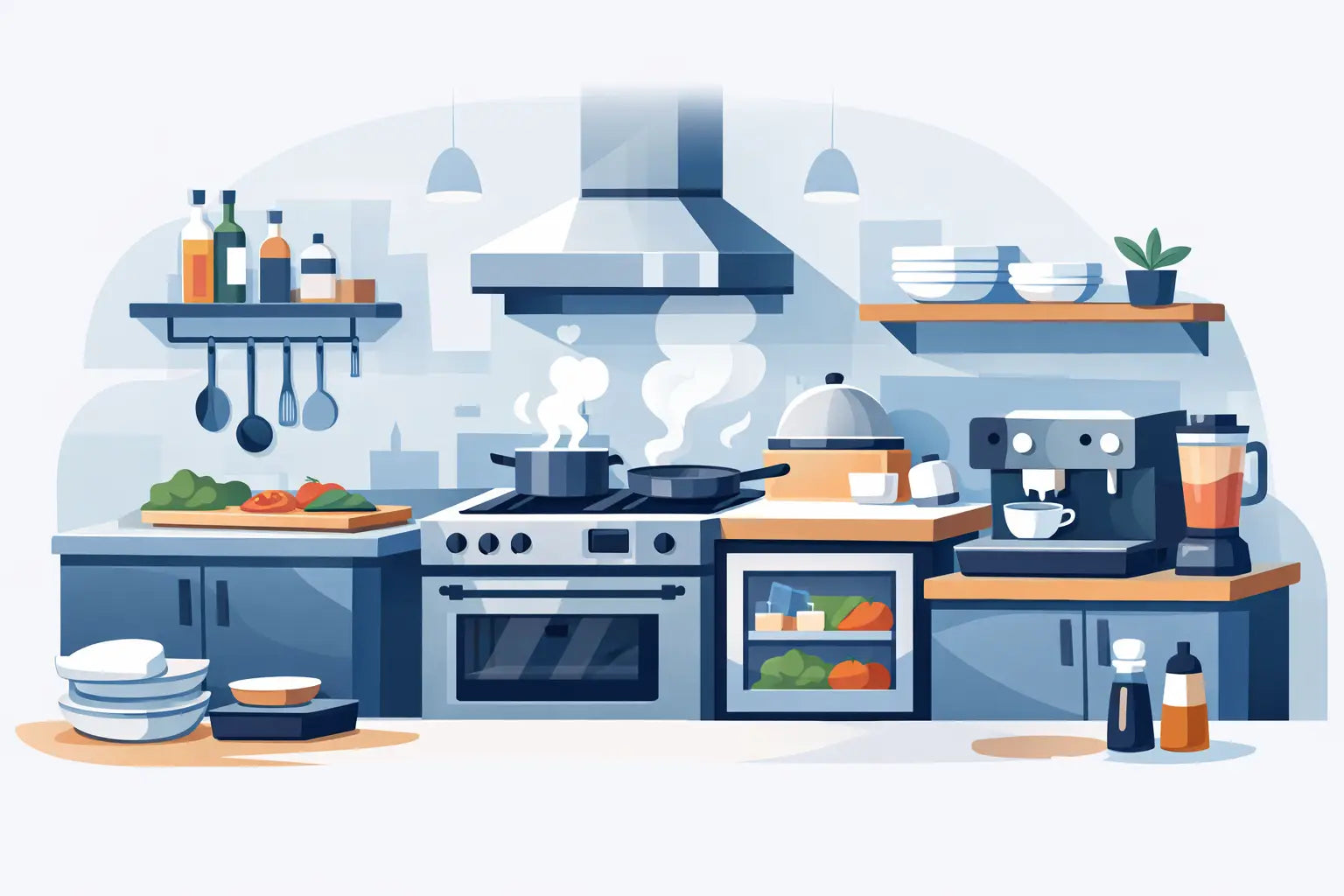
For most small commercial kitchens, the core package starts with cooking equipment, refrigeration, prep surfaces, holding equipment, and sanitation support. The exact mix depends on concept, but the operational questions stay the same: what supports throughput, what protects food safety, and what reduces wasted motion?
Cooking equipment should match your menu and your utility setup. Gas ranges and stoves offer familiar control and strong line versatility, but they can overwhelm a compact layout if the width exceeds your actual production needs. Countertop or narrower cooking equipment can be a smarter fit when the menu is focused and every inch matters. Convection ovens are especially useful in small kitchens because they improve consistency and can handle varied applications without expanding the line too far.
Refrigeration deserves careful attention because it affects speed and food quality every hour of service. Reach-ins work well when vertical storage is available, but undercounter refrigeration is often the stronger choice on the line where ingredient access drives ticket times. The trade-off is capacity. If you go undercounter, make sure par levels and restocking patterns are realistic for your service volume.
Prep equipment has to support flow, not just provide a place to work. Food mixers, prep tables, and ingredient stations should be selected based on daily production volume and station spacing. In a compact kitchen, a mixer that lives on a mobile stand may be more practical than a permanently installed setup that steals a valuable corner.
Holding and warming equipment become more important as kitchens tighten. When plating space is limited and service surges are intense, controlled warming can protect quality without overloading the cookline. This is especially relevant for operations balancing dine-in, takeout, and third-party delivery from one small production area.
Dishwashing and sanitation equipment can be easy to underestimate, but poor warewashing layout can create recurring traffic jams. Compact dish washers and smart sink configurations help maintain hygiene standards while keeping the back end from interfering with production. In small spaces, dirty-to-clean flow should be planned just as carefully as prep-to-service flow.
Common sizing mistakes that cost operators later
One of the biggest mistakes is measuring only the equipment footprint and ignoring the operating footprint. You need room for ventilation, door clearance, cleaning access, and safe movement. An appliance that technically fits may still fail in practice if staff cannot open it fully or service it properly.
Another common issue is buying too much refrigeration in one location and not enough where product is actually used. Centralized cold storage can look efficient on paper, but repeated trips across a small kitchen add friction fast. Distributed refrigeration, especially undercounter solutions, often improves line speed even if the total cubic footage is lower.
There is also the temptation to overbuild for future growth. Planning ahead is smart, but a small kitchen has to perform now. If a larger unit limits movement, increases heat load, or complicates cleaning, it can reduce current output while solving a future problem that may never arrive.
Workflow matters more than feature overload
The best restaurant equipment for small kitchens supports a clear sequence: receive, store, prep, cook, hold, plate, clean. If equipment interrupts that sequence, the operation feels cramped no matter how advanced the features are.
That is why spec-driven buying should always connect back to real kitchen behavior. Recovery time matters if you fire continuously. Refrigeration access matters if assembly is ingredient-heavy. Cleaning access matters if the same small team closes every night. Features are valuable when they remove friction from actual service, not when they only look impressive on paper.
This is where chef-aligned planning makes a difference. Operators who understand their menu cadence, peak periods, and staffing limits tend to choose equipment that performs better over time. A precision-focused supplier such as Culinary Precisions can be helpful because category breadth matters when you are balancing cooking, cold storage, holding, and sanitation in one compact footprint.
A smarter buying approach for tight spaces
Before you buy, map your top-selling menu items to the stations they require. Count every movement between storage, prep, cooking, and plating. If one piece of equipment creates extra steps for every ticket, it is probably too expensive operationally even if the purchase price looks reasonable.
Also think about maintenance and longevity. Small kitchens put heavy demands on every unit because there is usually less redundancy. If one refrigerator fails or one oven underperforms, the entire operation feels it immediately. Reliability is not just a quality preference. In compact kitchens, it is a workflow requirement.
Finally, choose equipment that gives you control. Precision temperature management, dependable recovery, durable construction, and practical access points all help smaller teams deliver professional results without wasted motion. That is what separates a crowded kitchen from an efficient one.
A small kitchen can still produce fast service, consistent food, and strong margins when the equipment is chosen with discipline. The goal is not to fit everything. The goal is to fit the right things well enough that your kitchen performs with confidence every shift.