Outdoor Kitchen Equipment Guide for Better Service
A well-built outdoor kitchen can increase covers, expand menu flexibility, and give guests a more memorable dining experience. But an outdoor line is not simply an indoor kitchen moved outside. This outdoor kitchen equipment guide helps operators and serious home cooks select equipment that performs through heat, weather, high-volume service, and demanding cooking schedules.
The best setup starts with the food you plan to produce, the pace you need to maintain, and the utilities available at the installation site. A compact pizza-focused station has different requirements than a full outdoor bar and grill serving lunch and dinner. Buy for the workflow first, then choose the equipment that gives that workflow the speed, safety, and consistency it requires.
Start With Menu, Volume, and Available Space
Before comparing grill sizes or adding specialty appliances, define your production needs. Consider peak-hour ticket volume, the number of cooks working at once, prep space, cold storage needs, and how far ingredients must travel from storage to the cooking line. These details determine whether a simple grill island will be productive or whether you need a complete outdoor cooking station.
For a restaurant patio, brewery, hotel, or event venue, capacity is often the deciding factor. Equipment that looks efficient during a slow service can become a bottleneck when 30 tickets arrive at once. Look at usable cooking surface, recovery time, burner output, holding capacity, and refrigeration volume rather than relying on overall exterior dimensions alone.
At home, the calculation is different but still practical. A serious pizza enthusiast may get more value from a high-performance outdoor pizza oven and a dedicated prep counter than from a large grill with features they will rarely use. Build around the dishes you want to execute consistently.
The Core Equipment for an Outdoor Kitchen
Grills, Charbroilers, and Griddles
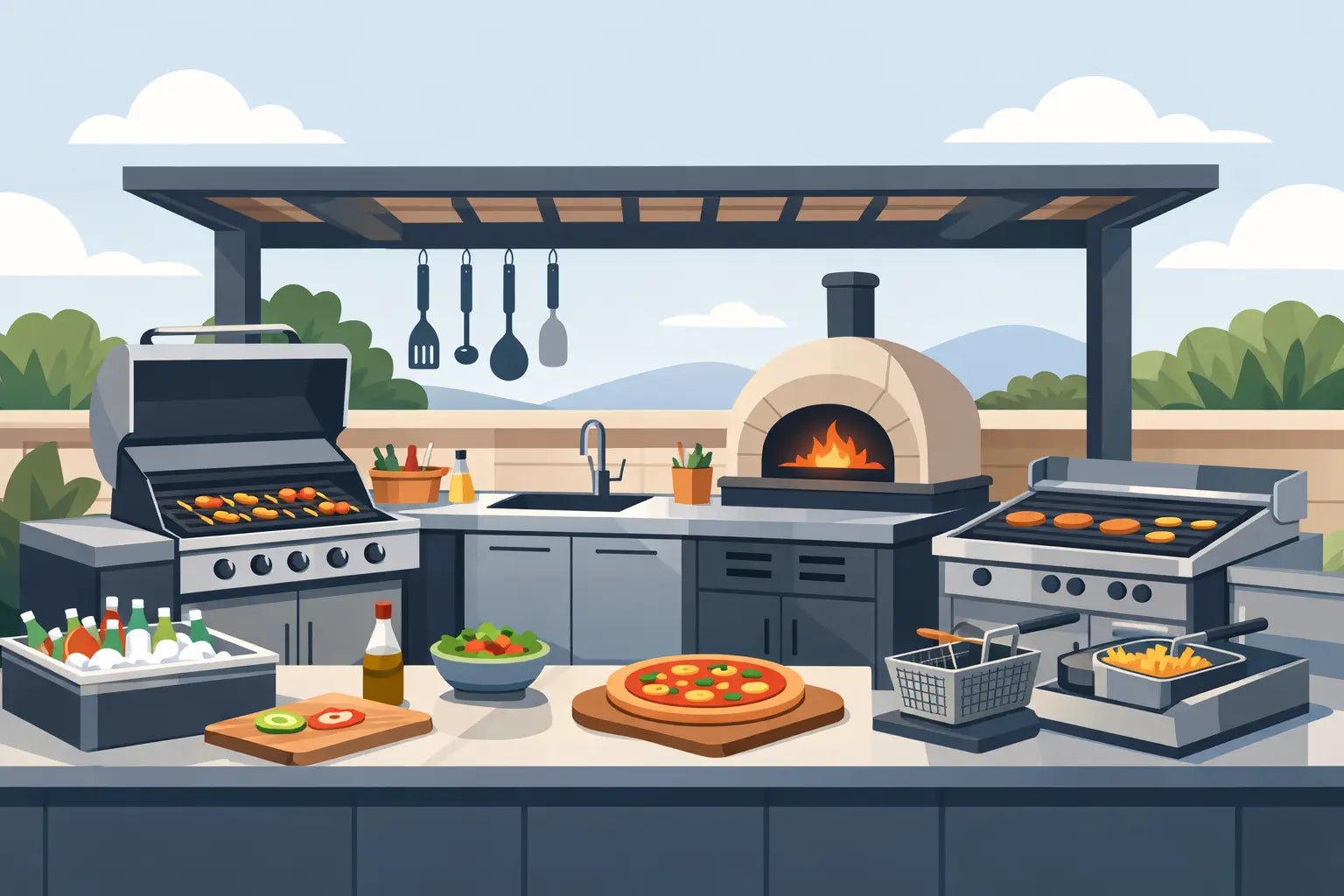
A grill is often the center of an outdoor kitchen, but the right type depends on the menu. Gas grills provide fast ignition, controlled heat, and repeatable performance for proteins, vegetables, and high-volume service. Charbroilers deliver stronger flame contact and distinct sear marks, making them a natural fit for burgers, steaks, chops, and fire-forward menus.
A flat-top griddle brings another level of versatility. It handles breakfast service, smash burgers, tacos, seafood, vegetables, and delicate items that would fall through grill grates. Operators who need menu flexibility may benefit from combining a grill or charbroiler with a griddle rather than oversizing one cooking surface.
Fuel choice matters. Natural gas is practical for permanent installations with access to a gas line. Propane offers placement flexibility but requires a reliable tank-change process during busy service. Charcoal and wood create distinctive flavor, yet they demand more labor, ash management, ventilation planning, and fire-safety discipline.
Outdoor Pizza Ovens
Pizza ovens can turn an underused patio into a high-value production area. Their high heat supports crisp crusts and fast bake times, but performance depends on more than maximum temperature. Consider deck size, heat recovery, fuel source, insulation, door design, and how easily staff can manage multiple pies without crowding the station.
Wood-fired ovens bring visual appeal and a traditional flavor profile. Gas-fired models generally provide simpler temperature control and faster training for teams that need repeatability. Hybrid options can suit operations that want gas convenience with occasional wood-fired character. The trade-off is usually added complexity, so choose the fuel system your staff can run confidently every day.
Refrigeration and Cold Ingredient Storage
Outdoor refrigeration protects food quality and reduces unnecessary trips inside. Undercounter refrigerators, refrigerated prep tables, and insulated cold-storage solutions keep proteins, toppings, garnishes, sauces, and beverages close to the point of use.
This category is not a place to compromise. Outdoor conditions place extra strain on refrigeration equipment, especially in direct sun and high ambient temperatures. Select units rated for the intended environment, allow room for airflow around the condenser, and verify that the equipment can hold safe temperatures during peak demand. A refrigerator that cannot recover quickly after frequent door openings can create both service delays and food-safety risk.
Plan ingredient storage in the order cooks use it. For example, a pizza station should keep dough, sauce, cheese, toppings, peels, and landing space within a short, logical reach. A grill line should position raw proteins separately from ready-to-serve garnishes and cooked-food holding areas.
Prep Counters, Sinks, and Storage
Stainless steel prep surfaces are essential for speed, sanitation, and durability. Choose worktables or built-in counters with enough uninterrupted space to portion food, assemble plates, rest cooked proteins, or stage pizza dough. Small counters create clutter quickly, especially when utensils, pans, sauces, and ticket rails compete for room.
A dedicated sink supports handwashing, produce rinsing, utensil cleaning, and sanitation procedures. Local health codes may determine the number and type of sinks required for commercial installations, so confirm those requirements before finalizing a layout. Do not treat water access as an afterthought. It affects hygiene, cleanup speed, and how independently the outdoor kitchen can operate.
Closed cabinets and weather-resistant storage protect smallwares, cleaning supplies, fuel accessories, and dry goods. Open shelving may be convenient, but it can expose equipment to dust, insects, rain, and temperature swings. Use open storage only for items that are cleaned and rotated constantly.
Equipment That Supports Faster, Safer Service
The highest-performing outdoor kitchens do not rely on cooking equipment alone. Supporting equipment keeps the line organized when volume rises.
Food warmers and heated holding cabinets are valuable when service includes batches of cooked proteins, sides, buns, or plated components that must remain at safe temperatures without drying out. They are especially useful for catering, outdoor events, and fast-casual concepts where production happens in cycles.
Ice makers, beverage coolers, and bar refrigeration can be equally important in hospitality settings. A busy outdoor bar should not depend on staff walking indoors for every bottle, garnish, or scoop of ice. Keeping beverage production separate from the hot line also reduces congestion.
For operations with substantial outdoor service, consider dishwashing and waste flow early. Dirty pans, utensils, and serviceware need a defined return path that does not cross raw food prep or guest traffic. Some kitchens can send warewashing indoors, while others need a more self-contained outdoor solution. The correct approach depends on local regulations, service volume, plumbing access, and labor availability.
Build for Weather, Utilities, and Local Code
Commercial-grade equipment is only as dependable as its installation. Outdoor kitchens must account for rain, wind, salt air, freezing temperatures, direct sun, and drainage. Use weather-rated equipment where required, protect electrical connections, and specify corrosion-resistant materials for exposed environments.
Ventilation and fire protection deserve careful attention. Open-air cooking can still produce smoke, grease vapor, and heat that affect guests, staff, adjacent structures, and local compliance. A covered patio may require ventilation systems, fire suppression, clearances, or other safeguards that an uncovered cooking area does not. Work with qualified local professionals on gas, electric, plumbing, ventilation, and permitting decisions.
Power requirements should be mapped before equipment arrives. Refrigeration, lighting, ovens, warmers, and specialty appliances may require dedicated circuits or higher-voltage service. A late utility upgrade is expensive and disruptive. The same principle applies to gas lines, water supply, drains, and floor slope.
Choose Durability Over Feature Overload
Outdoor equipment should earn its footprint. A built-in side burner, rotisserie, smoker box, or specialty appliance can be useful, but only if it supports real menu demand. Feature-heavy equipment that is difficult to clean or rarely used can slow staff down and consume valuable prep space.
Prioritize durable construction, accessible service components, easy cleaning, reliable temperature control, and sufficient capacity. Stainless steel grades, insulated doors, heavy-duty grates, quality burners, and solid hinges may seem like small specifications, but they influence how equipment performs after hundreds of service hours.
For commercial buyers, standardizing equipment across locations can simplify training, maintenance, and replacement parts. For home cooks, selecting fewer but better tools often produces a cleaner layout and stronger results than filling every cabinet with accessories.
A Smarter Buying Sequence
Purchase decisions are easier when made in the right order. Begin with the layout and utility plan, then select primary cooking equipment, refrigeration, prep surfaces, sanitation components, and finally accessories. This sequence prevents common problems, such as buying a large grill that leaves no landing space or installing refrigeration without adequate ventilation clearance.
Measure all access points as well as the final installation area. Confirm equipment dimensions, utility connections, clearance requirements, and whether the unit can be moved safely into place. For commercial operations, verify local code approval before making permanent construction decisions.
Culinary Precisions helps buyers evaluate professional-grade equipment with the performance standards that serious outdoor cooking demands. The goal is not to add more appliances. It is to create a station where every piece of equipment improves execution.
A capable outdoor kitchen should make the next busy service feel more controlled, not more complicated. Choose equipment that keeps food moving safely, gives cooks room to work precisely, and supports the kind of results guests remember long after the last plate leaves the pass.