Blast Chiller Food Safety Benefits That Matter
A stockpot of braise, a pan of roasted chicken, or a fresh batch of pastry cream can carry more risk after service than during the cook. The blast chiller food safety benefits begin in that vulnerable stretch between hot production and cold storage, when food needs to move through the temperature danger zone quickly, predictably, and with records a kitchen can stand behind.
For restaurants, caterers, hotels, commissaries, and ambitious culinary spaces, a blast chiller is not simply a faster refrigerator. It is a controlled cooling tool that protects the work already invested in ingredients, labor, and flavor. Used well, it gives chefs more command over timing while helping operators build a cleaner, more disciplined cold-food workflow.
Why Cooling Speed Changes the Safety Equation
Food held too long between 135°F and 41°F can support rapid bacterial growth. In commercial foodservice, the standard cooling benchmark is to reduce cooked food from 135°F to 70°F within two hours, then from 70°F to 41°F or below within the next four hours. The exact requirements for an operation should always be confirmed with its local health authority, but the principle is constant: cooling is a time-sensitive process, not a passive storage task.
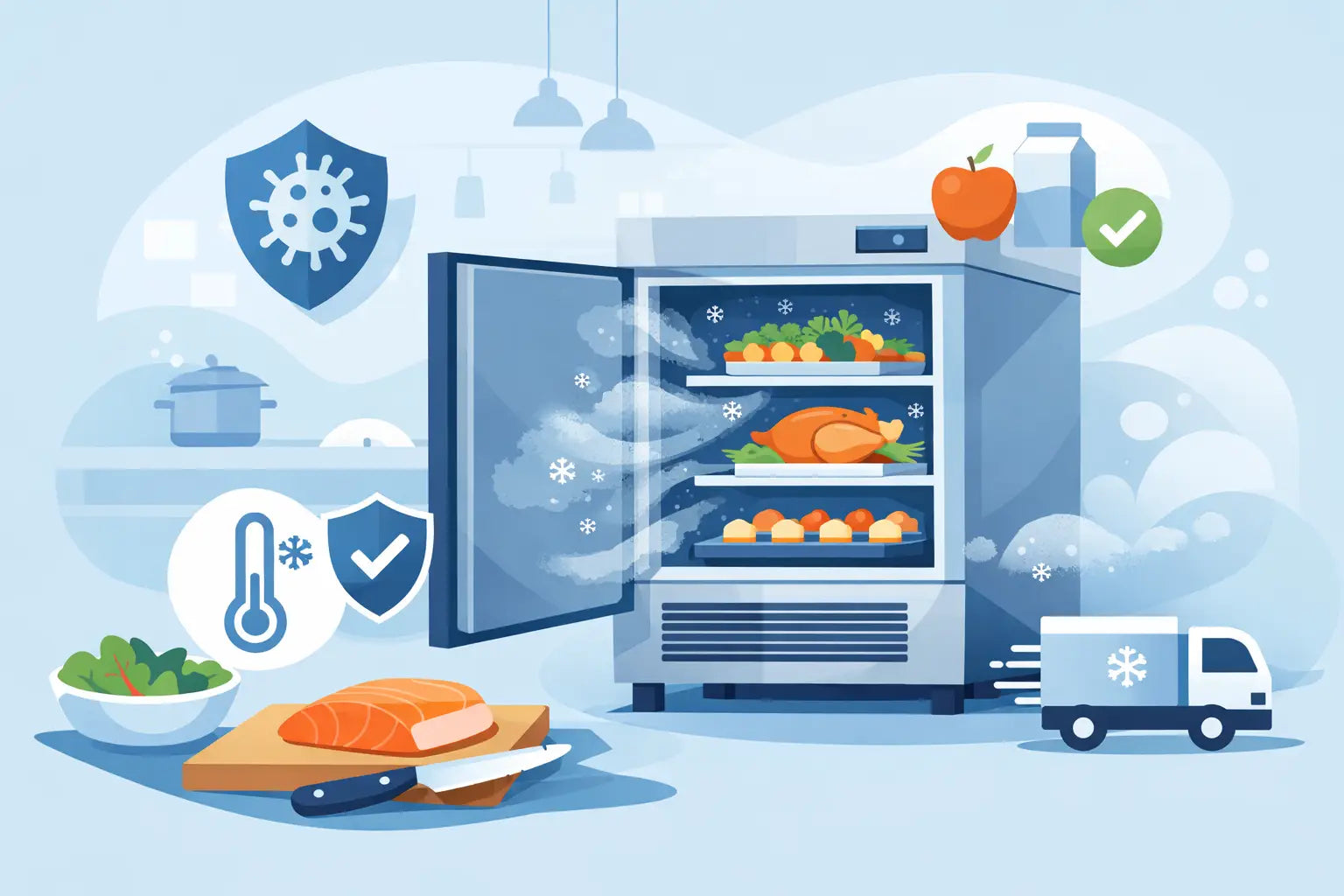
A standard reach-in refrigerator is designed to hold cold food cold. It is not built to absorb the heat load of several deep hotel pans of soup, rice, protein, or sauce without affecting its cabinet temperature and the foods around them. A blast chiller uses high-velocity, cold airflow to pull heat from product rapidly. That shorter cooling window is the central food-safety advantage.
It also protects the rest of the walk-in or reach-in inventory. When hot pans enter ordinary refrigeration, they can raise ambient temperatures around dairy, prepared salads, raw proteins, and other perishables. Separating rapid cooling from long-term holding helps preserve the intended conditions of both pieces of equipment.
Blast Chiller Food Safety Benefits in Daily Service
The most practical value of a blast chiller appears in the rhythm of prep. Instead of waiting for a batch to cool on a rack, dividing it repeatedly, or leaving a team member to monitor ice baths late into the evening, operators can move finished food into a defined cooling cycle. The process becomes more repeatable across shifts and less dependent on memory.
Better control over high-risk foods
Dense, moist foods are often the hardest to cool safely: stocks, soups, sauces, beans, cooked grains, pasta, braised meats, and filled preparations. Their center temperatures can remain warm long after the surface feels cool. Blast chilling creates stronger airflow around the pan and, when paired with a properly placed probe, gives the kitchen a clearer view of the product core rather than a guess based on cabinet air temperature.
That visibility matters for potentially hazardous foods, especially when a menu relies on batch cooking. A chef can produce a large quantity during a quieter prep period, chill it correctly, store it covered and labeled, then reheat portions for service with less pressure on the line.
More reliable HACCP documentation
Food safety systems work best when they can be repeated, measured, and taught. Many commercial blast chillers offer programmable cycles, core probes, alarms, and downloadable or printable data. These features can support HACCP logs by recording the cooling path rather than leaving staff to write down a single final temperature.
Records are not a substitute for sound procedures, but they make those procedures easier to verify. If a cooling cycle is interrupted, a probe is misplaced, or a cabinet is overloaded, the team has a reason to investigate before the product moves into storage. That is a meaningful shift from reaction to control.
Less handling, fewer opportunities for error
Traditional cooling methods often require extra movement: portioning hot food into shallow pans, stirring in an ice bath, transferring containers, and making room in shared refrigeration. Some of those techniques remain useful, particularly in compact kitchens, but every handoff creates another chance for contamination, poor labeling, or missed timing.
A blast chiller can reduce those touchpoints. Food may still need to be portioned appropriately for its depth and density, but the cooling environment is purpose-built and easier to standardize. This is especially valuable in operations with frequent staff turnover, multiple prep cooks, or production spread across long service days.
Safer cook-chill production
Cook-chill systems give operators a way to prepare food at its peak, cool it safely, and hold it under refrigerated conditions for later finishing or reheating. The model can bring consistency to catering kitchens, banquet operations, meal-prep programs, institutional foodservice, and restaurants with strong demand swings.
The safety benefit is tied to discipline. Products need clear date labels, defined shelf-life policies, protected storage, and correct reheating procedures. A blast chiller strengthens the first critical stage of that chain: bringing food down to safe holding temperatures without sacrificing the control needed for later service.
Quality Supports Safety, Too
Food safety and food quality are often discussed as separate concerns, but rapid chilling can support both. Faster cooling helps preserve texture in delicate proteins, vegetables, custards, and composed dishes. It can also reduce surface drying and help retain the clean, fresh character of sauces and stocks.
That quality protection makes compliance easier to sustain. When rapidly chilled food reheats well and performs consistently, teams are more likely to follow the process. When cooled food emerges dull, dry, or broken, staff may be tempted to improvise. The best systems make the safe route the preferable culinary route.
For pastry and dessert programs, the effect can be particularly useful. Creams, mousse bases, fruit preparations, and baked components benefit from prompt temperature control, while pre-chilled items can be moved into finishing, holding, or display with greater confidence. The result is not merely a colder product. It is a more stable one.
A Blast Chiller Is Not a Substitute for Good Process
A blast chiller is powerful, but it cannot correct every cooling mistake. Overloading the cabinet blocks airflow and can slow the cycle. Packing food in overly deep containers may leave the center warm even when the exterior has cooled. Warm product should be arranged with space between pans, and the manufacturer’s loading guidance should be treated as an operating limit, not a suggestion.
Probe placement deserves the same care. The probe should measure the thickest or warmest part of the product without touching the pan, bone, or another item that can distort the reading. Staff also need calibration checks, cleaning routines, and a clear response plan for an incomplete cycle.
There is a practical distinction between chilling and freezing as well. A blast chiller is designed to bring cooked food quickly into refrigerated temperatures. Some units also offer blast-freeze capability, which can be valuable for longer storage, portion control, and production planning. The right choice depends on the menu, volume, storage strategy, and whether the operation needs both functions.
Selecting Capacity for the Work You Actually Do
The best blast chiller is sized around peak production, not average traffic. A small chef-driven restaurant may need a compact unit for nightly sauces, proteins, and pastry work. A catering operation may need a larger roll-in or multi-pan model that can manage the output of a full prep crew. Buying too small can create a queue at the end of the shift, while buying too large can consume valuable floor space and electrical capacity without improving the workflow.
Consider the pans and vessels already used in the kitchen, the number of batches cooled during the busiest period, and the distance from hot production to cold storage. Door swing, ventilation clearance, electrical requirements, condensate management, and floor access all affect whether the equipment feels integrated or disruptive after installation.
At Culinary Precisions, equipment selection starts with that operational picture. A blast chiller should fit the cadence of the kitchen: the volume of the prep list, the shape of the pans, the service schedule, and the standard the team wants to maintain when the dining room is full.
Build the Cooling Step Into the Kitchen’s Rhythm
The strongest food-safety program does not depend on a heroic closing shift. It gives every batch a clear path: cook, portion when needed, chill, verify, label, store, and reheat according to the operation’s procedure. A blast chiller gives that path structure, speed, and a measure of calm.
For a kitchen built around precision, that is the real advantage. The food leaves the heat with its flavor intact, enters cold storage under control, and returns to the guest with the same intention that shaped it at the stove.