How to Choose a Commercial Dishwasher for Service
The dish pit is where a calm service can either hold its rhythm or come apart. Plates stack, glassware returns, pans arrive hot from the line, and every item needs to come back clean before the next turn. Knowing how to choose a commercial dishwasher starts with that real service pattern, not simply the machine's price tag or rack-per-hour rating.
A well-chosen dishwasher protects sanitation, reduces labor pressure, and keeps the pass supplied with clean wares when the dining room is full. The right format depends on what you serve, how quickly it moves, the space behind your kitchen, and the water, power, and ventilation already available.
Start With Your Peak, Not Your Average
A quiet weekday afternoon rarely reveals what a dishwasher must do. Build your decision around the sharpest 60 to 90 minutes of service: Saturday dinner, a catered event pickup, hotel breakfast, or the last rush at a busy coffee bar. Count the racks, trays, pans, and glassware that return during that period, then allow room for the unexpected.
Manufacturers list capacity in racks per hour, but that number is only useful when you translate it into your actual ware. A rack of dinner plates is different from a rack of stemware, and a machine running repeated cycles for baked-on hotel pans will not produce the same output as one washing lightly soiled cups. Consider cycle length, loading time, unloading time, and the distance staff travel to reach clean storage.
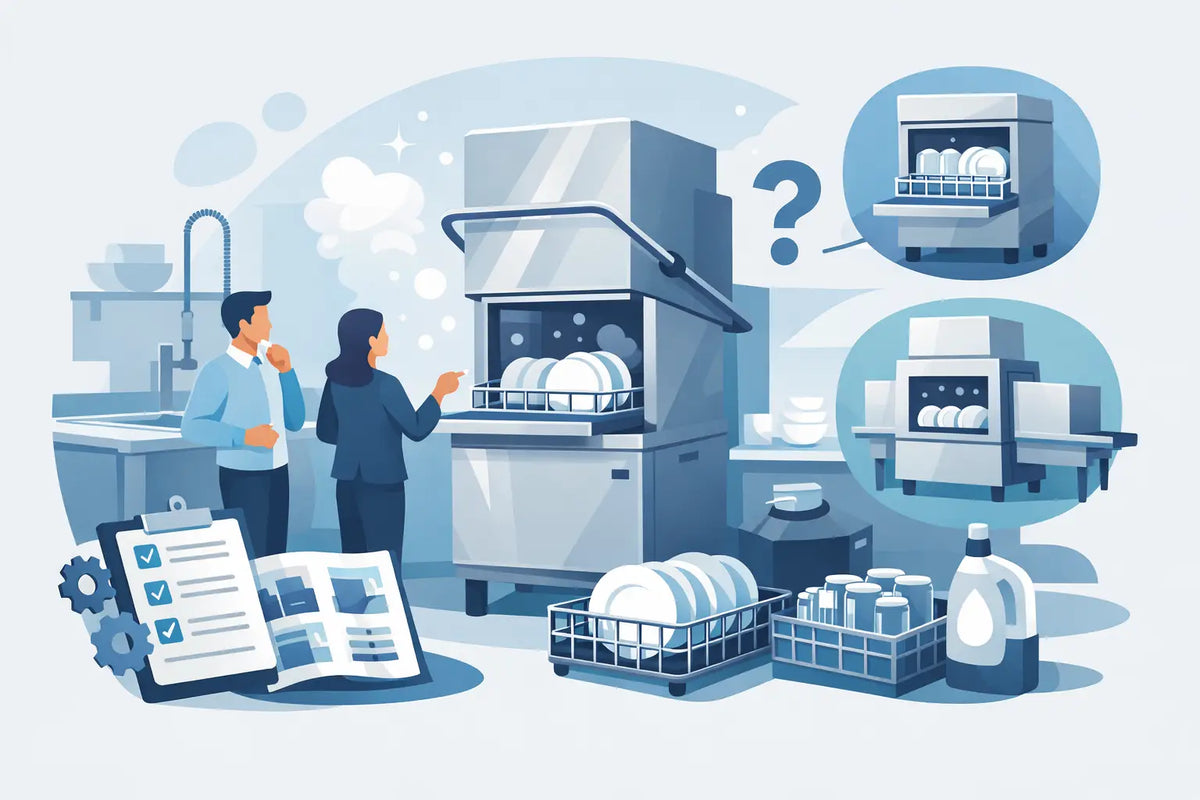
For a small café, wine bar, or satellite prep kitchen, an undercounter dishwasher may be the right scale. It preserves floor space and keeps a compact operation moving. For most full-service restaurants, a door-type machine offers a more practical balance of footprint and volume. High-volume cafeterias, hotels, commissaries, and institutional kitchens often need a conveyor or flight-type system designed for a continuous flow of racks.
Capacity should create breathing room. A dishwasher that technically meets demand but runs without pause leaves no margin for a sudden banquet order, a staffing gap, or a busy holiday service.
Choose the Machine Format Around the Ware
The best dishwasher is shaped by the objects passing through it. Start by separating your regular wash load into categories: plates and bowls, glassware, flatware, sheet pans, cookware, food pans, utensils, and specialty pieces. Then identify what creates the bottleneck.
Undercounter machines suit operations with smaller, steady loads and limited back-of-house real estate. They can sit beneath a counter and are often a refined fit for bars, espresso programs, tasting rooms, and compact kitchens. Their limitation is throughput. If staff must wait for clean plates during a rush, the space savings quickly loses its value.
Door-type dishwashers, also called upright or pass-through machines, are the workhorses of many restaurant dish rooms. A single rack is loaded at a landing table, washed, then moved to a clean-side table. This format gives staff a clear, repeatable rhythm and handles higher volume without the cost and footprint of a conveyor system.
Conveyor machines are built for accumulation. Racks move through wash and rinse zones with much less interruption, making them appropriate where dish volume is sustained rather than occasional. They require thoughtful dish-room design, adequate landing space, and enough labor to sort, rack, feed, and put away wares. Buying a conveyor for a kitchen with short bursts and low overall volume can mean paying for capacity that sits idle.
Do not overlook glasswashers. A dedicated glasswasher can protect a bar program from water spots, chipped rims, and the constant collision between glassware and kitchen plates. In a cocktail-forward operation, clean, brilliant glass is part of the guest experience.
High-Temperature or Low-Temperature Sanitizing?
This choice affects sanitation method, operating costs, ventilation, and the conditions inside the dish room.
High-temperature machines sanitize with a final rinse of very hot water. They generally use less chemical sanitizer and can leave wares dry faster because residual heat evaporates moisture. This makes them particularly appealing for plateware, flatware, and many high-turn restaurant applications. The trade-off is higher utility demand, more heat in the room, and possible need for a booster heater to bring final-rinse water to the required temperature.
Low-temperature machines use chemical sanitizer at a lower water temperature. They may have lower energy requirements and can be easier to place in locations where a high-temp installation is impractical. However, they require consistent chemical management, and wares may need more time to air-dry. They are often a sensible choice for glassware or operations where utility limitations drive the decision.
Local health codes matter here. Confirm the required sanitation method, final-rinse temperatures, chemical concentration procedures, and any testing or recordkeeping expected by your authority having jurisdiction. A dishwasher is not a standalone purchase. It is part of a food safety system.
Confirm Utilities Before You Fall for a Specification Sheet
A beautiful machine that does not match the building is an expensive delay. Before selecting a model, document the electrical supply, water line size, incoming water temperature, water pressure, drainage arrangement, floor drains, ceiling height, and available ventilation.
Commercial dishwashers may require 115V, 208V, 240V, or 480V service, with single-phase or three-phase power depending on the model. Verify this with a qualified installer rather than relying on assumptions from another piece of equipment. Electrical conversion, panel upgrades, and long wire runs can change the real project cost quickly.
Water quality deserves equal attention. Hard water leaves mineral scale on heating elements and glassware, undermining both appearance and machine life. A water softener, filtration system, or reverse-osmosis solution may be warranted, especially for high-temp systems and polished glass service. Incoming water temperature also affects recovery time and whether a booster heater is necessary.
Measure the route from the receiving area to the final installation point. Doorways, turns, stairs, counters, and low ceilings can defeat an otherwise appropriate machine. Include the space required for doors to open, racks to travel, and technicians to access service panels.
Design the Dish Room as a Working Sequence
A dishwasher performs best when the room around it has a clear dirty-to-clean progression. Dirty wares should enter at one side, move through scraping and pre-rinsing, load into racks, pass through the machine, and emerge onto a clean landing area. Clean items should never cross paths with soiled wares.
For a door-type machine, allow room for a dirty landing table, a pre-rinse station, the machine itself, and a clean landing table. Consider where racks will be stored and where staff will sort flatware. A few additional feet of stainless work surface can remove hundreds of unnecessary steps across a week.
Pre-rinsing is especially important when food soils are heavy or irregular. Choose a pre-rinse setup that matches your water-saving goals and local plumbing requirements. Train staff to scrape thoroughly before racking. Dish machines are designed to wash wares, not process scraps that should have been removed at the start.
Noise, steam, and heat belong in the plan as well. A high-output dish room can affect adjacent prep areas, employee comfort, and air balance throughout the kitchen. Condensate hoods and heat-recovery options may be worthwhile when volume is substantial or ventilation capacity is limited.
Look Beyond Purchase Price
The lower-priced machine is not always the lower-cost choice. Compare water consumption per rack, energy use, chemical use, cycle speed, expected maintenance, warranty terms, and the availability of service support in your market. A machine that saves a small amount of water on every rack can become meaningful over years of daily service.
Ease of use has a direct labor value. Clear controls, simple daily cleaning, accessible filters, automatic fill and drain functions, and dependable error diagnostics help staff maintain consistent results. If the machine is difficult to clean at closing, it will eventually be cleaned poorly. That is when odors, scale, wash-quality issues, and unnecessary service calls begin.
Ask what is included with the machine. Booster heaters, drain pumps, detergent dispensers, rinse-aid pumps, stands, tables, racks, and water treatment may be separate components. These are not minor details. They determine whether the machine arrives as one part of a complete dishwashing station or as the beginning of several additional purchases.
A Practical Way to Choose a Commercial Dishwasher
When deciding how to choose a commercial dishwasher, set your priorities in this order: service peak, ware mix, sanitation requirements, utility compatibility, physical workflow, and lifetime operating cost. This sequence prevents a common mistake: selecting capacity first and discovering too late that the machine does not fit the room or the building.
For a new build, bring the dishwasher decision into the kitchen layout early, alongside refrigeration, cooking equipment, and ventilation. For a replacement, use the existing operation as evidence. Notice where racks pile up, where employees wait, what comes out spotted, and what part of closing takes too long. Those details point to the features that will genuinely improve the next machine.
A commercial dishwasher is quiet infrastructure, but its effect is visible in every clean coupe, polished fork, and plate returning to the pass on time. Choose the machine that gives your team a dependable rhythm, then give it the water, space, and care it needs to hold that rhythm through every service.