Conveyor Oven Versus Deck Oven: Which Fits?
The first Friday night after a new pizza oven arrives can define a concept. Tickets stack, dough lands on the make line, and every pie has to leave the kitchen with the same color, structure, and flavor. The conveyor oven versus deck oven decision is not simply about how pizza cooks. It shapes the rhythm of service, the skill required on the line, the footprint of the kitchen, and the kind of crust guests associate with your name.
Both oven styles earn a place in serious foodservice kitchens. A conveyor oven brings controlled repetition and impressive throughput. A deck oven offers direct, radiant heat and a more hands-on relationship with the bake. The right choice depends on the menu, projected volume, labor model, available utilities, and how much variation your operation is prepared to manage during a rush.
Conveyor Oven Versus Deck Oven: The Core Difference
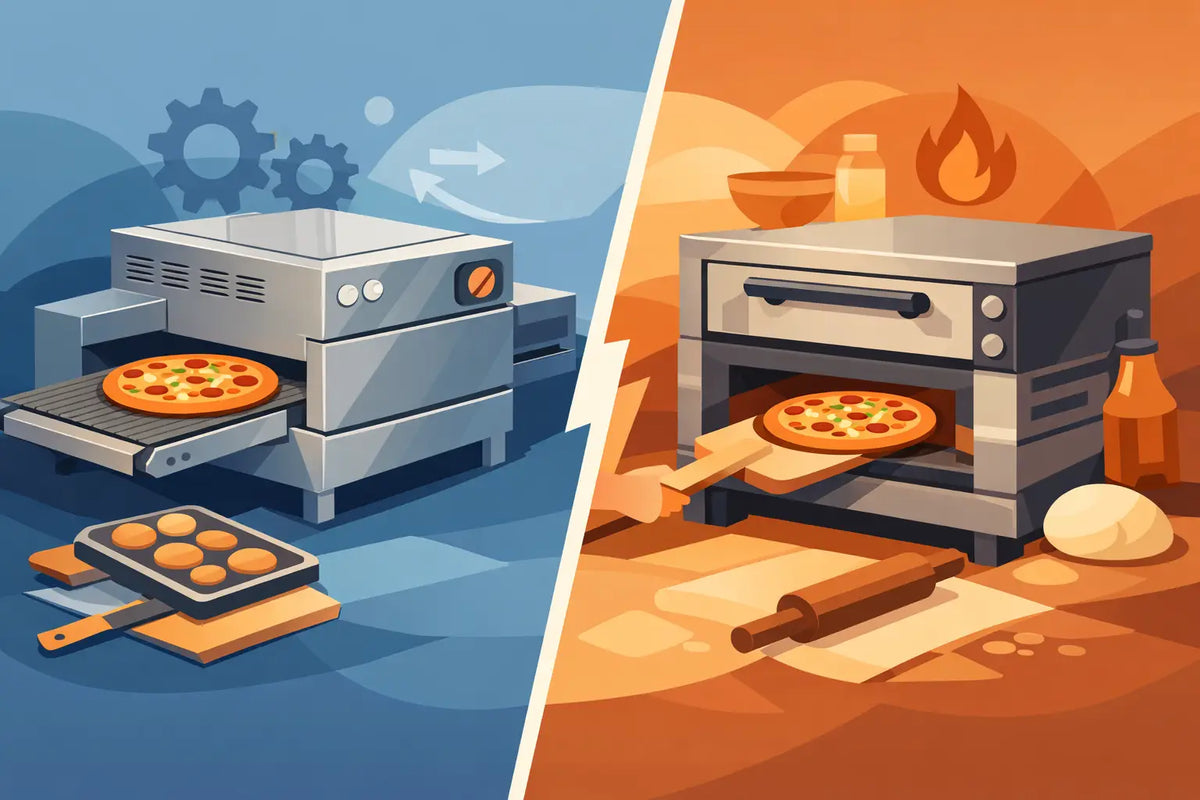
A conveyor oven moves food through a heated chamber on a continuously traveling belt. Operators set the belt speed and chamber temperature, then feed products into one end and receive finished food at the other. Air impingement models direct high-velocity hot air onto the product, allowing relatively fast cook times with dependable results.
A deck oven cooks food on a stationary hearth or deck, often stone, ceramic, or composite. Pizzas are loaded individually and the baker controls their position, timing, and rotation. The deck stores and delivers heat through the bottom of the crust while radiant heat develops the top. This creates a bake with more tactile involvement and, in capable hands, a distinct sense of depth.
Neither system is automatically superior. They are built around different operating philosophies. One prioritizes a measured, continuous flow. The other gives the cook more authority over every pie.
Choose a Conveyor Oven When Consistency Drives the Line
For high-volume operations, the conveyor oven can be an exceptionally disciplined piece of equipment. Once recipes, dough thickness, cheese coverage, temperature, and belt speed are dialed in, a trained team can produce a steady run of pizzas with minimal variation. That repeatability matters when a busy counter, delivery operation, stadium concession, campus kitchen, or hotel outlet must serve many guests in a narrow window.
The labor advantage is significant. A conveyor system reduces the need for a dedicated pizzaiolo constantly watching the bake. Team members can load, unload, cut, and box in a predictable sequence. That can shorten training time and make service less dependent on one highly experienced operator. It also supports menus beyond pizza, including toasted sandwiches, flatbreads, wings, baked appetizers, and certain desserts, provided each item is tested for the oven’s airflow and travel time.
Conveyor ovens are especially valuable for operators who need to protect consistency across shifts or multiple locations. A well-documented setup gives the opening cook and closing cook the same baseline. That is useful for growing brands, franchise-minded concepts, and kitchens where staff turnover is part of the operating reality.
There are trade-offs. The intense airflow that makes impingement ovens fast can affect delicate toppings or lighter cheeses. Product placement must be intentional, particularly with loose garnishes. Conveyor ovens also tend to occupy a long, linear footprint. Before selecting one, map the room needed for loading, unloading, landing pans, boxing, and safe staff movement around the belt.
What a conveyor oven does best
A conveyor oven is at its strongest when the menu calls for a consistent, repeatable bake and the business needs volume without a large increase in skilled labor. It is often the practical answer for fast-casual pizza, delivery-forward concepts, institutional foodservice, and operations where speed at peak periods matters as much as crust nuance.
Choose a Deck Oven When the Crust Is the Signature
A deck oven invites a different kind of cooking. Its heated deck pulls moisture from the dough and gives the crust a firmer, more developed base. Radiant heat from above helps brown the cheese and toppings with a character that many operators want for New York-style pizza, artisan flatbreads, rustic breads, and other dough-centered menus.
The appeal is not only visual. Deck baking gives the operator room to respond to the dough. A pie can be shifted to a hotter area, rotated for even color, or held for a moment longer to finish a topping. That control is valuable when dough changes with fermentation time, humidity, flour performance, or seasonal conditions. For a chef who sees the oven as part of the craft, a deck oven provides a more direct conversation with heat.
Deck ovens also make good use of vertical space. A stacked configuration can produce substantial capacity without extending deep into the room. This can suit a narrow pizzeria line or a kitchen where the oven must sit close to the make station. Still, the surrounding workflow matters. Staff need space to launch pizzas, turn them safely, retrieve hot pans or pies, and stage finished orders without interrupting the cook.
The cost of that control is labor and attention. Deck ovens require a team member who understands loading patterns, hot spots, recovery time, and the visual cues of a finished pizza. During a sustained rush, an undertrained operator can create inconsistent bakes, bottlenecks, or avoidable waste. The oven does not automate judgment. It rewards it.
What a deck oven does best
A deck oven is a strong fit when the menu is built around crust texture, hand-finished presentation, and a more expressive bake. It suits independent pizzerias, chef-led restaurants, bakery programs, and hospitality concepts where guests can see or sense the care behind the product.
Capacity Is More Than Pizzas Per Hour
Published production numbers are helpful, but they do not tell the entire story. Conveyor capacity depends on belt width, chamber configuration, belt speed, product size, and how efficiently the team feeds and clears the oven. A wide belt can move an impressive number of pizzas, but only if the make line and finishing station can keep pace.
Deck capacity depends on deck dimensions, the number of chambers, bake time, and the skill of the person managing the oven. A large deck may hold several pizzas at once, yet capacity drops if every pie needs frequent turning or if the deck has not recovered sufficiently between busy periods. The real question is not, "How many pizzas can this oven theoretically produce?" It is, "How many properly finished orders can our kitchen produce between 6:30 and 8:00 p.m.?"
Build that answer around the full service path. Consider dough production, cold storage, topping access, the make line, oven loading, cutting, boxing, and handoff. An oven should strengthen that sequence, not become the most elegant bottleneck in the room.
Heat, Utilities, and Installation Need Early Attention
Both oven types are available in gas and electric configurations, but the details vary by model. Confirm the required voltage, phase, amperage, gas connection, clearance requirements, ventilation needs, and local code requirements before placing an order. These practical dimensions are as consequential as the cooking chamber itself.
Electric conveyor ovens can be attractive where gas is unavailable or where precise digital settings are preferred. Gas units may offer favorable operating costs in some markets, though utility rates and local installation conditions determine the real equation. Deck ovens also vary widely in heat retention, recovery, insulation, and control systems, so comparing only the purchase price can be misleading.
Ventilation deserves special attention. Some equipment may qualify for ventless use in certain applications, while others require a hood system. Approval depends on the specific oven, the food being cooked, local authorities, and fire-safety requirements. Treat ventilation planning as an early design decision, not a final detail after the kitchen layout is set.
Match the Oven to Your Menu and Service Style
A focused delivery pizza concept may benefit from the conveyor’s pace and repeatability. A neighborhood pizzeria with a visible open kitchen may find that a deck oven better supports its identity and crust program. A bar serving flatbreads late into the evening may value an oven that is simple for a small team to operate. A chef-driven restaurant may accept slower, more hands-on baking because the final product carries a higher check average and a more distinctive story.
Consider how much your menu asks of the oven. If pizzas share space with sandwiches, wings, and appetizers, test each item rather than assuming one setting will suit everything. If pizza is the centerpiece, evaluate your dough formula with the oven type you are considering. Hydration, sugar content, proofing, screen or pan use, and topping load all influence the result.
A thoughtful equipment selection process begins with the food, then works backward through volume, labor, utilities, and layout. The oven should feel like a natural extension of the way your team cooks, not a constraint they must work around.
The best choice is the one that gives your kitchen a confident rhythm: enough speed for the rush, enough control for the product, and enough durability to keep the heat steady long after the first service ends.