Convection Oven Versus Conventional Oven Compared
At 6:40 p.m., a busy kitchen does not need a debate about oven technology. It needs chicken that finishes evenly, sheet pans that brown consistently, and a workflow that keeps tickets moving. The convection oven versus conventional oven decision directly affects all three. Both can produce excellent food, but they move heat differently, which changes cooking times, pan placement, product quality, and daily production capacity.
For restaurant operators, chefs, and serious home cooks, the right choice is less about which oven is universally better. It is about matching the equipment to the menu, volume, available space, and level of precision your operation demands.
How a Convection Oven Versus Conventional Oven Works
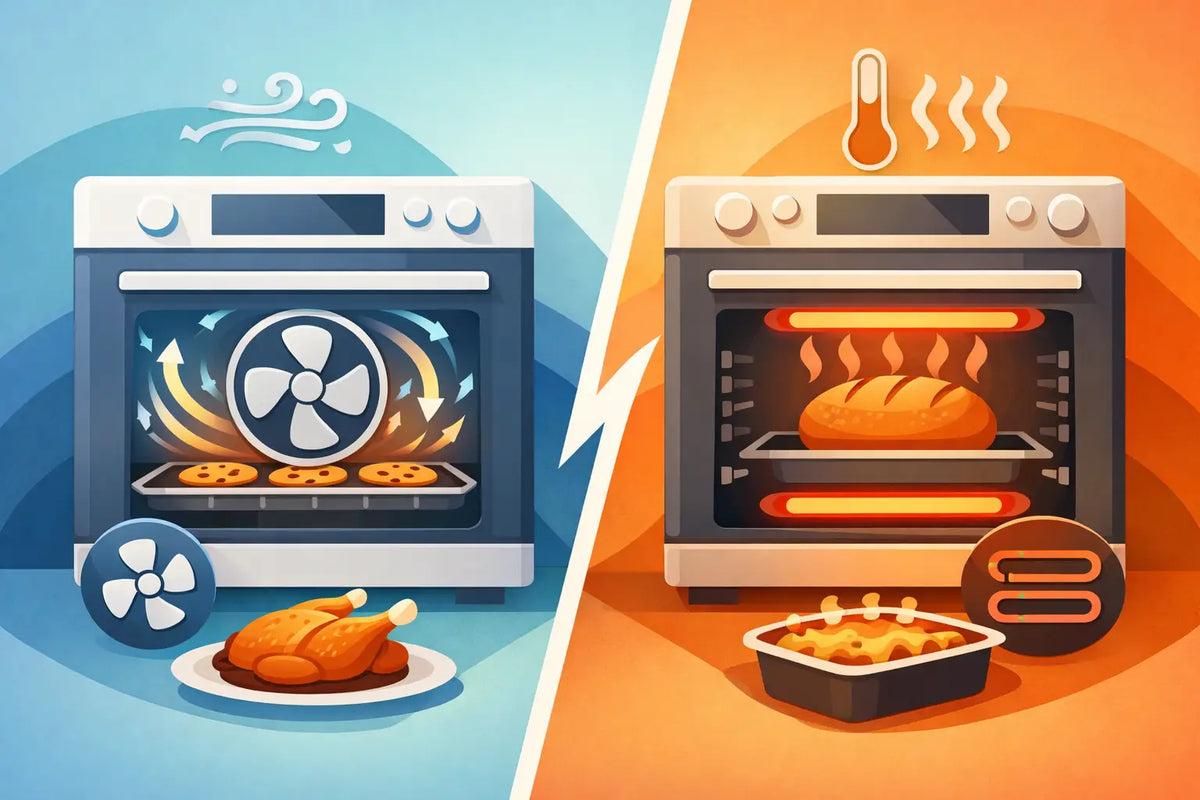
A conventional oven uses stationary heat generated by gas or electric elements. Heat rises and settles in natural patterns inside the cavity, creating areas that may run hotter or cooler. Many cooks know this as the reason a pan of cookies may brown more deeply on one side, or why rotating pans halfway through baking is part of the routine.
A convection oven adds a fan, and often an exhaust system, to circulate hot air around the food. That moving air transfers heat more efficiently. In practical terms, food typically cooks faster, browns more evenly, and develops a more consistent exterior across multiple racks.
What the fan changes
The fan does more than speed up the clock. It continuously replaces the thin layer of cooler air that surrounds food with hotter air. This improves heat transfer, especially around the edges and surfaces of a product. Roasted vegetables caramelize with greater consistency, chicken skin can crisp more effectively, and multiple sheet pans have a better chance of cooking at the same rate.
That performance comes with a trade-off. Moving air can dry delicate foods faster. Custards, souffles, cheesecake, and certain cakes may set unevenly, form a skin, or lose moisture when exposed to aggressive airflow. A convection setting is a powerful tool, but it is not always the preferred setting.
Why conventional heat still earns its place
Conventional ovens deliver gentler, more stable heat without active air movement. That makes them well suited to items that need a soft rise, delicate structure, or gradual setting process. Baked custards, airy sponge cakes, quick breads, and covered braises often benefit from this calmer environment.
Conventional cooking also offers a familiar baseline. Many recipes, especially consumer recipes, are written for a conventional oven. Teams can follow those directions without immediately adjusting temperature or cook time, although oven calibration and pan material still affect the final result.
Speed, Capacity, and Consistency in Daily Production
In a high-output kitchen, convection usually holds the advantage. Faster heat transfer can reduce cook times and allow operators to load more pans at once. A commercial convection oven with proper rack spacing can help a kitchen roast proteins, bake potatoes, finish casseroles, and reheat prepared foods with fewer bottlenecks.
The capacity benefit is not simply about fitting more pans inside the cavity. It is about using each rack productively. Because circulated air reaches food on several levels, a well-designed convection oven can produce more even results than a conventional oven loaded with the same number of pans. That improves consistency during peak service and reduces the need for constant pan rotation.
Still, capacity depends on airflow. Overloading a convection oven blocks circulation and undermines the performance you paid for. Pans should have room around them, and deep hotel pans may require more spacing than shallow sheet pans. Dense loads of cold food also need additional recovery time, even in a high-performance unit.
A conventional oven can be a better fit when production is smaller, the menu relies on delicate baking, or the kitchen needs straightforward operation with minimal recipe adjustment. For some operations, the strongest setup is not an either-or decision. A convection oven handles volume-driven roasting and baking, while a conventional or specialty oven supports sensitive menu items.
Which Foods Benefit Most From Convection?
Convection is a natural fit for foods where browning, crisping, and even roasting matter. Proteins with skin or a seasoned exterior, roasted vegetables, baked potatoes, cookies, biscuits, puff pastry, and sheet-pan appetizers generally benefit from moving air. It is also effective for reheating items that need to recover a crisp surface without prolonged exposure to heat.
For bakery production, convection can deliver excellent results with cookies, scones, croissants, and many yeasted products. The key is adjusting the recipe and process to the oven. A product that bakes beautifully in a static oven may need lower heat, shorter time, or a reduced fan speed in a convection model.
Conventional heat is usually the safer choice for dishes that require restraint. Think custards, flans, cheesecakes, souffles, angel food cake, and other products that can be disturbed by airflow. Covered dishes, such as braises or casseroles, are less affected by the fan, but conventional heat may still be appropriate when gradual cooking is the goal.
Some modern commercial ovens offer multiple fan speeds or programmable cooking modes. Those features narrow the gap by giving chefs more control over airflow. If your menu includes both crisp roasted items and delicate baked goods, that control may be more valuable than choosing strictly between oven categories.
Adjusting Recipes for a Convection Oven
A reliable starting point is to reduce a conventional recipe temperature by 25°F and begin checking for doneness earlier. Depending on the product, cooking time may be reduced by roughly 15 to 25 percent. These are starting points, not fixed rules. Product size, pan color, moisture content, oven load, and the specific oven’s airflow all influence the result.
Build testing into the rollout when moving a menu item from conventional to convection. Record the original settings, the adjusted settings, product temperature, color, yield, and hold quality. This creates a repeatable standard for every shift rather than leaving performance to individual judgment.
Use the same pan type during testing. Dark pans absorb more heat and can accelerate browning, while light aluminum pans tend to bake more gently. Perforated pans can improve airflow beneath certain products, but they may also dry fragile items more quickly.
For foodservice operations, these four practices protect consistency:
- Preheat fully before loading the first batch.
- Leave space between pans so air can circulate.
- Avoid opening the door repeatedly during the cook cycle.
- Verify doneness with product temperature and visual standards, not time alone.
Operating Costs, Cleaning, and Equipment Selection
A convection oven may improve throughput and shorten cook cycles, which can support energy efficiency per batch. However, actual operating cost depends on the unit’s fuel source, insulation, door condition, load size, preheat habits, and maintenance. A larger oven running half empty is not automatically the efficient choice.
Maintenance also matters. Fans, motors, seals, hinges, and controls are working components that need routine attention. Grease and debris can accumulate around fan covers and inside the cavity, affecting airflow and sanitation. In a commercial setting, establish a cleaning schedule that matches production volume and follow the manufacturer’s procedures for safe cleaning.
When selecting equipment, start with the menu and production window. Measure the footprint, door clearance, ventilation requirements, electrical or gas availability, and the number of pans needed per batch. Then consider control features. Manual controls may suit a focused, repeatable application, while programmable settings can support multi-item menus, staff consistency, and faster training.
For operators building a performance-driven kitchen, a commercial convection oven is often the stronger all-purpose production tool. Its speed and even heat distribution support the pace of restaurants, catering operations, bakeries, and ambitious home kitchens. Culinary Precisions helps buyers evaluate equipment around real production demands, not just headline specifications.
Choose the oven that gives your team control when service gets busy. The best equipment decision is the one that turns your menu standards into repeatable results, batch after batch.