Commercial Freezer Temperature Guide for Service
The difference between a freezer set at 0°F and one quietly holding at 8°F can show up long before a thermometer check. Ice cream loses its fine texture, proteins develop dry edges, packaging softens, and inventory becomes harder to trust. This commercial freezer temperature guide gives operators a practical standard for protecting product quality while keeping the pace of a working kitchen intact.
The Commercial Freezer Temperature Standard
For most commercial foodservice applications, set the freezer to hold food at 0°F or below. This is the widely used benchmark for long-term frozen food quality and a dependable operating target for restaurants, markets, caterers, bars, and institutional kitchens. At 0°F, microbial growth is stopped, although freezing does not destroy every microorganism already present in food.
There is a useful distinction between the cabinet's air temperature and the temperature at the center of the product. Air temperature rises whenever the door opens, warm pans enter the cabinet, or a defrost cycle runs. Product temperature changes more slowly. A well-loaded, properly operating freezer may briefly show a small swing on its display while frozen products remain safely solid.
That does not mean temperature variation should be ignored. A cabinet that routinely drifts above 0°F is working against food quality, compressor life, and operator confidence. Setpoints should leave enough margin to account for normal cycling. Many operators choose a setting between -5°F and 0°F for general frozen storage, then confirm that food itself remains at or below 0°F.
Local health codes, product labels, HACCP plans, and manufacturer instructions can set more specific requirements. When those standards differ, follow the stricter applicable direction.
Why a Few Degrees Matter
Frozen food can remain safe when kept solidly frozen, but quality is less forgiving. Repeated warming and refreezing encourages larger ice crystals, which damage cell structure. After thawing, seafood can weep, fruit can turn soft, and proteins can lose moisture before they ever reach the grill, fryer, or oven.
Temperature also shapes how your inventory performs in service. A pastry team wants laminated dough that stays structured. A high-volume pizza operation needs portioned toppings that separate cleanly. A bar program needs frozen fruit and batch components that are consistent from one shift to the next. Freezer control is not merely a back-of-house compliance task. It is part of recipe control.
Freezer burn is another operational cost. It is caused primarily by moisture leaving exposed food and collecting as frost, but unstable temperatures accelerate the damage. Tight wrapping, well-sealed containers, and a steady cold environment work together. No freezer setting can rescue poorly protected product, yet careful storage makes the equipment's precision count.
Recommended targets by product and application
The 0°F standard is the right starting point for most food. Certain products benefit from colder holding, particularly when texture is central to the guest experience.
| Product or application | Practical storage target | What to watch |
| --- | --- | --- |
| General meats, seafood, vegetables, prepared foods | 0°F or below | Keep packages sealed and rotate by date. |
| Ice cream and gelato storage | -10°F to 0°F | Warmer temperatures can create a coarse, icy texture. |
| Premium seafood held for longer periods | -10°F to 0°F when product specifications call for it | Protect from dehydration and temperature cycling. |
| Frozen dough, pastry, and dessert components | 0°F or below | Avoid crowding warm product into the cabinet. |
| Ice storage | 0°F or below | Keep ice protected from odors and contamination. |
These ranges are not a substitute for a supplier's product requirements. Ice cream, for example, may be stored colder than its ideal scooping temperature. A hardening cabinet, storage freezer, and display case serve different purposes, even when all are part of the same dessert program.
Set the Freezer for Real Service Conditions
A lightly used reach-in freezer in a private club has a different temperature burden than a busy line freezer beside a charbroiler. Ambient heat, door openings, loading habits, cabinet location, and product turnover all affect the setting that delivers a true 0°F product temperature.
Start by placing a calibrated thermometer in a location that represents the stored product, rather than relying only on the control display. For a reach-in unit, avoid positioning it directly against an evaporator cover or beside the door. In a walk-in, check several zones, including the area near the door and the back of the room. A glycol-buffered thermometer or sensor can provide a more product-like reading than a bare probe reacting instantly to moving air.
Allow the cabinet to stabilize after any adjustment. A freezer needs time to pull down, circulate air, and settle through its defrost rhythm. Changing the setting repeatedly over a single shift can mask the actual problem, especially if the issue is hot product loading or restricted airflow rather than the control itself.
For a freezer that sees constant service, a lower setpoint may be appropriate. The trade-off is energy use and, in some cases, harder product that slows prep or portioning. The right setting is the one that holds product at the required temperature through the busiest part of the day, not simply the coldest number the controller can display.
Loading and organization affect temperature recovery
A freezer needs open air paths to do its work. Overloading shelves, pressing cases against interior vents, or stacking product to the ceiling can create warm pockets and force the compressor to run longer. Keep product organized with enough clearance for circulation, and do not block evaporator fans.
Bring food down to safe temperatures before freezing whenever possible. A freezer is designed to maintain frozen inventory, not to rapidly remove heat from large batches of soup, sauce, stock, or cooked proteins. A blast chiller is the more purposeful tool for moving hot food through the cooling process before frozen storage. Loading a warm batch into a crowded freezer can raise the temperature of everything around it.
Door discipline matters as well. Assign locations for high-turn items, label containers clearly, and close doors promptly. In a walk-in, strip curtains, well-sealed gaskets, and a self-closing door reduce the warm, humid air that creates frost and makes the refrigeration system work harder.
Monitoring That Supports Food Safety and Quality
A temperature log is most useful when it leads to action. Record readings at least daily, and increase the frequency for high-risk operations, high-value inventory, or equipment with a history of fluctuation. Automated monitoring adds another layer of control by alerting the team when a unit drifts outside its acceptable range overnight or during a closed period.
When a reading is above target, check the product temperature, not just the display. Note how long the condition may have existed, whether food is still solidly frozen, and whether the door was recently left open or the unit was loaded with warm product. Move vulnerable inventory to a functioning freezer if necessary, document the event according to your food safety plan, and call for service when the unit cannot recover.
Do not use a freezer as a place to postpone decisions. If packages have thawed substantially, leaked, or been held under uncertain conditions, evaluate them through your established food safety procedures rather than refreezing automatically. Clear documentation protects both the operation and the people you serve.
When Temperature Problems Point to Equipment Issues
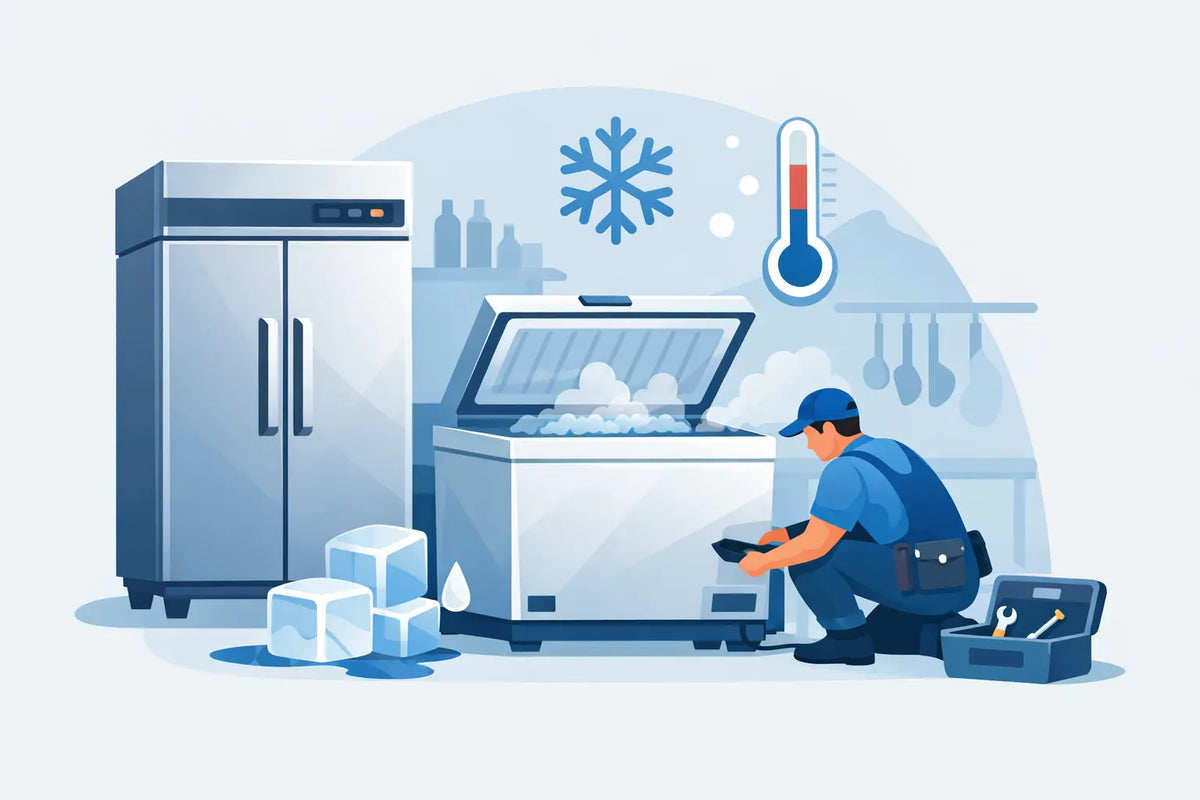
Frost buildup, long run times, water around the cabinet, a fan that sounds strained, or uneven temperatures across shelves are signs worth addressing early. Dirty condenser coils are a frequent source of poor performance. So are worn door gaskets, blocked vents, failed fan motors, and defrost-system faults.
A clean condenser improves heat rejection, but maintenance should follow the equipment manufacturer's instructions and the conditions of your kitchen. A flour-heavy bakery, a greasy line, or an outdoor kitchen environment may need more frequent attention than a low-volume pantry. Keep clearance around the unit, protect the power supply, and schedule professional service before a small performance issue becomes a product-loss event.
Equipment selection matters from the start. A reach-in freezer offers immediate access for line work, while a walk-in creates deeper reserve capacity and a more deliberate storage rhythm. Undercounter models protect tight stations; specialty low-temperature freezers may suit ice cream, seafood, or other texture-sensitive programs. Capacity alone is not the deciding factor. Consider ambient conditions, expected door openings, recovery needs, electrical requirements, and the way product moves from delivery to prep to service.
At Culinary Precisions, that kind of fit is central to building a freezer program that feels as dependable as the rest of the kitchen. The right cabinet should hold its temperature quietly in the background, leaving the team free to focus on prep, pace, and the food in front of the guest.
A freezer at 0°F is a clear standard. The real craft lies in designing the habits, storage flow, and equipment support that allow it to stay there through every rush.