Choosing Food Processors for a Working Kitchen
A food processor earns its counter space when prep begins to set the pace of service. The right machine turns cases of onions into a clean, even dice, brings pie dough together without warming the butter, and produces sauces with a texture that feels deliberate rather than improvised. The wrong one creates bottlenecks: undersized batches, overheated motors, awkward cleaning, and a prep cook waiting for the bowl to clear.
For a restaurant, catering operation, bakery, bar program, or serious home kitchen, the decision is not simply about wattage. It is about matching a machine’s capacity, cutting system, duty cycle, and footprint to the work that happens before the doors open and while the ticket rail fills.
Start With the Prep You Actually Produce
Before comparing specifications, look at the ingredients that move through your kitchen every day. A small bistro making a few quarts of pesto, vinaigrette, and herb oil has a different need from a pizza operation processing cheese, vegetables, and sauce components through multiple shifts. A pastry team may prioritize dough and nut processing. A high-volume salad concept may need consistent slicing and shredding more than fine emulsification.
The most useful question is: what task must this machine perform without interrupting the rhythm of the kitchen? If the answer is mirepoix, slaw, sliced potatoes, and shredded cheese, a continuous-feed vegetable prep machine may be more productive than a traditional batch-bowl processor. If the answer is hummus, tapenade, pie crust, breadcrumb mixes, and small-batch sauce work, a bowl-style unit offers better control.
Batch size matters as much as total daily volume. Processing six pounds of onions at once in a bowl designed for three pounds does not save time. It strains the machine, produces uneven cuts, and adds avoidable labor when the operator has to stop and redistribute ingredients. Choose capacity based on the largest batch you need to complete cleanly, not the smallest quantity the processor can handle.
Bowl Food Processors and Continuous-Feed Models
Both formats have a place in a well-built prep station, but they solve different problems.
Bowl processors favor texture and versatility
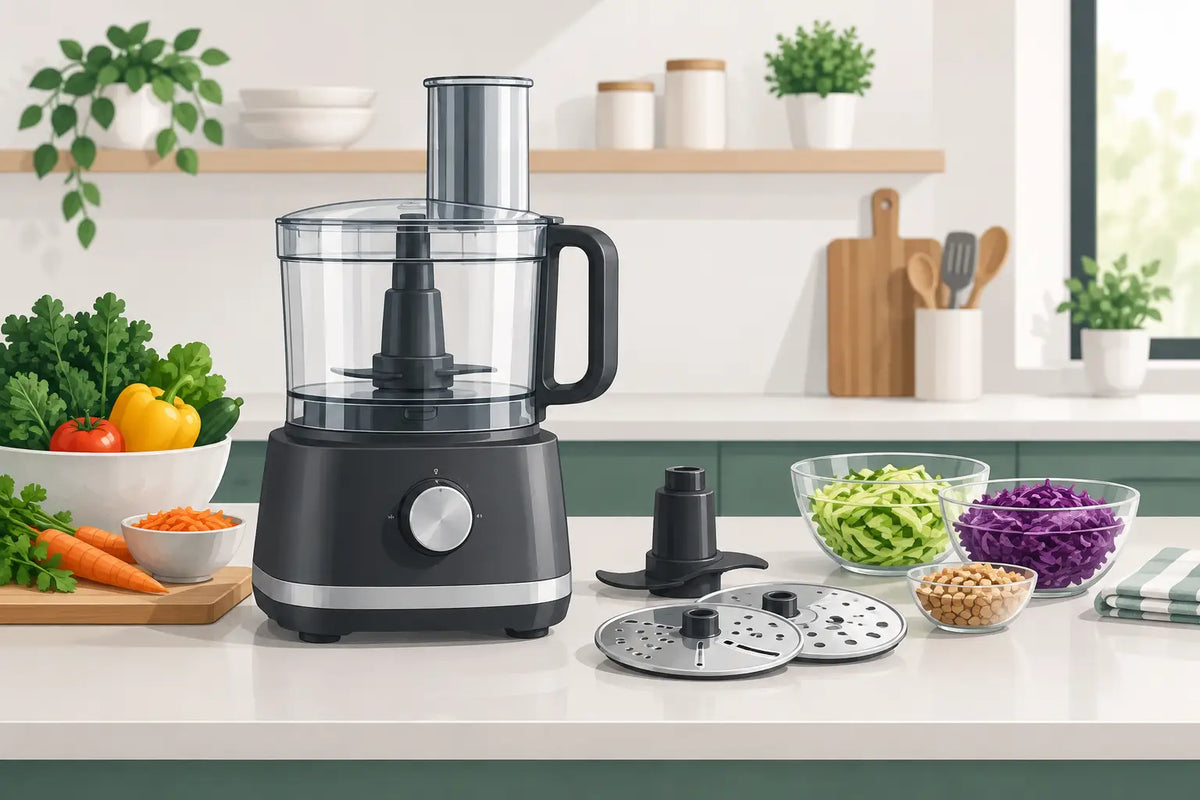
A bowl food processor uses a fixed work bowl and central blade or disc. It excels at jobs where the final texture is the point: silky hummus, coarse salsa, pureed soups, chopped herbs, ground nuts, pastry dough, aioli, and blended dressings. The operator can pulse, scrape down the sides, add liquid gradually, and stop at precisely the right moment.
Look closely at the usable bowl capacity rather than the advertised maximum volume. Wet ingredients, flour-based doughs, and dense mixtures all require headroom. A bowl that is technically large enough can still be a poor choice if it leaves no room for circulation or ingredient incorporation.
Continuous-feed machines favor throughput
Continuous-feed models move product through a feed tube and out into a hotel pan or receiving container. With the right discs, they can slice cucumbers, grate mozzarella, shred cabbage, julienne carrots, and produce uniform potato cuts at a pace a batch bowl cannot match.
They are particularly valuable where repetition defines prep. A deli counter, commissary, pizzeria, catering kitchen, or busy sandwich program can keep product moving without the repeated fill, process, empty, and wash cycle of a bowl machine. The trade-off is that these machines are less suited to purees, emulsions, and delicate texture work.
Some operations benefit from both: a continuous-feed unit for volume vegetable prep and a bowl processor for sauces, doughs, and finishing work. That is not duplication when each machine removes a separate point of friction.
Motor Power Is About the Workload
Motor ratings attract attention, but horsepower or wattage alone does not tell the whole story. The useful measure is how a processor performs under the ingredients and duration your menu demands. Dense root vegetables, chilled cheese, large quantities of nuts, and stiff dough place a different load on a motor than soft herbs or ripe tomatoes.
A commercial-duty motor should maintain speed under load rather than slowing into a rough, uneven cut. It should also be built for the number of cycles your team will run. A machine used for a few batches at brunch has different requirements from one used continuously through morning prep, lunch replenishment, and banquet production.
Do not oversize blindly, either. Larger motors often come with larger footprints, heavier components, and a higher investment. If your kitchen only needs smaller batches of sauces and garnishes, a thoughtfully selected compact unit may improve workflow more than a large machine that sits idle because it is cumbersome to clean and store.
The Cutting System Determines Consistency
A processor is only as useful as the tools that touch the product. Standard S-shaped blades are versatile for chopping, mixing, and pureeing, but discs expand the machine’s role. Slicing, grating, shredding, julienne, dicing, and specialized vegetable-prep attachments can create a level of repeatability that supports portion control and plate consistency.
When reviewing discs and blades, consider your finished product rather than simply the number of accessories included. A kitchen that makes hash browns, slaw, and pizza toppings needs different cut sizes from one producing shaved fennel salads and fine grated hard cheese. A broad accessory package can be valuable, but only if its cuts belong on your menu.
Blade sharpness and disc condition deserve a place in preventive maintenance. Dull cutting surfaces bruise herbs, crush tomatoes, tear leafy vegetables, and force operators to push harder. That affects both product quality and safety. Keep spare high-use blades or discs where the volume justifies it, and establish a clear inspection routine.
Build Cleaning Into the Purchase Decision
The best food processors are not necessarily the ones with the longest feature list. They are the ones your team can disassemble, wash, sanitize, dry, and reassemble correctly between tasks. A complex machine can be worthwhile, but only when its labor savings outweigh the time needed to maintain it.
Pay attention to the practical details: whether the bowl and lid are easy to remove, whether food traps around seals or drive shafts, whether components fit in your warewashing setup, and whether replacement parts are readily available. Clear labeling on discs and simple assembly reduce mistakes during a fast prep shift.
Allergen control also changes the equation. Kitchens managing nuts, dairy, sesame, gluten, or multiple dietary programs may need separate bowls, blades, or dedicated equipment for specific applications. Washing a processor well is essential, but operational separation can be the more dependable choice in a high-risk environment.
Size the Footprint, Electrical Supply, and Workflow
A processor that cannot live near the ingredients it handles is less likely to deliver its full value. Measure the counter or prep-table space, including clearance for loading a feed hopper, removing a bowl, and positioning hotel pans beneath an output chute. Consider where the machine will be stored when it is not in use. Heavy equipment is often left out because moving it is inconvenient, which can be fine if the station is planned for it, but not if it crowds the line.
Confirm electrical requirements before purchasing. Commercial models may require a dedicated outlet, a specific voltage, or a particular plug configuration. It is easier and less expensive to verify utility readiness during planning than to solve it after equipment arrives.
Also consider the person operating the machine. Controls should be easy to understand, safety interlocks should work reliably, and the machine should be stable during use. The fastest prep process is one your staff can repeat confidently without improvisation.
Make the Investment Fit the Menu
A food processor should support margin as well as craft. Uniform slicing reduces waste. Fast shredding shortens prep labor. Consistent sauces protect the flavor profile guests come back for. Yet a processor cannot fix a menu that asks too much of one station or a workflow built around constant last-minute prep.
For operators choosing equipment for a new build or an upgrade, it helps to map the processor to specific menu items and daily quantities before ordering. Culinary Precisions can help translate those requirements into capacity, cutting attachments, electrical needs, and a footprint that belongs in the larger kitchen plan.
Choose the machine that makes your prep feel quieter: product moving with purpose, cuts landing cleanly, and cooks free to focus on seasoning, timing, and the hospitality that reaches the table.