Best Commercial Kitchen Equipment to Buy
A kitchen usually tells the truth fast. If tickets stall, cold storage runs warm, or hot food loses holding temp before service peaks, the issue is rarely effort. It is equipment. Choosing the best commercial kitchen equipment means building a kitchen that can keep pace with volume, protect food quality, and stay reliable when the pressure is highest.
The right setup is not always the biggest or most expensive package. It is the equipment mix that matches your menu, service model, floor plan, and production rhythm. A pizza shop, hotel kitchen, concession operation, and serious home pizza lab will all define performance differently. What matters is selecting equipment that improves consistency, speed, food safety, and labor efficiency without creating bottlenecks somewhere else.
What the best commercial kitchen equipment really does
At a baseline, professional equipment should hold temperature accurately, recover quickly, and withstand repeat use. That sounds simple, but these three factors shape almost every daily outcome in a working kitchen. Better heat recovery protects ticket times. Better temperature control protects product quality. Better durability protects margins.
This is why experienced operators evaluate equipment by workload, not just by feature sheet. A range that performs well in a light-duty setting may struggle in a high-output line. An undercounter refrigerator that fits a tight footprint may still be the wrong choice if it cannot maintain safe temperatures through repeated door openings. The best commercial kitchen equipment earns its place by supporting production under real conditions, not ideal ones.
Start with your production pressure points
Before comparing brands or configurations, identify where your kitchen wins and where it breaks down. For some operations, the weak point is cooking capacity. For others, it is cold storage, dish turnover, or hot holding. Buying smart starts with the station that limits service.
Cooking equipment for output and control
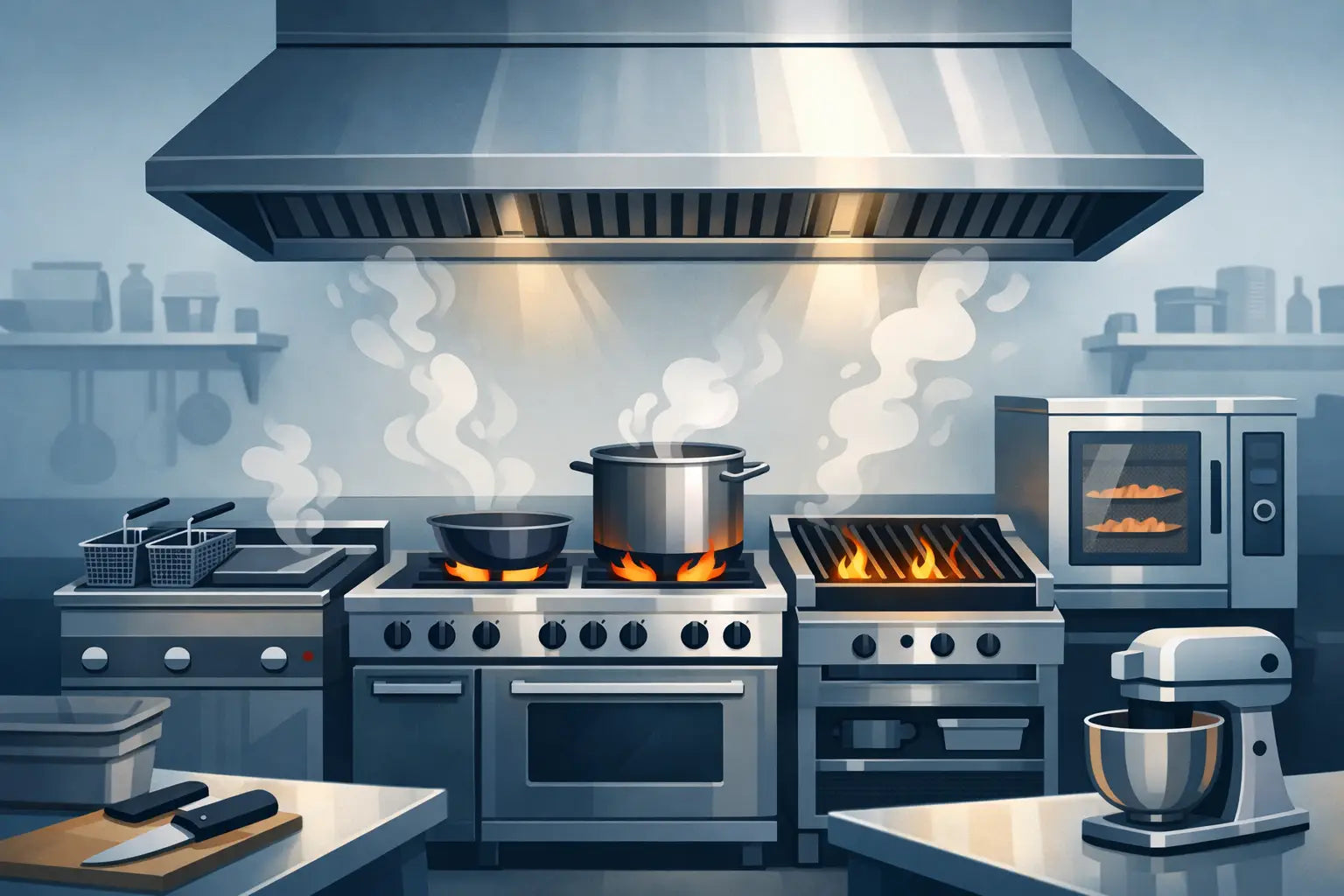
If your menu depends on fast line cooking, your core investment usually begins with gas ranges, convection ovens, grills, or charbroilers. These are the engines of production. The right choice depends on how your team cooks, not just what they cook.
Gas ranges and stoves are flexible and familiar, especially for sauté, stock work, and multi-station prep. They make sense when menus shift often and cooks need direct flame response. The trade-off is ventilation demand and, in some kitchens, more ambient heat.
Convection ovens bring stronger consistency for roasting, baking, and batch cooking. Air circulation supports even results and can reduce hot spots that compromise product quality. They are often a better fit than standard ovens when repeatability matters more than open-flame versatility.
Grills and charbroilers matter when flavor, appearance, and speed are tied to live-fire style cooking. They deliver the marks and caramelization customers expect, but they also demand careful cleaning and ventilation planning. If your menu relies on premium proteins or outdoor-inspired items, these pieces can directly shape perceived quality.
Pizza ovens deserve their own category because they define the product, not just the process. Deck style, conveyor, and specialty high-heat models all produce different crust characteristics, bake times, and throughput levels. A high-performance pizza concept should choose the oven first and build workflow around it.
Refrigeration that protects inventory and service
Cold storage is often where small mistakes turn into expensive losses. Refrigerators, undercounter refrigeration, and blast freezers do different jobs, and each one affects freshness, food safety, and prep efficiency.
Reach-in refrigeration supports bulk storage and daily accessibility. Capacity matters, but recovery matters more in active kitchens. Doors open constantly during prep and service. Units that struggle to pull temperature back down can compromise ingredients gradually, not dramatically, which makes the problem easy to miss until waste rises.
Undercounter refrigeration helps compress movement and keep key ingredients near the line. It is especially valuable in kitchens with limited square footage or high assembly volume. The trade-off is capacity. These units improve speed, but they do not replace larger cold storage.
Blast freezers solve a different problem: preserving quality while increasing production flexibility. They allow operators to cool products quickly, protect texture, and extend usable life for prepared items. For batch-heavy kitchens, commissaries, bakeries, and operations focused on waste reduction, this is often one of the smartest performance upgrades available.
The best commercial kitchen equipment for support stations
Strong kitchens are not built on cooking equipment alone. They rely on support equipment that keeps product moving safely and consistently.
Food warmers and steamers for holding and moisture control
Food warmers are essential when timing across stations is uneven. They help preserve serving temperature without forcing cooks to rush or refire. The key is controlled holding, not just heat. Poor holding equipment dries out product and hides service issues instead of solving them.
Steamers add precision when moisture retention matters. Vegetables, seafood, rice, dumplings, and reheated items often perform better with steam than dry heat. In high-volume environments, steam cooking can improve consistency while reducing labor at the stove.
Dishwashers that protect pace and sanitation
A dishwasher is not a back-of-house afterthought. It affects labor flow, sanitation standards, and service continuity. If clean pans, utensils, or plates are not cycling fast enough, the entire kitchen feels it.
Operators should evaluate dish machines by hourly demand, rack turnover, available utility connections, and staffing realities. A larger unit is not automatically better if it overwhelms your space or workflow. The right machine is the one that maintains hygiene standards without slowing the kitchen down.
Mixers, specialty machines, and menu-specific equipment
Food mixers, curing machines, slushy machines, and soft serve equipment all fall into the category of specialized production tools. These purchases make sense when they support a real revenue stream, not just menu ambition.
A commercial mixer can save labor, improve batch consistency, and reduce physical strain in bakeries, pizzerias, and prep-heavy kitchens. Soft serve and frozen beverage machines can drive profitable impulse sales, but only if cleaning routines and demand justify the footprint. Specialty equipment performs best when it is tied to a defined menu strategy.
How to choose the best commercial kitchen equipment for your space
Space changes every buying decision. A compact kitchen may need undercounter refrigeration, multi-use cooking equipment, and smaller-footprint holding solutions. A larger production kitchen may prioritize capacity, station separation, and dedicated specialty equipment.
Measure more than the floor plan. Door clearances, ventilation requirements, service access, electrical compatibility, and drain placement all matter. Equipment that technically fits can still create installation problems or maintenance headaches if there is no clearance to operate it properly.
This is where many buyers overspend or underspec. Overspending happens when operators buy capacity they will not use. Underspec happens when they buy for average volume instead of peak demand. The smarter approach is to buy for your busiest realistic service windows while preserving room for workflow.
Performance, durability, and when price should not lead
Budget matters, but low upfront cost can become expensive if equipment struggles under daily load. The best commercial kitchen equipment is rarely the cheapest option in its category. It is the equipment that gives you dependable performance over time.
Look closely at materials, recovery speed, temperature stability, and cleaning practicality. Stainless construction, commercial-grade components, and accessible maintenance points are not cosmetic details. They influence lifespan, downtime, and labor.
That said, premium does not always mean necessary. A serious home cook building an outdoor kitchen may want professional-grade grills or pizza ovens, but not the same volume capacity a restaurant needs. Matching duty level to actual use is just as important as chasing top-tier specifications.
Buying with confidence instead of guesswork
Equipment purchases carry operational consequences long after checkout. That is why support matters. Clear specifications, transparent policies, and access to real guidance help buyers avoid mismatches that cost time and money later.
For many operators, the best buying experience comes from working with a supplier that understands both culinary output and equipment performance. Culinary Precisions speaks directly to that need by focusing on chef-aligned results, broad category coverage, and equipment built for reliability under pressure.
The best commercial kitchen equipment is the equipment that keeps your standards intact when demand rises. Buy for the way your kitchen actually works, and every service after that gets a little faster, safer, and more consistent.