Undercounter Freezer Review for Working Kitchens
The freezer line is often where a kitchen either keeps its rhythm or loses it. A thoughtful undercounter freezer review starts with the work happening above it: portioning proteins during prep, holding backup desserts near the pass, or keeping frozen garnishes within reach at a bar. This is not simply cold storage in a smaller footprint. It is a working surface, a station anchor, and a decision that affects every handoff in service.
For restaurants, caterers, bars, and serious outdoor kitchens, the best undercounter freezer is rarely the one with the largest stated capacity or the lowest purchase price. It is the unit that holds temperature through a hot shift, fits the available clearance, opens cleanly in a crowded aisle, and gives the team a dependable place to work.
What an Undercounter Freezer Must Do Well
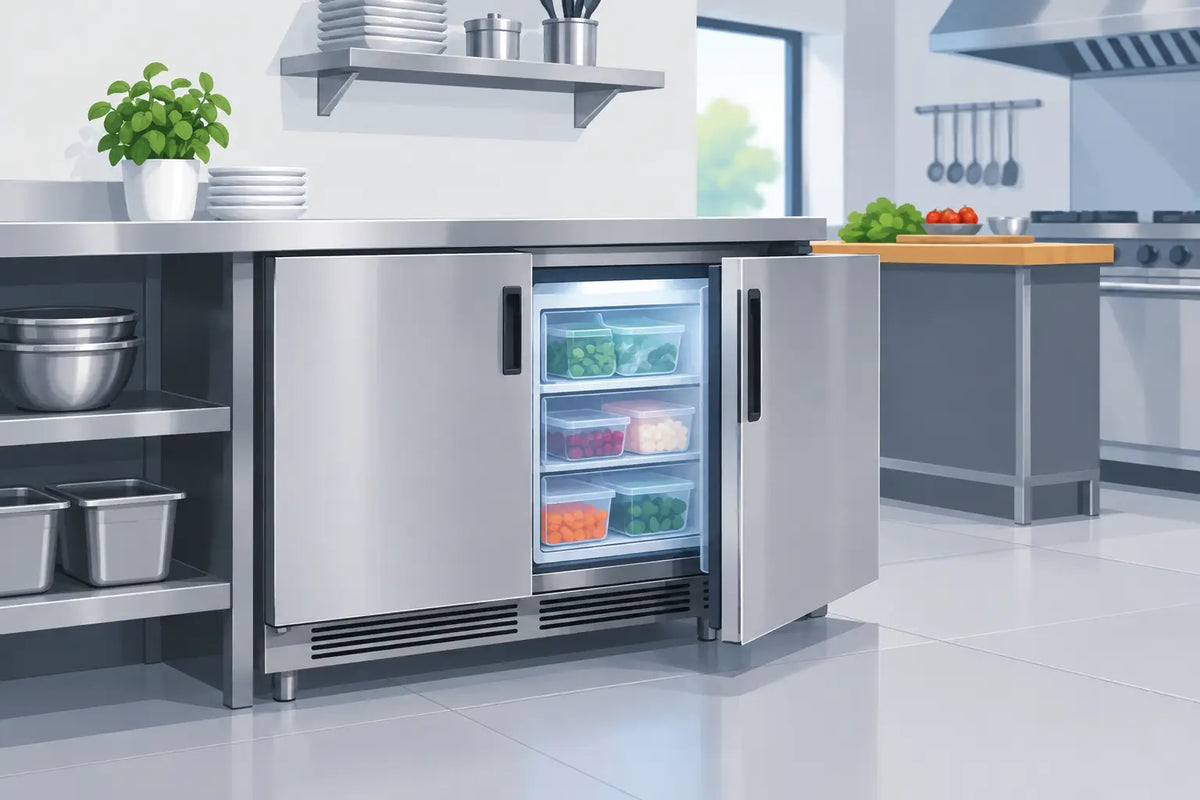
An undercounter freezer earns its space by placing frozen inventory close to the point of use. That can mean pastry sheets and plated-dessert components at a bakery station, reserve proteins beneath a charbroiler line, or ice cream novelties behind a hospitality bar. Compared with a reach-in unit, it shortens the walk. Compared with a chest freezer, it brings organization and an accessible worktop into the same compact piece of equipment.
The trade-off is capacity. An undercounter cabinet is not designed to replace a walk-in or carry an entire weekend's frozen inventory. Its strength is controlled, immediate access. Operators who treat it as station storage tend to get the best return: faster prep, fewer unnecessary steps, and less disruption during service.
Temperature performance remains the first test. Commercial freezers should maintain a stable frozen environment even when the door or drawer is opened repeatedly. Look beyond a stated temperature range and consider the conditions around the unit. A freezer positioned beside ovens, fryers, or a sunny patio kitchen works harder than one in a cool prep room. A well-built cabinet, sound door gaskets, effective insulation, and a correctly sized refrigeration system matter most when the kitchen is busy.
Undercounter Freezer Review: The Details That Matter
A useful review looks past polished stainless steel and considers how the unit will behave after hundreds of shifts. Start with the cabinet itself. Stainless steel exterior panels suit hard-working kitchens because they tolerate regular cleaning, resist the visual wear of daily use, and complement an intentional line design. Interior construction matters too. A durable, easy-to-clean liner supports sanitation while standing up to pans, product movement, and repeated loading.
Doors or drawers change the workflow
Door models generally offer flexible bulk storage. Shelves can be adjusted to suit boxed product, hotel pans, bags of portioned proteins, or containers with irregular dimensions. They are often the better choice when inventory varies from week to week and staff need to see a larger section of the cabinet at once.
Drawer models bring more discipline to high-volume stations. They make it easier to separate product by service, daypart, or menu category, and they reduce the need to bend and search. A pastry program may dedicate one drawer to dough and another to finished frozen components. A bar can separate reserve fruit, novelty items, and specialty ice. Drawers are usually more expensive, but the labor savings can be real when every movement at the station has a purpose.
Neither configuration is universally better. Think about the containers your team already uses, the way product is labeled, and whether the freezer will be opened by cooks in the middle of a rush or stocked primarily during prep.
Capacity is usable space, not just cubic feet
Published cubic footage helps compare cabinet sizes, but it does not tell the full story. Shelves, drawer architecture, evaporator placement, and the shape of your stored product determine what actually fits. A freezer with a slightly lower listed capacity may prove more useful if it accepts your hotel pans cleanly or provides drawers that keep portions in order.
Measure the product, not just the opening. Consider the height of lidded containers, the footprint of sheet pans, and the amount of clearance needed to lift them out. If frozen product is commonly delivered in cases, plan how those cases will be broken down before they reach the cabinet. Good organization supports air circulation, and good air circulation helps the freezer recover after opening.
Ventilation and clearance are nonnegotiable
Most undercounter freezers reject heat through a front-breathing or rear-breathing condenser system. That distinction changes installation requirements. Front-breathing designs are often better suited to a tight equipment line because they can sit within a counter run with appropriate manufacturer-specified clearance. Rear-breathing units need open space behind them and can struggle if boxed tightly against a wall.
This is a practical point with expensive consequences. Restricted airflow forces the refrigeration system to work harder, raises energy use, and can shorten component life. Before ordering, confirm the unit's overall dimensions, door or drawer swing, ventilation requirements, electrical connection, and route into the building. The right cabinet on paper can become the wrong cabinet if it cannot clear a doorway or open fully beside a prep table.
Build Quality Shows Up After Service
The quiet indicators of quality are often the components touched every day. Door hinges should feel secure and close reliably. Drawer slides should move under load without binding. Gaskets should seat firmly and be simple to inspect and clean. Casters can make a major difference in sanitation, allowing staff to pull the unit forward for floor cleaning and condenser maintenance when appropriate.
A self-closing door is valuable in kitchens where hands are full and attention is divided. It reduces the chance of a door being left ajar, but it should not be used as an excuse to ignore traffic patterns. If a door must be held open constantly for a recurring task, the station may need a drawer configuration, a different cabinet location, or a revised prep process.
Also consider the worktop. Many undercounter units serve as a landing zone for pans, mixers, plating tools, or mise en place. A sturdy top turns the freezer into part of the workstation. In a refined open kitchen or outdoor entertaining space, its clean stainless profile can also create visual continuity with adjacent cooking equipment. Still, do not confuse a freezer top with a universal counter surface. Confirm load limits and avoid obstructing any airflow paths.
Electrical Load, Defrost, and Operating Cost
A freezer purchase should include a candid look at utilities. Verify voltage, plug type, amperage, and whether a dedicated circuit is needed. Commercial kitchens often have a patchwork of electrical decisions made over years of growth. Checking the requirement before delivery is simpler than moving equipment after the fact.
Defrost design also affects day-to-day ownership. Automatic defrost systems reduce manual labor and help maintain operation, though they introduce cycles that should be understood in relation to sensitive inventory. For most foodservice applications, the convenience and consistency are worthwhile. The right choice depends on the menu, product turnover, and the operator's maintenance habits.
Energy use deserves attention, particularly for units that operate around the clock. Efficient components and sound cabinet insulation can reduce operating cost over time, but the cheapest energy profile is undermined by poor placement, damaged gaskets, overloaded storage, or neglected condenser cleaning. Refrigeration rewards routine care. Keeping the condenser clear and reporting temperature changes early protects both the equipment and the food inside it.
Choosing for Your Operation, Not a Generic Kitchen
A compact café may need a single-door unit beneath the prep counter to hold backup pastry and frozen fruit. A high-output pizza operation may favor a two-door cabinet near the line for portioned toppings and dough reserves. A hotel bar might prioritize drawers for clean separation and quick restocking. For a residential outdoor kitchen, weather exposure, installation environment, and intended frequency of use deserve especially careful review.
Culinary Precisions approaches this category as part of a broader kitchen system. The freezer should relate to the surrounding equipment, the menu's pace, and the way guests experience the space. Dimensions, capacity, refrigeration configuration, and electrical requirements all deserve the same attention as the finish and footprint.
Before making a final choice, stand at the intended station and trace the movement of a shift: where product arrives, where it is prepped, where it is held, and where it leaves the line. The undercounter freezer that supports that motion will feel less like an appliance and more like a well-made tool - quiet, capable, and ready when the kitchen reaches full speed.