Article: Commercial Pressure Fryer Review for Busy Kitchens
Commercial Pressure Fryer Review for Busy Kitchens
The first rush tells you what a fryer is made of. When tickets stack up and a cook drops another basket of bone-in chicken, the right machine holds its temperature, manages moisture, and returns food with a crisp crust and a juicy center. This commercial pressure fryer review looks past headline capacity to the operating details that determine whether pressure frying earns its place on your line.
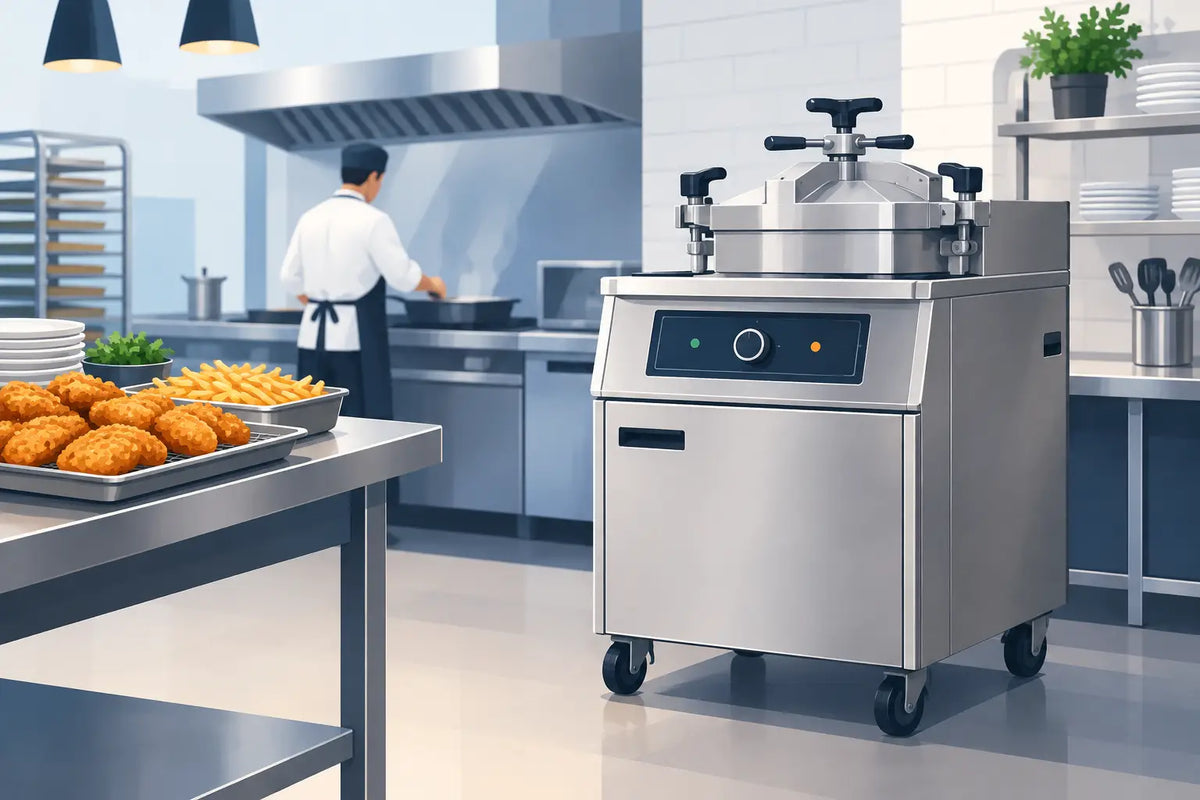
Pressure fryers are specialized equipment, not simply enclosed versions of an open fryer. Their sealed cooking environment uses controlled pressure to raise the boiling point of water inside the food. For chicken, this can mean less moisture loss, a faster cook cycle, and a distinctive tender texture beneath a well-set breading. The trade-off is a more disciplined workflow around loading, filtering, cleaning, ventilation, and safety.
Commercial Pressure Fryer Review: Where Performance Shows
A well-built pressure fryer is at its best when the menu has a steady, repeatable demand for breaded proteins. Fried chicken concepts are the natural fit, but caterers, hotel kitchens, grocery prepared-food programs, and operators building a premium comfort-food menu can also benefit. It is less compelling for a menu centered on delicate seafood, loose-battered items, or a broad mix of quick fried snacks. Those applications often favor the accessibility of an open fryer.
The strongest pressure fryers balance four things: oil recovery, usable vat capacity, pressure control, and filtration. Each affects the rhythm of service. A large oil tank sounds productive, for example, but a vat that takes too long to recover between drops can become the actual bottleneck. Conversely, a smaller fryer with responsive heat and a realistic batch size may carry a compact chicken program with more confidence.
Heat recovery is more valuable than a large number on a spec sheet
Fryer output is frequently discussed in pounds per hour, but real production depends on the product being cooked, its temperature at loading, breading style, batch weight, oil condition, and the cook's willingness to avoid overfilling. Look for a machine engineered for rapid recovery after a cold load, then consider its performance at the batch size your team will use during peak periods.
For gas units, burner design and BTU input matter, but they are not the whole story. Heat transfer through the vat and the control system's ability to hold its setpoint matter just as much. Electric pressure fryers can offer highly precise temperature response and may be the practical choice where gas infrastructure is limited. They require careful attention to voltage, phase, amperage, and the electrical capacity already available in the building.
A pressure fryer should support consistency rather than demand constant correction. Programmable cook cycles are particularly valuable when several employees work the station. A reliable program can standardize cook time, temperature, pressure release, and hold expectations across shifts, protecting the product even when the kitchen is moving at full speed.
Capacity means usable product load, not only oil gallons
Pressure fryers are commonly described by oil capacity and by the number of chicken pieces they can cook per cycle. Both measurements help, but neither replaces a clear production plan. Start with the menu mix and forecast your busiest 15-minute window. Then determine how many batches you need, how long each cycle runs, and how much holding capacity is available without compromising quality.
For a smaller operation, a single fryer may be the right expression of control: fewer moving parts in the workflow, lower oil volume, and a modest footprint. A high-volume chicken concept may need two fryers or a battery arrangement so one unit can carry core chicken while another handles tenders, specialty flavors, or recovery during filtration. Building redundancy into the line is often more useful than buying one oversized vat and expecting it to cover every rush.
Do not overlook the physical path around the fryer. The cabinet needs room for a cook to load product, access controls, drain and filter oil, and move safely without crossing the plating or pickup lane. Good equipment earns its value when it fits the room's choreography.
The Oil System Is the Long-Term Cost Story
Oil is a working ingredient, and pressure frying asks a great deal of it. Breading fragments, moisture, high production volume, and inconsistent filtering can shorten oil life and cloud flavor. A fryer with an integrated filtration system can make routine care more achievable, which is often more important than having a cleaning process that looks excellent on paper but gets skipped after a difficult close.
Evaluate how the filter pan rolls out, how easily staff can engage the drain valve, whether the pump is suited to the oil type you use, and how many steps stand between a busy cook and a properly filtered vat. Small design choices matter here: protected drains, manageable hose connections, accessible crumb zones, and controls that clearly guide the process all reduce the chance of costly shortcuts.
Oil management should also include the menu itself. Heavily seasoned breadings and sugary sauces introduced before frying can darken oil quickly. If your signature flavor depends on an aggressive seasoning profile, set a filtering schedule based on actual oil condition rather than a generic calendar. The best fryer cannot compensate for neglected oil, and fresh oil cannot fully rescue a line that is consistently overloaded.
Pressure, Safety, and Cleaning Demand Respect
The qualities that make pressure frying effective also make disciplined operation nonnegotiable. The lid, locking mechanism, pressure valve, gasket, and control system must work together precisely. Staff should never improvise around a lid that does not seal correctly, a damaged gasket, an error code, or a pressure-release issue. These are service calls, not workarounds.
Before selecting a unit, confirm how the lid opens, how it is counterbalanced or assisted, and whether the handle and latch arrangement suits the staff who will use it most often. A lid that feels awkward during a demonstration will not feel better at the end of a long shift. Ask about daily cleaning points, scheduled gasket inspection, and the practical availability of replacement wear parts.
Cleaning is also a product-quality decision. Carbonized debris and neglected sediment create off flavors and shorten oil life. The most useful cleaning procedures are specific enough to train from: cool-down expectations, crumb removal, filter-pan care, exterior wipe-down, vat boil-out requirements, and the approved chemicals for seals and surfaces. Assign ownership by shift rather than leaving the process as an unclaimed closing task.
Installation Is Part of the Equipment Decision
A pressure fryer is not a plug-and-play purchase. Before ordering, verify the exact width, depth, height, door and aisle clearances, utility requirements, and service access. Confirm whether your kitchen needs natural gas, liquid propane, or electric power, and have a qualified professional validate the available supply. Electrical units deserve the same scrutiny, including breaker capacity and the required receptacle or hardwired connection.
Ventilation and fire protection must be planned with local code, the fryer manufacturer's requirements, and the authority having jurisdiction. The hood system, clearances, suppression coverage, floor conditions, and drainage all shape whether the installation will pass inspection and remain comfortable for the crew. For mobile or constrained kitchens, these constraints can decide the category before cooking performance does.
Equipment buyers should also weigh local service coverage and parts support. A pressure fryer is a revenue-producing station, particularly in chicken-focused concepts. The right purchase includes a realistic plan for preventive maintenance and a fast response if a critical component fails.
Who Should Choose a Pressure Fryer?
Choose pressure frying when chicken or similarly structured breaded proteins are central to your identity, and when tenderness, yield, and repeatable crust justify a dedicated station. It is especially persuasive for operators seeking a familiar, craveable fried-chicken finish without relying on excessively long cook times or a heavy moisture loss.
Choose an open fryer instead when your menu needs constant flexibility across fries, wings, appetizers, seafood, and varied batters, or when your team benefits from a simpler visual cooking process. Some kitchens need both: pressure frying for the signature chicken and open frying for the rest of the board. That division keeps each piece of equipment working in its strongest territory.
The most rewarding pressure fryer is not necessarily the largest or most automated model. It is the one whose capacity matches the rush, whose filtration routine will actually be followed, whose utilities suit the site, and whose controls help the team repeat your standard plate after plate. For operators shaping a kitchen around flavor, pace, and durable craft, that fit is where a fryer becomes more than a hot vat of oil - it becomes a dependable part of the service rhythm.