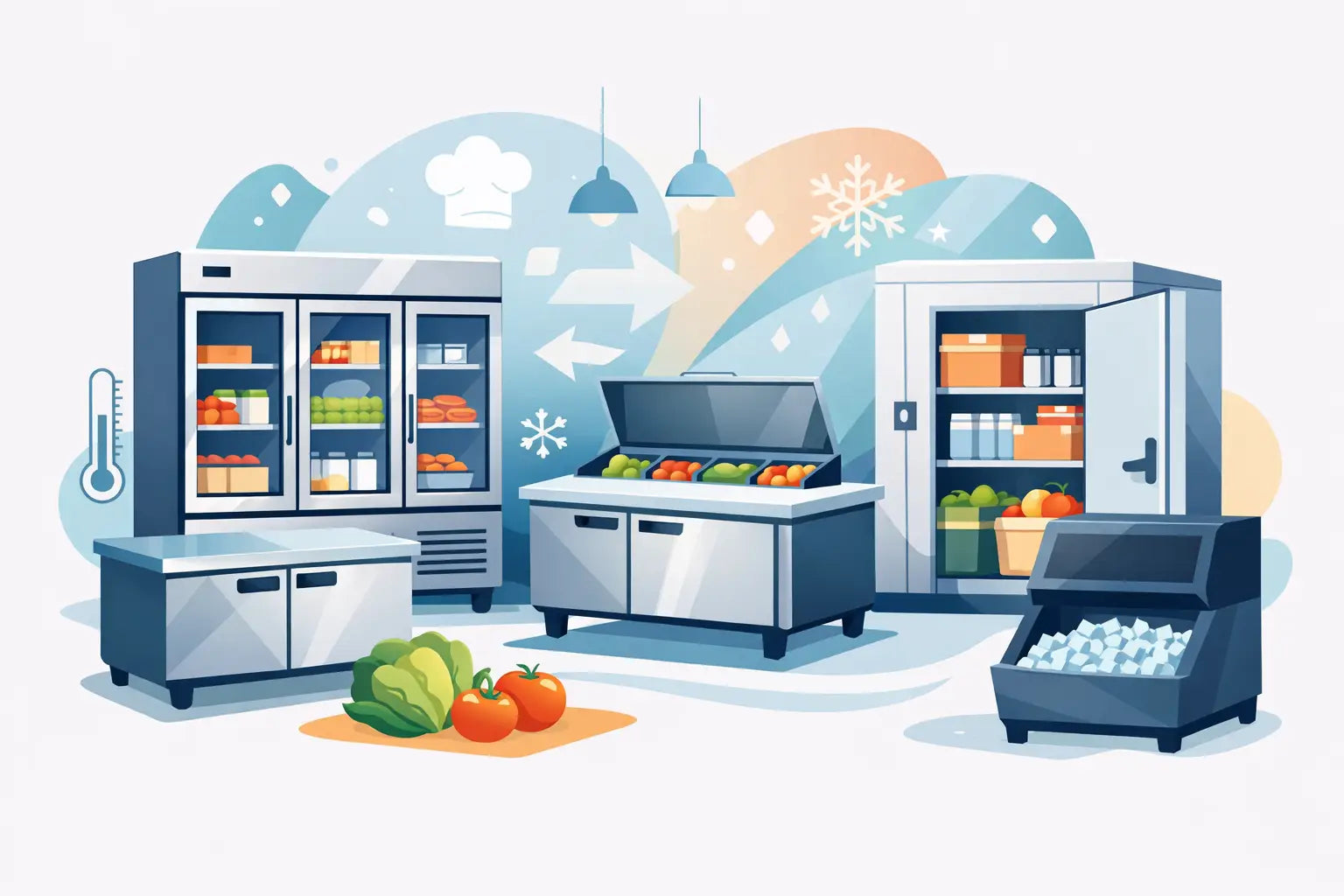
Restaurant Refrigeration Buying Guide
A refrigerator that runs warm for even a few hours can cost you prep time, product quality, and food safety at once. That is why a smart restaurant refrigeration buying guide starts with kitchen reality, not catalog specs. The right unit has to fit your menu, your line flow, your storage volume, and the pace of your service.
For chefs and operators, refrigeration is not a background purchase. It affects ingredient integrity, station speed, HACCP discipline, and labor efficiency every day. Buy too small and the kitchen starts improvising with overflow storage. Buy too large and you spend more on footprint, energy, and unused capacity than you need to.
How to use this restaurant refrigeration buying guide
Start by thinking in terms of workload. A coffee shop, a pizzeria, a full-service restaurant, and a catering kitchen all use refrigeration differently. The best buying decision comes from matching the equipment to production patterns rather than chasing the lowest price or the biggest box.
You also need to separate storage refrigeration from line refrigeration. Reach-in refrigerators and freezers are built for holding product in bulk. Prep tables, chef bases, and undercounter units are built to support active stations. One can sometimes cover for the other in a pinch, but that usually creates slower movement and more door openings where you can least afford them.
Choose the right refrigeration type first
The fastest way to narrow the field is to decide what job the unit needs to do.
Reach-in refrigerators and freezers
Reach-ins are the backbone of back-of-house cold storage. They are ideal when you need dependable capacity, shelf organization, and quick visibility. A single-door model can work well for smaller kitchens, bakeries, or specialty prep spaces. Two-door and three-door cabinets make more sense when volume is steady and the kitchen needs room to separate proteins, produce, dairy, sauces, or desserts.
The trade-off is space. Reach-ins offer strong storage density, but they take floor area and can create traffic points if placed near the line or dish return. Before buying, check how the doors open within your actual workflow. A unit that technically fits may still interrupt service.
Undercounter refrigeration
Undercounter units are built for kitchens where every step matters. They keep product close to the station, reduce unnecessary movement, and help smaller operations maximize limited square footage. They are especially useful in bars, sandwich lines, dessert stations, and compact prep areas.
Their limitation is capacity. An undercounter refrigerator improves speed, but it is not a substitute for proper bulk storage if your menu turns through volume. Operators often get into trouble when they expect one undercounter unit to support both line service and reserve stock.
Refrigerated prep tables
Prep tables combine cold holding with work surface efficiency. For pizza, sandwiches, salads, and deli-style production, they are often the most operationally valuable refrigeration purchase in the kitchen. Ingredients stay within reach, top rails support fast assembly, and the worktop becomes part of the station instead of a separate surface.
The key is pan layout and real ingredient count. If your menu uses ten toppings every shift, a smaller prep rail may look economical but force backup containers, crowding, and frequent refill trips. That slows the line and creates more open-lid time.
Chef bases and worktop refrigerators
Chef bases put refrigerated storage beneath cooking equipment, while worktop refrigerators offer a flat production surface with cold storage below. These are smart choices when floor space is tight and station efficiency matters. In high-output kitchens, they can reduce steps and tighten the relationship between cooking and holding.
You need to pay attention to top load capacity and ventilation requirements. Not every unit is built to support every piece of cooking equipment. This is where precision matters more than appearance.
Capacity is not just cubic feet
Many buyers focus on total storage volume, but usable capacity is what actually matters. Shelf configuration, pan compatibility, product mix, and door frequency affect performance more than a headline number on a spec sheet.
If you store bulky cambros, sheet pans, or boxed product, shelf spacing matters. If your team opens the door constantly during service, recovery time matters. If you rotate inventory across multiple dayparts, interior organization matters. A refrigerator with slightly less listed volume can still perform better if it supports cleaner storage logic and faster access.
A practical rule is to buy for your busiest realistic demand, not your quietest week and not your once-a-year holiday surge. Oversizing for rare spikes is expensive. Undersizing for normal business is worse.
Compressor location, airflow, and kitchen conditions
Not every kitchen gives refrigeration an easy life. Hot lines, tight corners, flour in the air, and long service hours all influence how well a unit performs.
Top-mounted compressors can be a good fit in hotter kitchens because they sit farther from floor debris and may stay cleaner in some environments. Bottom-mounted compressors can be easier to service and may provide ergonomic access to lower shelves, but they are more exposed to dust and grease near the floor. There is no universal winner. It depends on your kitchen conditions and maintenance discipline.
Ventilation clearance is another detail buyers underestimate. If a unit is pushed too tightly against walls or equipment, heat rejection suffers and performance drops. The result can be higher energy use, more compressor strain, and less reliable holding temperatures.
Temperature performance and food safety
A commercial refrigerator is not just a cold box. It is part of your food safety system. Consistent holding temperatures protect product quality and help reduce spoilage risk, especially with proteins, dairy, prepared sauces, and cut produce.
Look closely at operating temperature ranges and how the unit is meant to be used. Some models are built for ingredient holding under frequent access. Others are better suited for less active storage. If a unit will sit on the line through repeated openings during a rush, temperature recovery becomes especially important.
This is also where build quality matters. Door gaskets, insulation, evaporator performance, and controller reliability all affect real-world consistency. Lower upfront pricing can be tempting, but uneven holding performance tends to show up at the worst time - during service.
Construction quality affects long-term value
In a serious kitchen, refrigeration takes abuse. Doors are opened hard, shelves are loaded fast, spills happen, and cleaning has to be done quickly. Construction details tell you a lot about whether a unit is built for daily pressure or just built to look competitive online.
Stainless steel interiors and exteriors generally support durability and easier sanitation, though some mixed-material designs can still make sense in lighter-duty settings. Shelving strength, hinge quality, caster durability, and door closure feel are all worth attention. These are not cosmetic details. They shape how the unit performs over years, not just months.
If your operation runs long hours, the strongest value is usually not the cheapest refrigerator. It is the model that holds temperature reliably, cleans easily, and stands up to constant use without creating downtime.
Match the unit to your menu and service model
A smart restaurant refrigeration buying guide has to account for what your kitchen actually produces. A burger concept may need more refrigerated drawer access near the line. A pizzeria may get more value from a high-capacity prep table with ingredient rail space. A bakery may prioritize stable reach-in storage and sheet pan compatibility. A bar may need undercounter refrigeration that preserves speed in a narrow footprint.
Even serious home cooks and outdoor kitchen buyers should think this way. Professional-grade refrigeration only pays off when it supports a real workflow. If the unit is oversized for the space or mismatched to the menu, performance suffers no matter how impressive the specs look.
Serviceability, cleaning, and day-two ownership
Buying well means thinking beyond delivery day. Condenser access, removable shelving, drain management, and ease of wiping down food contact areas all affect ownership costs. Equipment that is harder to clean usually gets cleaned less consistently, and that leads to performance decline over time.
Ask practical questions. Can staff reach the interior corners easily? Are shelves simple to reconfigure? Is the condenser accessible for routine maintenance? These details rarely drive impulse purchases, but they matter to kitchens focused on reliability.
At Culinary Precisions, that performance-first mindset matters because refrigeration is not a decorative upgrade. It is operational equipment that has to produce dependable results under pressure.
Budget smart, not cheap
Price always matters, but total value matters more. A lower-cost unit can look attractive until energy use, inconsistent temperatures, premature repairs, or poor fit start draining time and margin. A better approach is to compare cost against expected workload, lifespan, and the operational importance of the station it supports.
If the refrigerator is central to your line, paying more for stronger recovery, better construction, and easier maintenance is often justified. If it serves a lighter-duty role in a secondary prep area, a more modest unit may be the right call. The point is not to spend the most. It is to spend where performance actually protects the business.
The best refrigeration purchase is the one that keeps pace with your kitchen without demanding constant attention. When your cold storage supports speed, safety, and consistency, the whole operation works with more confidence.