How to Choose Food Warmers That Fit Service
The wrong warmer usually shows itself during the rush. Fries lose texture under harsh heat, sauces skin over, plated meals back up at the pass, and staff start working around equipment instead of with it. If you are figuring out how to choose food warmers, the best place to start is not with features - it is with service. The right unit protects food quality, supports speed, and holds safely without creating new bottlenecks.
How to choose food warmers based on your operation
A food warmer should match the way your kitchen moves. That sounds obvious, but many buyers start with size or price before they define what the unit actually needs to do. A cafeteria line, a busy concession stand, a catering setup, and a serious home pizza station may all need warming equipment, but not the same kind.
If you are holding cooked proteins for service, humidity control matters differently than if you are keeping packaged foods hot for grab-and-go. If you are staging plates before runners pick them up, response time and pass-through access may matter more than long holding duration. If your operation rotates menu items fast, recovery speed is more important than maximum hold time. When the service model is clear, the equipment choice gets much easier.
Start by asking a few operational questions. Are you holding food for minutes or hours? Are you warming open trays, covered pans, or plated dishes? Is the warmer part of the customer-facing line, or is it strictly back-of-house? Those answers shape nearly every other decision.
Dry heat, moist heat, and what they do to food
One of the biggest decisions in how to choose food warmers is the heating method. This is where food quality is won or lost.
Dry heat warmers are often the better choice for items that suffer from excess moisture. Fried foods, bread products, pizza slices, and some plated meals generally hold better in dry conditions, especially for shorter windows. The trade-off is that foods can dry out faster if held too long.
Moist heat warmers, including steam table style units and some humidity-assisted cabinets, help protect foods that need moisture retention. Rice, vegetables, braised meats, sauces, and many buffet items often benefit from this environment. The downside is texture. Crisp surfaces soften quickly, and some foods can become overhydrated if the setting is too aggressive.
This is where precision matters. The best choice is not simply dry versus moist. It is matching the holding environment to the food’s ideal texture and service time. A kitchen with a broad menu may even need more than one warming solution rather than one unit trying to do every job poorly.
Match the warmer to the menu, not the catalog
A soup station, a carving line, and a holding cabinet for barbecue all sound like “food warmers,” but they perform very different jobs. Menu mix should guide the category.
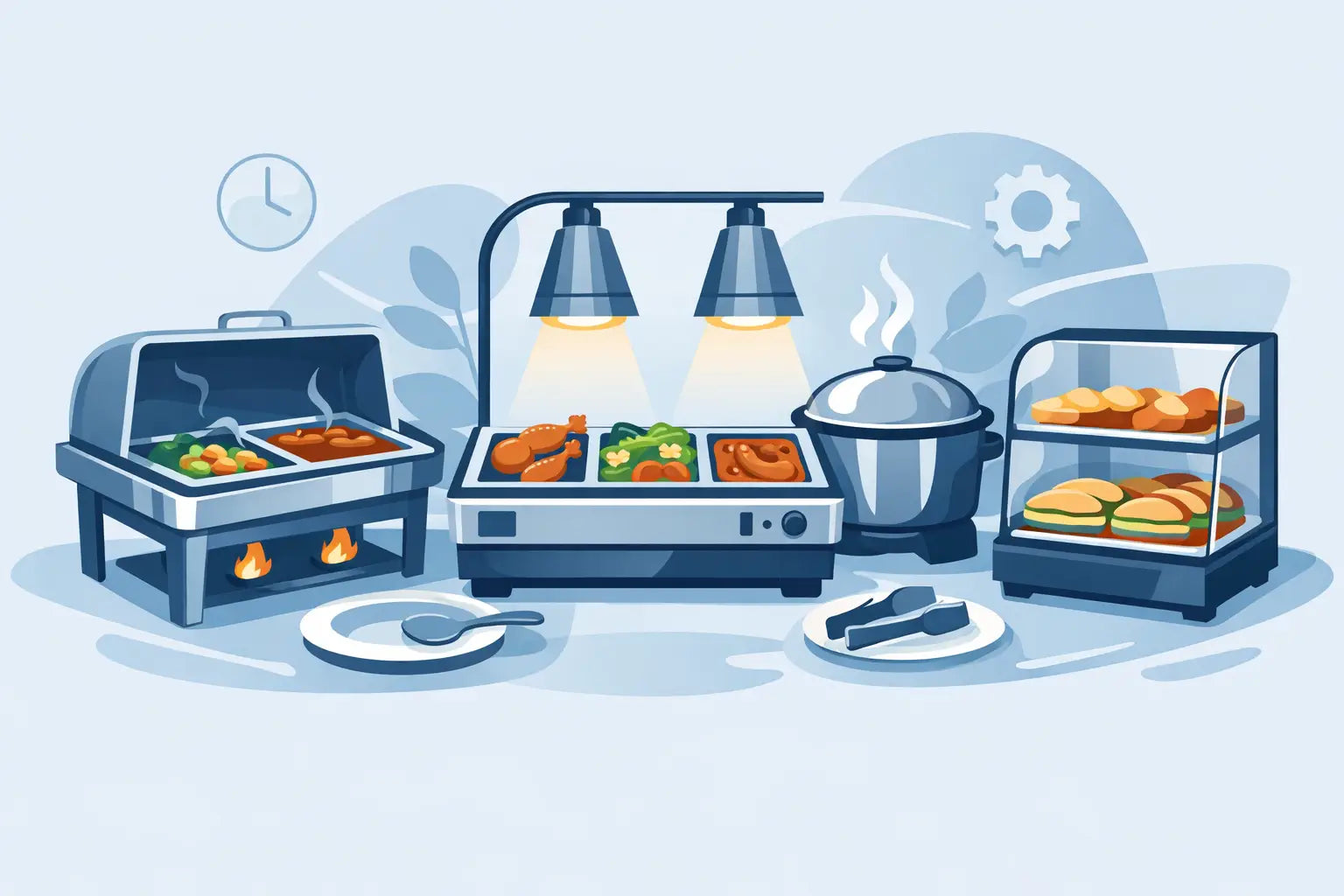
Countertop warmers work well when space is limited and output is focused. Drawer warmers are strong for holding cooked items close to the line without giving up valuable top-surface workspace. Heated display merchandisers matter when presentation drives sales. Holding cabinets support batch cooking and service continuity. Strip heaters and pass-through warmers serve plating lines and expediter stations best.
A common buying mistake is choosing based on a broad category and overlooking what the food actually needs during the hold window.
Capacity is not just about volume
Most buyers look at pan count, shelf quantity, or external dimensions first. Those matter, but true capacity is about usable output during peak demand.
A warmer that technically fits eight pans may still be too small if staff need fast access and end up crowding the interior. A cabinet with large internal volume may underperform if recovery is slow every time the door opens. On the other hand, oversizing can waste energy, consume floor space, and reduce temperature consistency if the unit is lightly loaded.
Think in terms of peak service periods. How much food needs to be held at one time, and for how long? How often will staff open the unit? Will the product be rotated in small batches or loaded in larger cycles? Capacity should support your heaviest realistic service period, not just an average hour.
For serious home cooks, the same principle applies. If you host often, run outdoor kitchens, or stage multiple dishes for holidays, choose for those moments rather than for a quiet weeknight.
Space, placement, and workflow matter more than buyers expect
A food warmer can be technically right and operationally wrong. That usually happens when placement is treated as an afterthought.
Measure more than the footprint. Check door swing, ventilation clearances, countertop load limits, access to power, and the path staff take around the unit. A warmer placed one step too far from the prep line or the pass can slow service all day long. In compact kitchens, that friction adds up quickly.
Also think about who uses it. If multiple team members need access during rush periods, a narrow single-door unit may create backups. If the warmer sits in front-of-house, appearance and customer visibility matter. If it lives in a greasy, high-heat line environment, exterior durability and ease of cleaning move up the priority list.
Good equipment supports flow. Great equipment disappears into the workflow because it is exactly where it needs to be.
Temperature range, controls, and consistency
Food safety is non-negotiable, but consistency is what separates acceptable equipment from dependable equipment. A warmer should not only reach the right temperature. It should hold that temperature evenly and recover quickly when doors or drawers are opened.
Look closely at control style. Basic analog controls can work well in simpler applications, especially where staff want straightforward operation. Digital controls offer tighter accuracy and are often better for menus with stricter holding requirements. Neither is automatically better in every kitchen. The right choice depends on how much precision your menu and team require.
Uniform heat distribution also matters. Hot spots can overcook one pan while another drifts too cool. That is especially costly in operations where consistency is part of the brand promise. Restaurants, schools, hospitals, and catering teams all feel that problem differently, but none can afford it.
If your menu is sensitive, choose a unit built for stable holding rather than one designed simply to keep food warm enough.
Build quality, cleaning, and long-term value
If a warmer is used daily, construction quality is not a premium extra. It is part of the return on investment.
Stainless steel bodies, durable drawer slides, solid door seals, and interiors designed for easy wipe-down all contribute to performance over time. In busy commercial kitchens, weak hinges, inconsistent seals, or hard-to-clean corners turn into service issues fast. A lower upfront price can disappear quickly if the unit slows cleaning, fails under heavy use, or struggles to maintain safe holding temperatures.
For operators, long-term value usually comes from three things: reliable performance, reduced downtime, and easier sanitation. For home buyers investing in pro-grade equipment, the same logic applies. If you want commercial results, build quality needs to support repeated use without losing control or convenience.
This is one reason chef-focused retailers such as Culinary Precisions emphasize equipment that performs under pressure rather than simply filling a category slot.
Power requirements and real-world installation
Before you buy, verify the basics with discipline. Voltage, amperage, plug type, and location readiness should all be confirmed. This step is easy to rush and expensive to overlook.
A floor cabinet may offer the capacity you want but require a power setup your space does not support. A countertop model may fit physically but overload the station where you intend to place it. Some buyers also forget to account for ambient conditions. Equipment near hot lines, open doors, or outdoor cooking areas may perform differently than it would in a controlled interior kitchen.
If the warmer is mobile for catering or events, portability and setup speed matter as much as hold performance. If it stays fixed in a production kitchen, stability and integration matter more.
How to choose food warmers without overbuying
The best warmer is not the biggest, most advanced, or most expensive. It is the one that protects your food and pace of service without forcing your team to adapt around it.
That means being honest about menu complexity, holding time, traffic, cleaning demands, and available space. It also means accepting trade-offs. A display warmer may help sales but offer less flexibility than a back-of-house cabinet. A compact countertop unit may save space but limit batch size. Moist heat may preserve tenderness but reduce crispness. Every kitchen chooses what matters most.
Buy for your real service model, not an imagined future menu that may never arrive. If growth is likely, leave room for a smart next step, but do not let “maybe later” distort what the operation needs now.
A good food warmer does a quiet, critical job. When it is chosen well, service stays sharp, food holds its intended texture, and the kitchen gains a little more control where it counts most.