Commercial Kitchen Equipment for Sale Guide
A kitchen breaks down long before service stops - it starts when the wrong equipment slows prep, strains staff, and creates inconsistent results. When you are evaluating commercial kitchen equipment for sale, the real question is not just what fits your budget. It is what will hold up under pressure, protect food quality, and keep your operation moving without compromise.
For restaurant owners, chefs, foodservice managers, and serious home cooks, equipment is not a background purchase. It shapes ticket times, workflow, sanitation, product consistency, and labor efficiency. A gas range that recovers heat quickly, a blast freezer that protects texture, or an undercounter refrigerator that keeps ingredients within reach can change how the entire kitchen performs.
How to evaluate commercial kitchen equipment for sale
The best buying decisions start with the line, not the catalog. Before comparing brands, sizes, or fuel types, look at what your kitchen actually needs to produce in a normal shift and during peak volume. A pizza operation has different demands than a cafe, and a catering kitchen needs different cold storage than a burger concept. Equipment should match production goals first, then square footage and budget.
Capacity is where buyers often overcorrect. Buying too small creates bottlenecks, but buying too large can waste energy, consume valuable floor space, and leave you paying for output you rarely use. A 60-quart mixer sounds efficient until it is sitting half-empty every day and taking up room needed for prep or cold holding.
Power source matters too. Gas equipment often delivers strong heat response and suits high-output cooking lines, while electric models can be the better fit where ventilation, utility access, or local code requirements shape the installation. The right answer depends on your building, your menu, and your expected volume.
Start with the equipment that affects service most
Some categories have a bigger impact on day-to-day performance than others. Cooking equipment, refrigeration, and holding equipment usually drive the fastest operational gains because they sit at the center of prep, production, and food safety.
Cooking equipment
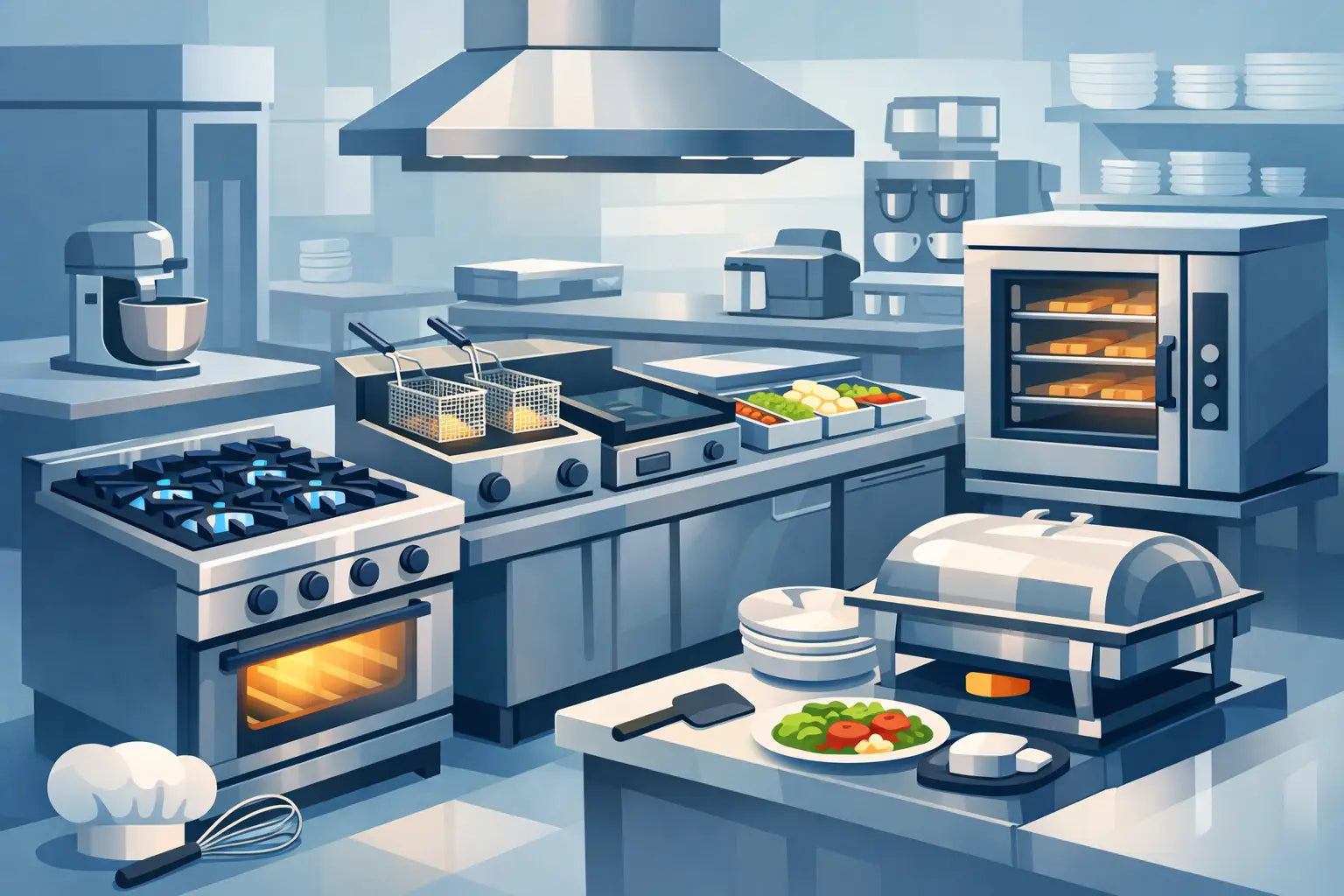
Ranges, convection ovens, charbroilers, pizza ovens, steamers, and grills should be chosen based on how your kitchen produces food during the rush. Heat consistency, recovery time, and ease of cleaning matter just as much as total BTUs or advertised capacity. A powerful oven that cooks unevenly or takes too long to recover between batches creates waste instead of speed.
If your menu depends on repeatable results, precision is worth paying for. This is especially true with baking, roasting, pizza production, and high-volume grilled items. Better temperature control means fewer remakes and a more predictable line.
Refrigeration and cold storage
Refrigeration protects more than ingredients - it protects margin. Reach-ins, undercounter units, prep tables, and blast freezers all serve different purposes, and choosing the wrong format can create workflow problems even if total storage volume looks sufficient on paper.
Undercounter refrigeration works well when speed and accessibility are priorities. Staff should not have to cross the kitchen for high-use ingredients during service. Blast freezers are a strong fit for operations that batch prep, preserve product integrity, or need tighter control over cooling times for safety and quality.
Holding and warming
Food warmers and heated holding equipment are often underestimated until the kitchen gets busy. If your operation runs takeout, catering, buffet service, or staggered pickup windows, holding performance becomes critical. Good warming equipment helps protect texture, temperature, and timing without continuing to cook the product into a lower-quality version of itself.
Choose for workflow, not just square footage
A compact kitchen can still perform at a high level if the layout supports movement. This is where buyers need to think beyond simple dimensions. The footprint of the machine matters, but so do door swing, ventilation clearance, access for cleaning, and where staff will stand when using it.
A refrigerator that technically fits but blocks a prep route is not a fit. A dishwasher that cannot support dish return flow will slow both sanitation and service. Even outdoor kitchen equipment needs the same discipline. Weather resistance, fuel access, and cleaning requirements all affect whether the setup is truly practical.
For serious home cooks buying professional-grade equipment, this point matters just as much. Commercial-style capability is exciting, but oversized or poorly placed equipment can make a home setup less efficient instead of more capable. Buy for the cooking experience you want repeatedly, not just the one product that looks impressive.
Durability is not a luxury feature
In a commercial setting, durability directly affects uptime. Stainless steel construction, heavy-duty components, quality door gaskets, reliable burners, and straightforward controls all contribute to equipment that survives daily use. Flashy features do not matter if the unit fails under real kitchen conditions.
This is one reason experienced buyers often prefer equipment that is easy to service and easy to clean. The less time your team spends fighting grease traps, awkward corners, or fragile parts, the more time they spend producing food. Durability is not only about lifespan. It is about maintaining performance with less interruption.
There is a trade-off here. Entry-level models can make sense for lighter use, seasonal concepts, or low-volume specialty stations. But for core line equipment, buying strictly on price often becomes expensive later through repairs, inconsistency, and premature replacement.
Key features that actually improve performance
Not every feature deserves equal attention. In most kitchens, the highest-value features are the ones that improve consistency, safety, and speed. Reliable temperature control, fast recovery, strong insulation, easy-clean surfaces, and thoughtful storage access tend to matter more than cosmetic upgrades.
For mixers, look at batch size, motor strength, and attachment compatibility. For ovens, focus on heating consistency, chamber capacity, and control precision. For refrigeration, pay attention to temperature stability, internal organization, and how quickly the unit recovers after repeated door openings.
Dishwashers deserve the same level of scrutiny. Throughput, wash cycle speed, and sanitation performance affect labor and compliance in ways that many operators underestimate. A machine that cannot keep up during peak periods creates a ripple effect across the whole back of house.
Buying online can be a smart move if the details are clear
Many buyers used to rely on local dealer networks because they wanted access to product guidance and a sense of trust before purchasing. Today, online buying works well when the product information is clear, support is available, and the retailer understands how kitchens operate.
That means looking for precise specifications, honest sizing information, and equipment categories that let you compare by operational need rather than by marketing language alone. A dependable online equipment partner should make it easier to shop for output, dimensions, and application without wasting time.
This is where a performance-focused retailer such as Culinary Precisions can stand out. When the catalog covers everything from soft serve machines and slushy machines to convection ovens, gas ranges, food warmers, and refrigeration, buyers can build around a workflow instead of piecing together equipment from disconnected sources.
When new equipment makes more sense than waiting
Operators often delay upgrades because existing equipment still functions at a basic level. But there is a difference between functioning and performing. If a refrigerator struggles to hold temperature, a range heats unevenly, or a prep station slows every rush, your kitchen is already paying the price through waste, delays, and staff frustration.
New equipment can also support growth. Maybe your menu is expanding, your volume is increasing, or you want to add profitable categories like frozen desserts, pizza, or outdoor service. The right purchase should not only solve a current problem. It should give your kitchen room to perform at a higher level.
The strongest buying decisions come from clarity. Know what your team needs the equipment to do, how often it will be used, and what level of consistency your customers expect. Once that is clear, the right commercial kitchen equipment for sale becomes easier to identify - not as inventory, but as a tool built for speed, safety, and results.
The best equipment earns its place every shift. Buy the pieces that help your kitchen stay sharper, cleaner, faster, and more consistent, and the return shows up where it matters most - on the plate and in the pace of service.